Pearson Edexcel · GCSE · Combined Science
Key concepts of physics
Master the fundamental language of physics. This topic covers the essential skills of using SI units, standard form, and significant figures — the critical building blocks you need to secure top marks across every other topic in your Combined Science GCSE.
- 5 min read
- 3 worked examples
- 5 practice questions
- 6 key terms
Study Notes

Overview
Welcome to Key Concepts of Physics! This topic might seem like pure mathematics at first glance, but it is actually the foundation of all scientific measurement. Physics is the study of the universe, from the smallest subatomic particles to the largest galaxies, and to study these, we need a universal language of measurement. That language is the International System of Units (SI).
Why is this important for Combined Science? Because examiners will test these skills in almost every calculation question across the entire specification. Failing to convert a unit, misinterpreting a metric prefix, or rounding to the wrong number of significant figures can cost you crucial marks, even if your underlying physics knowledge is perfect. This guide will ensure you master these foundational skills.
Listen to our comprehensive revision podcast to reinforce these concepts:
Key Concepts
Concept 1: The SI Base Units
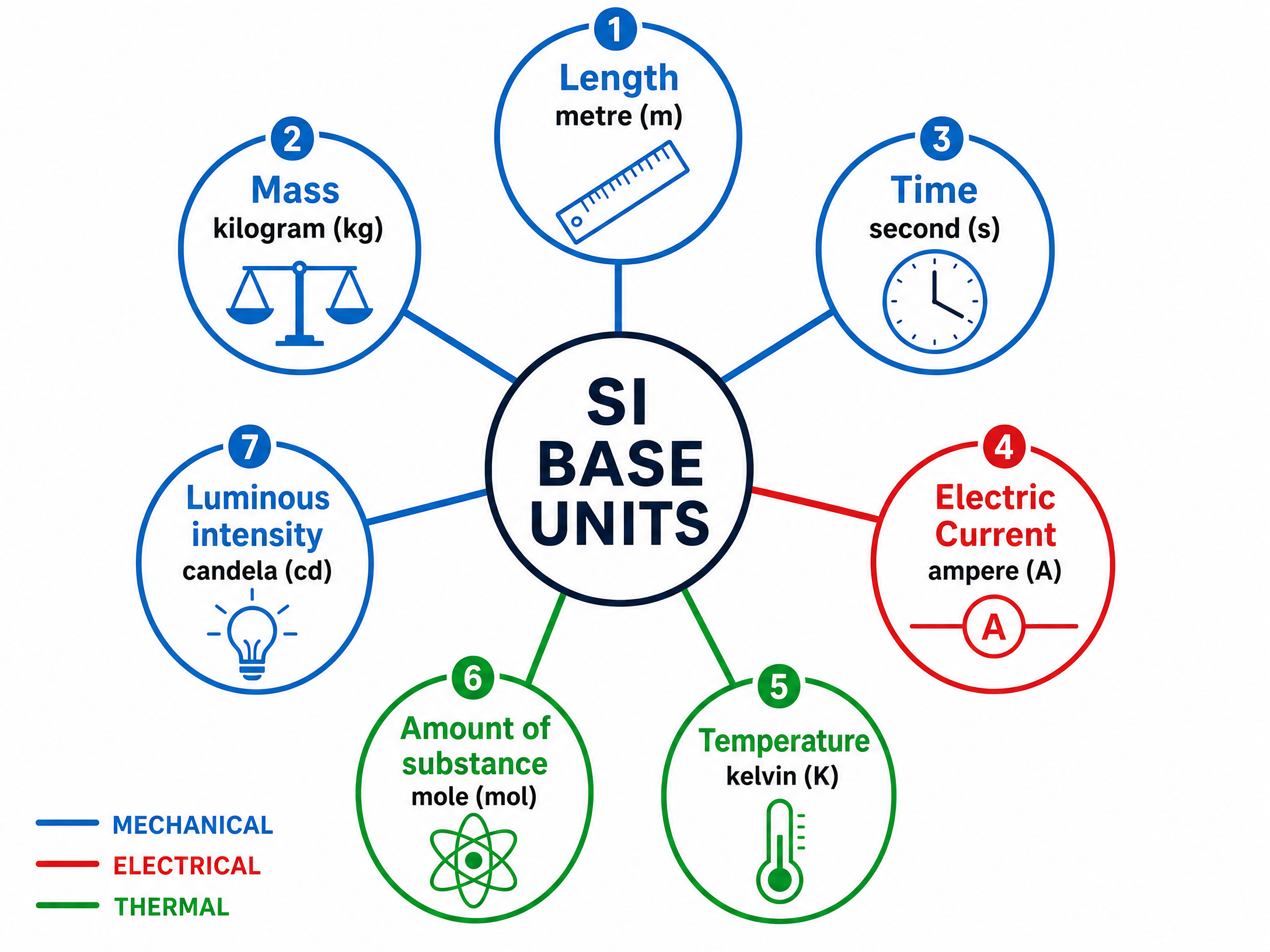
To ensure scientists globally can communicate their findings without confusion, the scientific community agreed on the International System of Units (SI). For your GCSE, you must be familiar with the core base units from which all other units are derived.

When you encounter a physical quantity in a question, you must ensure it is in its SI base unit before substituting it into an equation. For example, if a question gives you a mass in grams, you must convert it to kilograms before calculating force or energy.
Example: A student measures the mass of a block as 450 g. Before using this in the equation W = mg, they must convert it to the SI base unit (kg) by dividing by 1000. Therefore, m = 0.45 kg.
Concept 2: Metric Prefixes
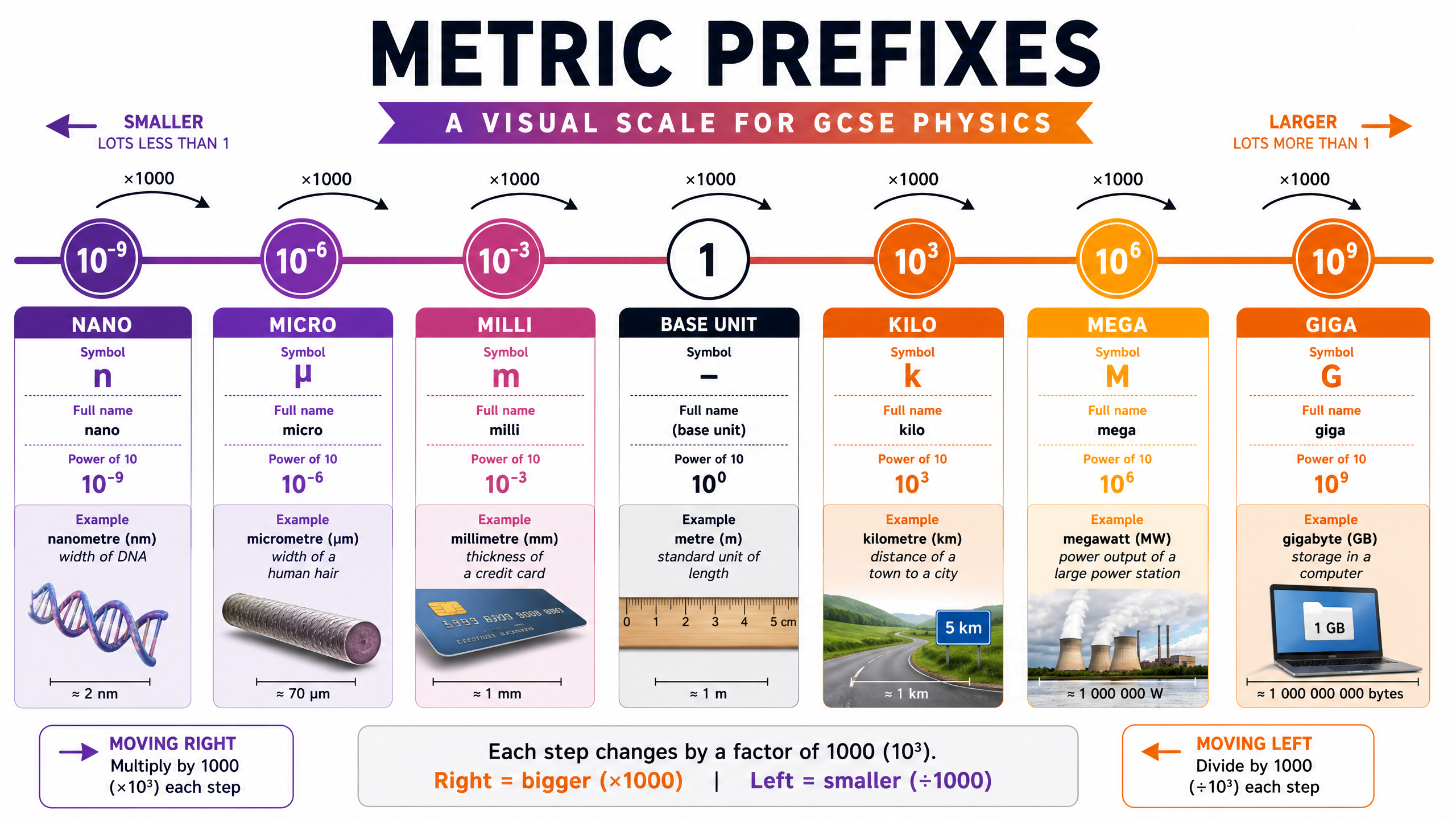
In physics, we deal with extremes. The mass of an electron is incomprehensibly small, while the distance to the nearest star is staggeringly large. Writing out dozens of zeros is prone to error, so we use metric prefixes to denote powers of ten.

You must memorise the standard prefixes and their corresponding multipliers:
- Giga (G): 10^9 (1,000,000,000)
- Mega (M): 10^6 (1,000,000)
- kilo (k): 10^3 (1,000)
- centi (c): 10^{-2} (0.01)
- milli (m): 10^{-3} (0.001)
- micro (μ): 10^{-6} (0.000001)
- nano (n): 10^{-9} (0.000000001)
Example: A wavelength of red light is given as 650 nm (nanometres). To use this in the wave equation v = f\lambda, you must convert it to metres. Since nano means 10^{-9}, the wavelength is 650 \times 10^{-9} m.
Concept 3: Standard Form
Standard form (or scientific notation) is a concise way of writing very large or very small numbers. It is written in the format:
A \times 10^n
Where:
- A is the coefficient, which must be greater than or equal to 1, and strictly less than 10 (1 \le A < 10).
- n is the exponent, which must be an integer (whole number).
Example: The speed of light is approximately 300,000,000 m/s. In standard form, this is written as 3.0 \times 10^8 m/s. The coefficient is 3.0 (which is between 1 and 10), and the decimal point has moved 8 places to the left.
Concept 4: Significant Figures
Significant figures indicate the precision of a measurement. When performing calculations in your exam, you should generally give your final answer to the same number of significant figures as the least precise piece of data provided in the question.
Rules for Significant Figures:
- All non-zero digits are significant (e.g., 456 has 3 sig figs).
- Zeros between non-zero digits are significant (e.g., 4006 has 4 sig figs).
- Leading zeros are never significant (e.g., 0.0045 has 2 sig figs).
- Trailing zeros are significant only if there is a decimal point (e.g., 45.00 has 4 sig figs, but 4500 has 2 sig figs unless specified otherwise).
Example: Calculate the area of a rectangle with sides 4.5 m (2 sig figs) and 3.25 m (3 sig figs). The calculator gives 4.5 \times 3.25 = 14.625. Since the least precise input has 2 sig figs, the final answer should be rounded to 2 sig figs: 15 m^2.
Mathematical/Scientific Relationships
While there are no specific physics formulas exclusive to this introductory topic, the mathematical rules of unit conversion and standard form apply to every formula in the specification.
Converting Units:
- Larger to smaller unit (e.g., kg to g): Multiply by the conversion factor (e.g., \times 1000).
- Smaller to larger unit (e.g., mA to A): Divide by the conversion factor (e.g., \div 1000).
Practical Applications
These concepts are fundamental to all Required Practicals. For example, when measuring the extension of a spring, you might use a ruler calibrated in millimetres (mm). However, to calculate the spring constant in N/m, you must convert your extension measurements into metres (m) before plotting your graph or performing calculations.
Interactive Diagrams
2 interactive diagrams to visualise key concepts
Conceptual Flow Outline
The Calculation Workflow: A systematic approach to avoiding common unit and rounding errors.
Conceptual Flow Outline
Anatomy of Standard Form Notation.
Worked Examples
3 worked examples — open one to explore the question and available guidance.
Practice Questions
Test your understanding — click to reveal model answers
State the SI base unit for electric current. (1 mark)
Hint: Think about the unit used when measuring the flow of charge in a circuit.
A force of 45 \text{ kN} is applied to an object. Express this force in Newtons using standard form. (2 marks)
Hint: First, convert kilo-Newtons to Newtons. Then, format that number into standard form.
A student measures the diameter of a human hair as 75 \text{ \mu m}. Calculate this diameter in metres, giving your answer in standard form. (2 marks)
Hint: Recall what power of ten the prefix 'micro' ($\mu$) represents.
The mass of a car is 1.2 \times 10^3 \text{ kg}. The car accelerates at 2.5 \text{ m/s}^2. Calculate the resultant force acting on the car. Use the equation F = ma. Give your answer to an appropriate number of significant figures. (4 marks)
Hint: Check the units first. Are they in SI base units? Then substitute and calculate. Finally, look at the precision of the numbers given in the question.
Explain why scientists use the International System of Units (SI) rather than their own national measurement systems. (2 marks)
Hint: Think about collaboration and sharing data globally.