Pearson Edexcel · A-Level · Computer Science
Big O Notation and Complexity Analysis
Master Big O Notation to predict how algorithms perform at scale. This guide breaks down complexity analysis into exam-focused chunks, showing you how to earn marks by comparing algorithms and justifying their efficiency.
- 6 min read
- 3 worked examples
- 5 practice questions
- 6 key terms
Check what you remember
Read the wording for your board, then hide it and explain Big O Notation in your own words. Rough notes are fine. This is a self-check, with no mark or grade.
Reference: Pearson Edexcel
A mathematical notation used to describe the limiting behavior of a function when the argument tends towards a particular value or infinity, used in computer science to classify algorithms according to their running time or space requirements.
Study Notes
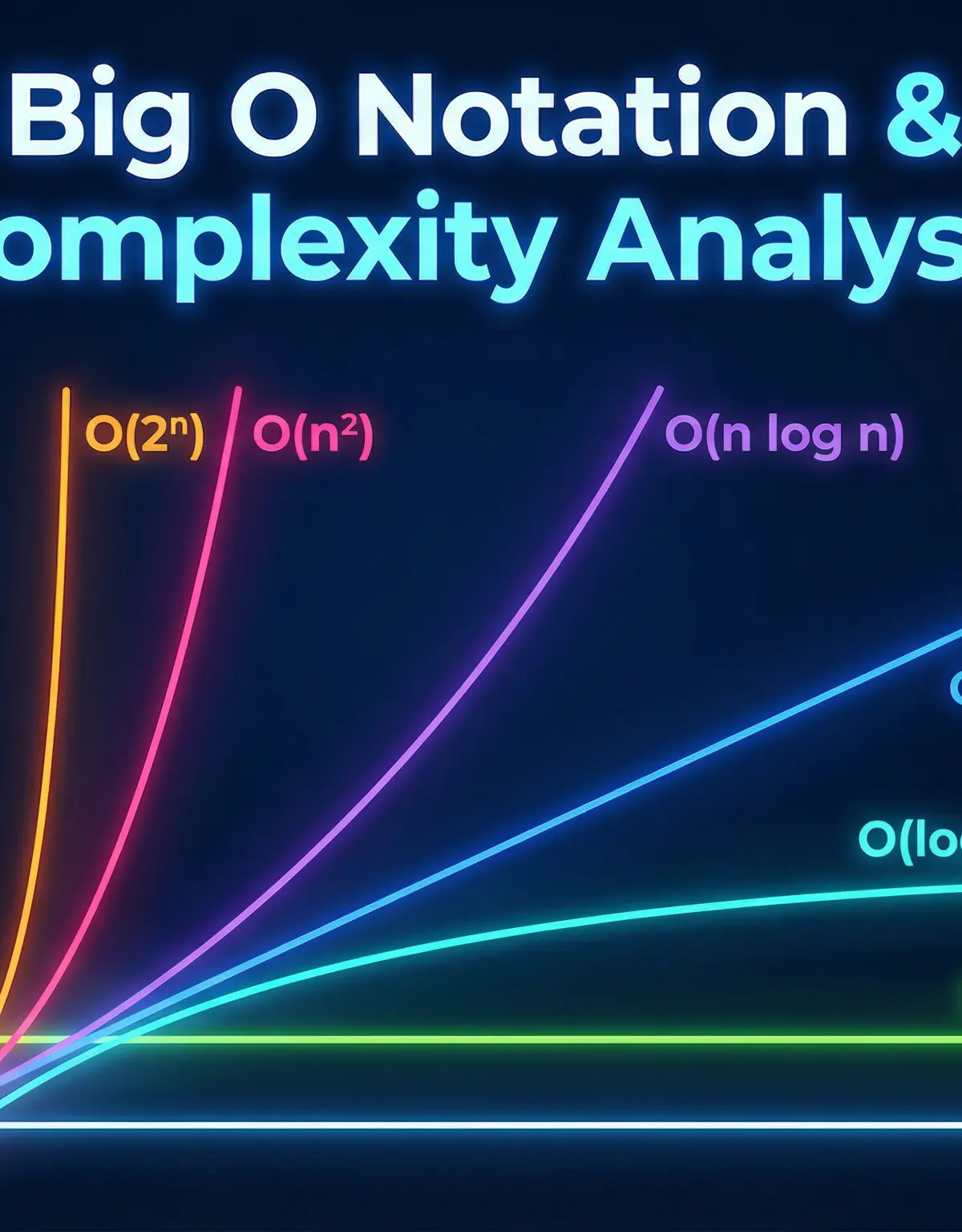
Overview
Big O notation is the system we use in computer science to describe an algorithm's efficiency in terms of how its running time or memory usage grows with the size of the input. For your Edexcel A-Level exam, this isn't just about memorising a few terms; it's about deep analysis. You'll be expected to look at a piece of pseudocode and derive its time and space complexity, often considering best, average, and worst-case scenarios. This topic, specification reference A3.5, is fundamental because it's how we make informed decisions about which algorithm to use when solving a problem. A solution that's fast for 10 items might be disastrous for 10 million, and Big O gives us the language to predict this. Examiners will test your ability to apply this knowledge (AO2) by asking you to compare algorithms and justify your reasoning with precise, evidence-based statements about their growth rates.
Key Concepts
Concept 1: Asymptotic Analysis & The Dominant Term
Big O is concerned with asymptotic analysis. This means we only care about how an algorithm performs as the input size, n, tends towards infinity. When analysing an algorithm, you might derive a precise formula for the number of operations, like 3n² + 5n + 12. However, for Big O, we simplify this by taking the dominant term (the term that grows fastest) and ignoring any coefficients. In this case, n² grows much faster than n, so the complexity is O(n²). The 3, 5n, and 12 become insignificant as n gets very large. This is a core marking point: correctly identifying the dominant term is the first step to earning credit.
Example: An algorithm performs 4n³ + 20n² + 100 operations. The dominant term is n³. Therefore, the time complexity is O(n³).
Concept 2: Time vs. Space Complexity
It's crucial to distinguish between these two types of efficiency. Examiners can ask about either, and confusing them is a common mistake.
- Time Complexity: Refers to the number of operations or CPU cycles an algorithm takes to complete. This is what we usually mean when we talk about Big O. It's a measure of how long the algorithm will run.
- Space Complexity: Refers to the amount of memory (RAM) an algorithm requires. This includes the space for the inputs themselves, plus any auxiliary or temporary data structures created, including the depth of the recursion stack.
Example: A linear search through an array of size n has a time complexity of O(n). Its space complexity is O(1) because it only needs a few variables (the loop counter, the target value) regardless of the array's size. In contrast, Merge Sort has a time complexity of O(n log n) but a space complexity of O(n) because it needs to create new arrays to hold the sorted halves.
Concept 3: Common Complexity Classes
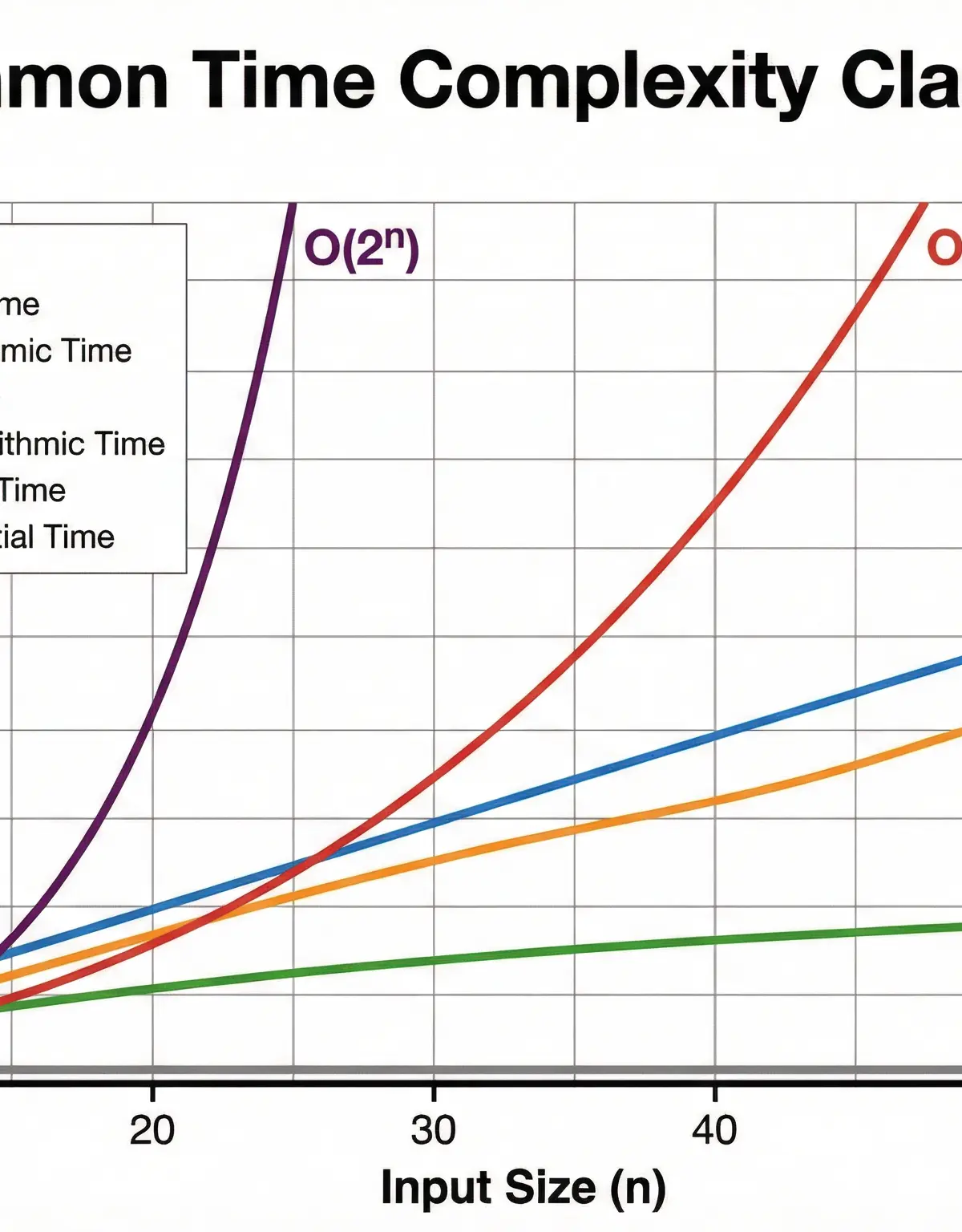
You must be able to identify and compare the following complexity classes. They are listed here from most efficient (best) to least efficient (worst).
- O(1) - Constant: The execution time is independent of the input size. Example: Accessing an array element at a given index.
- O(log n) - Logarithmic: The time increases with the log of the input size. Typically found in algorithms that halve the dataset in each step. Example: Binary Search.
- O(n) - Linear: The time is directly proportional to the input size. Example: Iterating through a list once.
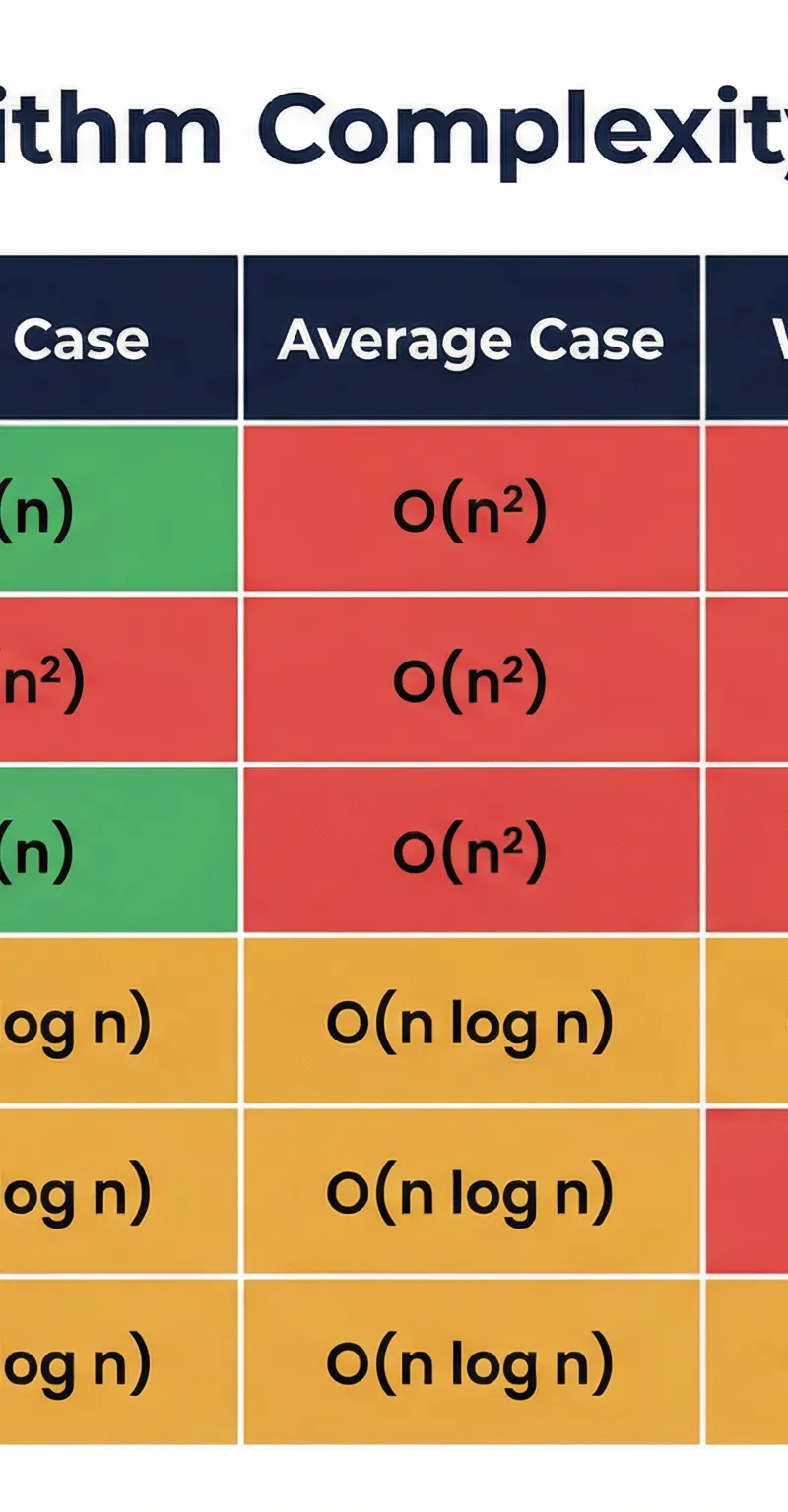
- O(n log n) - Linearithmic: A very common complexity for efficient sorting algorithms. Example: Merge Sort, Heap Sort.
- O(n²) - Quadratic: Time is proportional to the square of the input size. Often involves nested loops over the dataset. Example: Bubble Sort, Insertion Sort.
- O(2ⁿ) - Exponential: Time doubles with each addition to the input size. These algorithms are only practical for very small n. Example: Brute-force solutions to the Travelling Salesman Problem.
Mathematical/Scientific Relationships
The most important mathematical relationship to understand is the growth rate of these functions. For large n:
O(1) < O(log n) < O(n) < O(n log n) < O(n²) < O(n³) < O(2ⁿ)
Another key relationship is the summation of an arithmetic series, which often appears in nested loop analysis:
1 + 2 + 3 + ... + n = n(n+1)/2
When you see this pattern, you should immediately recognise that the complexity is O(n²), because the dominant term in n(n+1)/2 is n²/2, and we discard the coefficient.
Practical Applications
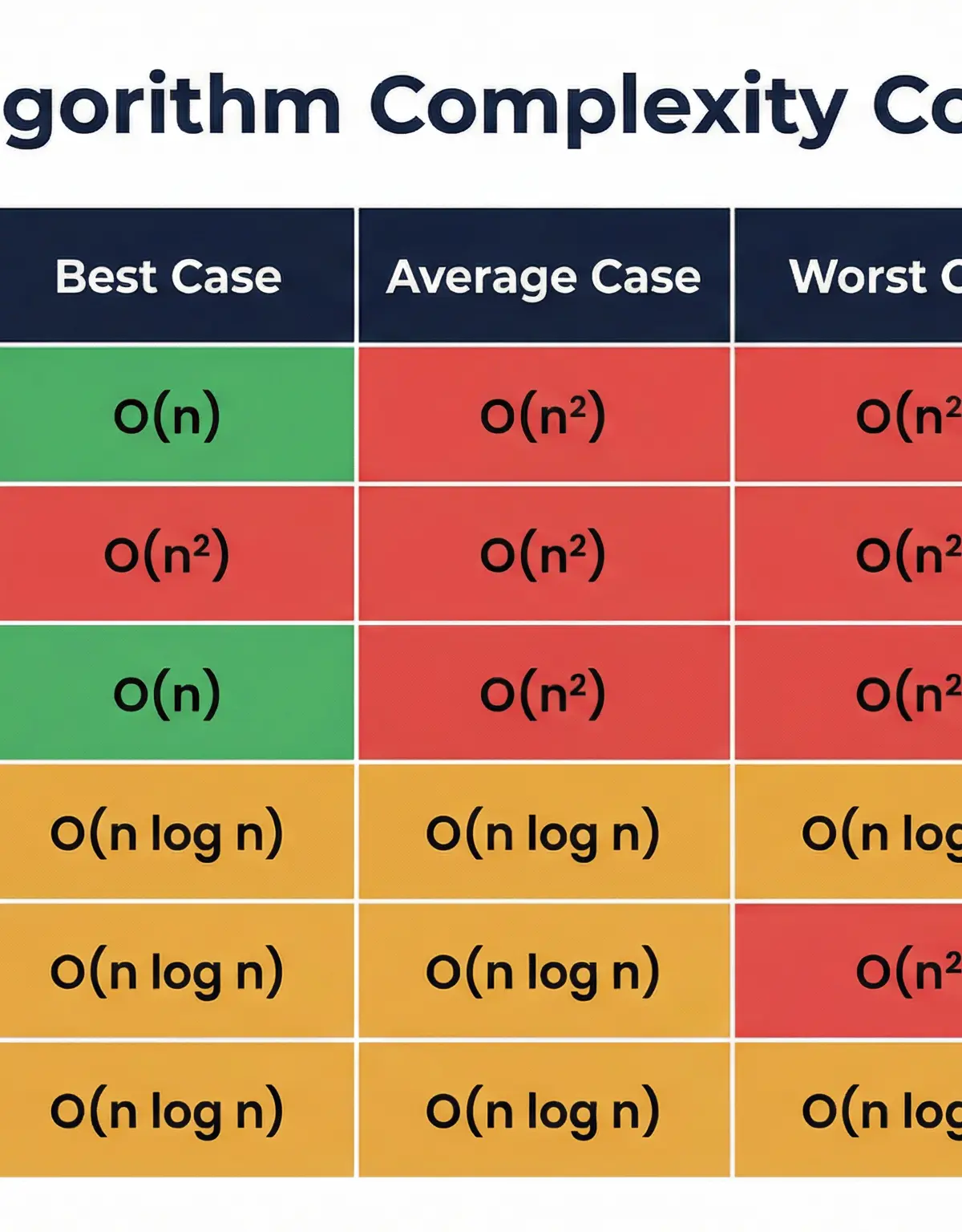
Big O isn't just theoretical. It dictates real-world system performance.
- Database Indexing: Databases use B-Tree data structures, which allow for searching, insertion, and deletion in O(log n) time. Without this, searching a database with billions of records would be impossibly slow.
- Sorting Large Datasets: When a social media site sorts your feed, it uses an efficient algorithm like Merge Sort or a hybrid (Introsort), which works in O(n log n) time. Using Bubble Sort (O(n²)) would make the user experience terrible.
- Graph Traversal in GPS Navigation: GPS systems like Google Maps use algorithms like Dijkstra's or A* to find the shortest path. The efficiency of these algorithms (often related to O(E + V log V), where E is edges and V is vertices) is what allows them to calculate routes across a vast road network in seconds.
Visual Resources
2 diagrams and illustrations
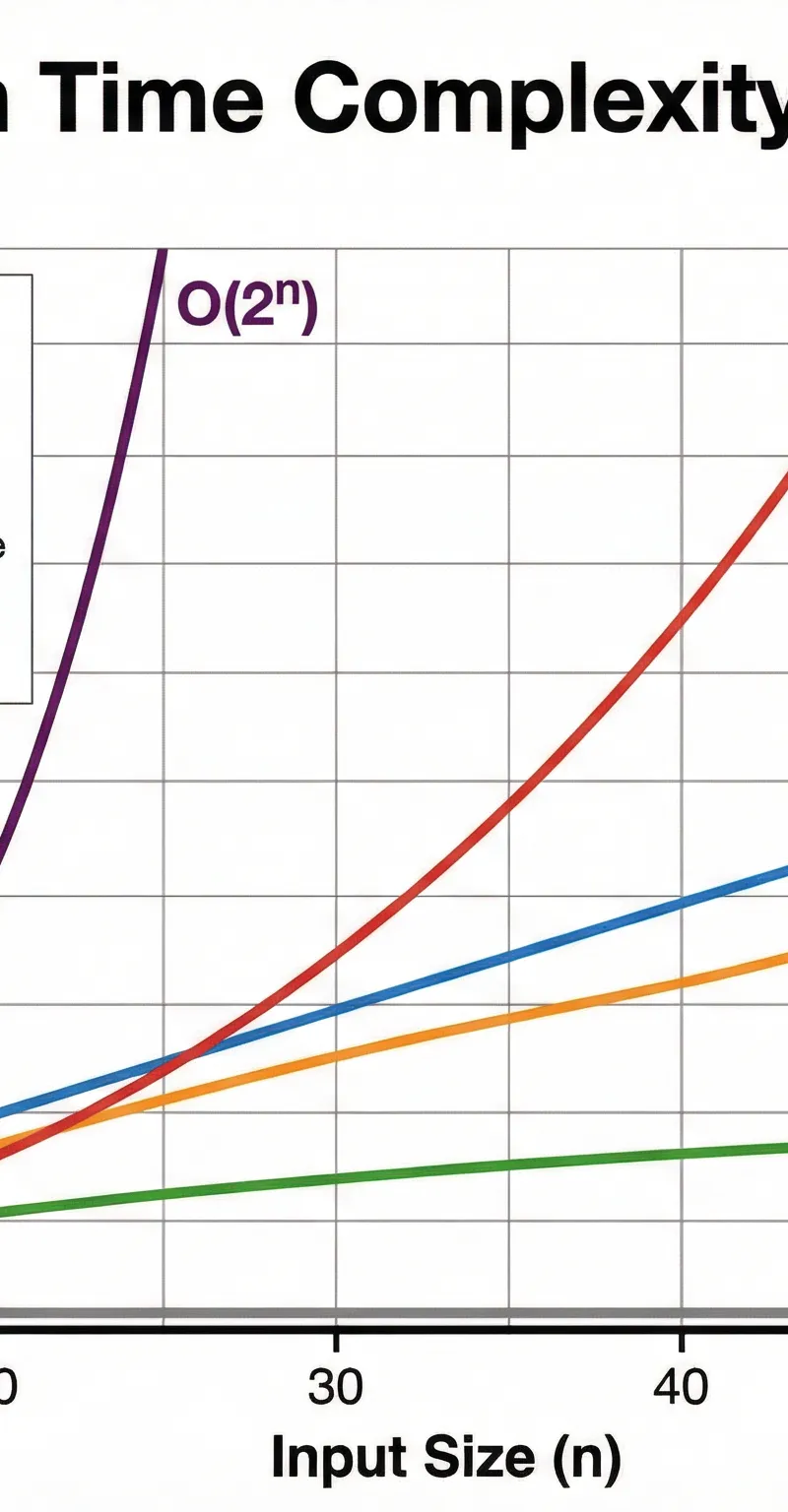
Interactive Diagrams
2 interactive diagrams to visualise key concepts
Conceptual Flow Outline
Flowchart for the Bubble Sort algorithm, illustrating the nested loop structure that leads to its O(n²) complexity.
Conceptual Flow Outline
Flowchart for the Merge Sort algorithm, illustrating the 'divide and conquer' approach that results in O(n log n) complexity.
Worked Examples
3 worked examples — open one to explore the question and available guidance.
Practice Questions
Try the question, then reveal an answer plan or example response
What is the time complexity of accessing the 5th element in an array of size 10,000? Justify your answer. (2 marks)
Hint: Does the size of the array affect how long it takes to find an element if you already know its index?
An algorithm has a time complexity of O(n³). If it takes 2 seconds to run for an input of size n=100, estimate how long it will take for an input of size n=200. (3 marks)
Hint: How does the number of operations change when you double the input size for a cubic complexity algorithm?
A developer uses a recursive function to calculate the nth Fibonacci number. Analyse the time complexity of this naive recursive approach. (4 marks)
Hint: Draw the recursion tree for fib(5). How many times are fib(2) and fib(1) calculated? How does the tree grow?
Why is it important to consider the worst-case complexity of an algorithm? Give an example. (3 marks)
Hint: Think about applications where performance guarantees are critical.
Explain why an algorithm with O(n) space complexity may be unsuitable for an embedded system. (2 marks)
Hint: What are the typical constraints of embedded systems?
Exam technique
How to turn what you know into marks
How to approach the question
1. **Identify the command word**: 'Analyse', 'Compare', 'Explain'. This tells you the required depth. 2. **Scan for keywords**: 'time complexity', 'space complexity', 'worst-case'. 3. **Analyse the code**: If pseudocode is given, trace it. Look for loops (single, nested) and recursion. 4. **Formulate the answer**: Structure your answer around the marking points, providing justification for each claim.
How to structure your answer
- **1-2 marks**: A short, direct statement (e.g., 'The complexity is O(n)').\n- **3-4 marks**: A statement followed by a justification (e.g., 'The complexity is O(log n) *because* the dataset is halved at each iteration').\n- **5-6 marks**: A comparative answer. Use a point-by-point structure, comparing Algorithm A and Algorithm B on time, then space, then worst-case, with a concluding judgement.
Timing
Approximately 1 minute per mark, so a 6-mark question should take about 6-7 minutes
Common pitfalls
- Confusing O(1) with 'instant'. State that execution time is *independent* of input size.
- Incorrectly analysing nested loops where the inner loop depends on the outer variable. Remember the arithmetic series leads to O(n²).
- Forgetting to consider the space complexity of recursive algorithms, which is determined by the depth of the call stack.
- Failing to state the specific conditions for Quicksort's O(n²) worst case (poor pivot selection).
What the command words want
- Compare
- Identify similarities AND differences - use comparative language like 'whereas', 'more efficient than', 'has a better space complexity'. Address both items being compared for each point.
- Explain
- Say HOW or WHY - use 'because' to link cause and effect. E.g., 'The complexity is O(n²) *because* there is a loop nested inside another loop, both running n times'.
- Describe
- Say what happens or what something is like - use correct terminology. E.g., 'The algorithm iterates through each element in the list once'.
- Evaluate
- Make a judgement based on evidence. E.g., 'For this application, Merge Sort is a better choice because its worst-case performance is guaranteed to be O(n log n), avoiding the potential O(n²) of Quicksort'.
- Calculate
- Show working, use correct formula, include units. Not common for this topic, but might apply to counting operations.
- State/Give
- Brief factual answer - 1-2 words or a short phrase. E.g., 'O(n log n)'.
Watch or listen (optional)
Test your understanding of Big O Notation and Complexity Analysis
Active recall beats re-reading. Take an instant quiz now to test what you’ve learned and lock it into long-term memory.
7 days Premium · Then the free plan continues · No card, no charge