OCR · GCSE · Computer Science
Course version: J277 · Version from Sept 2022
Embedded systems: The purpose and characteristics of embedded systems
An embedded system is a computer built into another device to control it, rather than being a general-purpose machine used for many tasks.
Checked against the OCR J277 specification on .
- Point 1 of 2
- 4 key terms
Study notes
From the checked teaching notes for this specification point.
The idea
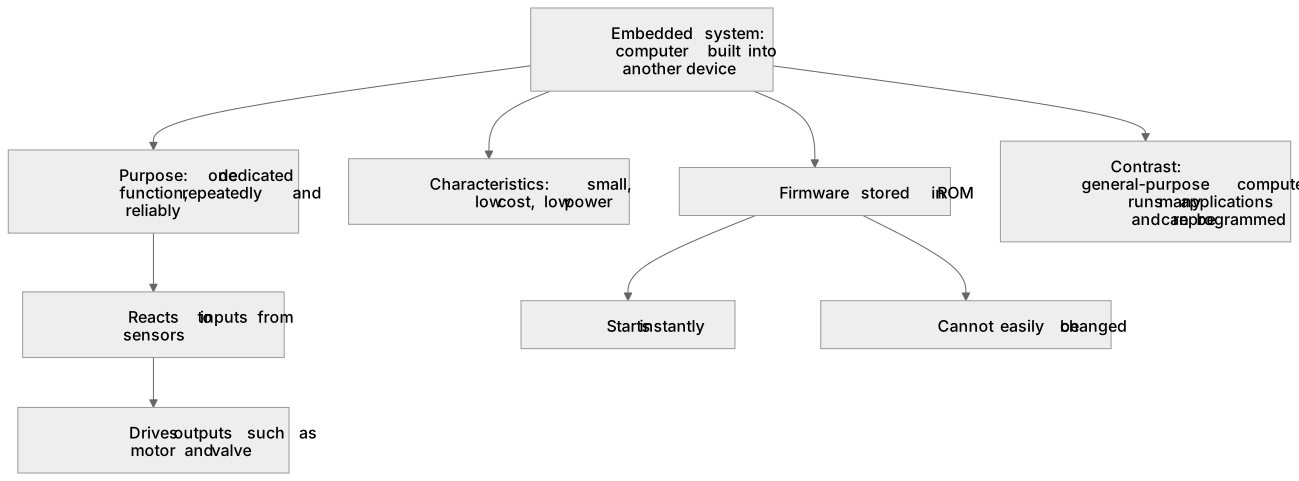
An embedded system is a computer built into another device to control it, rather than being a general-purpose machine used for many tasks. Its purpose is to carry out one dedicated function repeatedly and reliably, often reacting to inputs from sensors. Characteristics include being small, low cost, low power, and having firmware stored in ROM so it starts instantly and cannot easily be changed. For example, a washing machine controller reads temperature and door sensors, then drives the motor and valve. It does not run word processors or games. Because the job is fixed, designers can strip away unnecessary hardware and software, making the system cheap and dependable.
What earns the marks
- States that an embedded system is a computer inside another device, dedicated to controlling that device or performing one specific function.
- Explains that the program is usually held in ROM or flash as firmware, so it is fixed and starts automatically when power is applied.
- Identifies typical characteristics such as small size, low cost, low power consumption and limited processing or memory resources.
- Describes interaction with the physical world through sensors and actuators, for example reading a temperature sensor and switching a heater.
- Contrasts embedded systems with general-purpose computers that run many different applications and can be reprogrammed by the user.
Common mistakes and how to put them right
Saying an embedded system is simply a small computer.
Put it right: , size is not the defining feature; the defining feature is that it is dedicated to controlling a larger device.
Claiming embedded systems always run an operating system with a graphical user interface.
Put it right: , many run a single program directly with no user interface.
Confusing ROM with RAM when describing firmware.
Put it right: , firmware is normally stored in non-volatile ROM or flash so it survives power loss, while RAM is volatile working memory.
Exam tips
- Link each characteristic to a benefit, such as low power use extending battery life in a portable device.
- Use a named device and describe the input, processing and output to show understanding rather than listing features.
- When comparing with a general-purpose computer, mention reprogrammability and range of software as the key difference.
Try the lesson
The start of the Embedded systems: The purpose and characteristics of embedded systems lesson, made from checked teaching notes for this specification point.
Have a go first
What is the main purpose of an embedded system?
Listen
An embedded system is a computer built into another device to control it, rather than being a general-purpose machine used for many tasks. Its purpose is to carry out one dedicated function repeatedly and reliably, often reacting to inputs from sensors. Characteristics include being small, low cost, low power, and having firmware stored in ROM so it starts instantly and cannot easily be changed. For example, a washing machine controller reads temperature and door sensors, then drives the motor and valve. It does not run word processors or games. Because the job is fixed, designers can strip away unnecessary hardware and software, making the system cheap and dependable. A strong answer earns marks for these points. States that an embedded system is a computer inside another device, dedicated to controlling that device or performing one specific function. Explains that the program is usually held in ROM or flash as firmware, so it is fixed and starts automatically when power is applied. Identifies typical characteristics such as small size, low cost, low power consumption and limited processing or memory resources. Describes interaction with the physical world through sensors and actuators, for example reading a temperature sensor and switching a heater. A common slip: Saying an embedded system is simply a small computer. Instead, , size is not the defining feature; the defining feature is that it is dedicated to controlling a larger device. Exam tip: Link each characteristic to a benefit, such as low power use extending battery life in a portable device.
See it
Key words
Say what each word means before you turn the card.
Dedicated function
Try answering aloud or in your head before turning the card.
Firmware in ROM
Try answering aloud or in your head before turning the card.
Low cost and low power
Try answering aloud or in your head before turning the card.
Interaction with sensors and actuators
Try answering aloud or in your head before turning the card.
See every definition
- Dedicated function
- The single job an embedded system carries out repeatedly and reliably, rather than being a general-purpose machine used for many tasks.
- Firmware in ROM
- The program stored in ROM so the system starts instantly and cannot easily be changed.
- Low cost and low power
- Characteristics of embedded systems that make the system cheap and dependable, with unnecessary hardware and software stripped away.
- Interaction with sensors and actuators
- Reacting to inputs from sensors and driving parts such as a motor and valve in the physical world.
Label the diagram
Some boxes have lost their names. Pick the right name for each number.
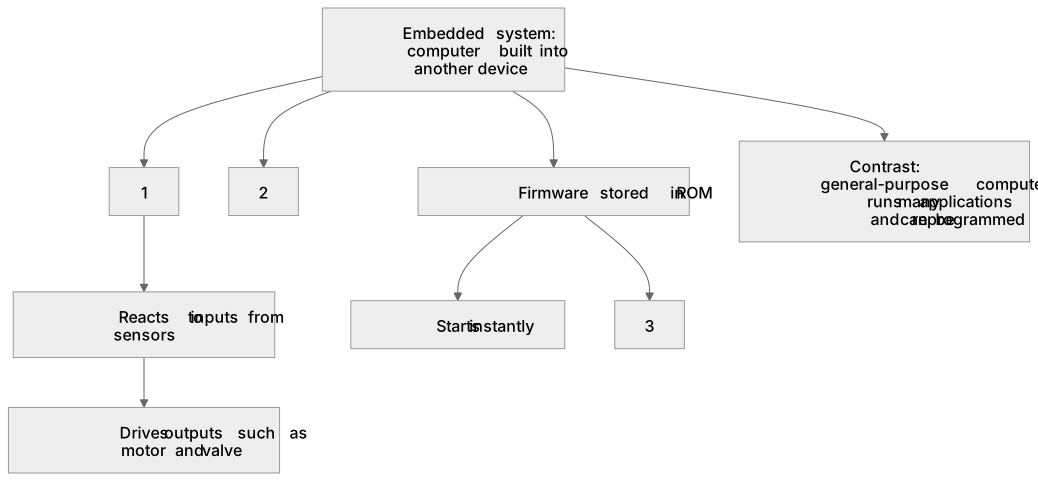
1Box 1
2Box 2
3Box 3
There is more to this lesson
The full lesson goes on to check your understanding and help you earn the marks. Create a free account to carry on, with your progress saved.
A week of Premium from your first lesson · Then the free plan continues · No card, no charge
Test your understanding of Embedded systems: The purpose and characteristics of embedded systems
Active recall beats re-reading. Take an instant quiz now to test what you’ve learned and lock it into long-term memory.
A week of Premium from your first lesson · Then the free plan continues · No card, no charge