OCR · GCSE · Computer Science
Course version: J277 · Version from Sept 2022
Impacts of digital technology on wider society including Ethical issues…
Full specification wording
Ethical, legal, cultural and environmental impact: Impacts of digital technology on wider society including Ethical issues Legal issues Cultural issues Environmental issues Privacy issues
Digital technology changes how people live, work and relate, so its effects reach far beyond the device.
Checked against the OCR J277 specification on .
- Point 1 of 2
- 4 key terms
Study notes
From the checked teaching notes for this specification point.
The idea
Digital technology changes how people live, work and relate, so its effects reach far beyond the device. Ethical issues ask what is right or fair: should a company sell personal data, or should a self-driving car prioritise one life over another? Legal issues arise when behaviour is governed by law, such as handling personal data under the Data Protection Act 2018. Cultural issues concern how technology shapes shared ways of life, for example streaming changing how music is consumed or social media altering language. Environmental issues cover energy use in data centres, mining materials for batteries (such as lithium and cobalt) and electronic waste. Privacy issues concern control over personal information, such as location tracking or always-on microphones. A strong answer names a specific technology, identifies the affected group and explains a benefit and a drawback.
What earns the marks
- Identifies a named digital technology or service, such as social media, cloud storage, smartphones or AI assistants, rather than discussing technology in general.
- Explains an ethical issue by weighing what is right or fair, for example whether it is acceptable to profile users for targeted advertising without clear consent.
- Explains a legal issue by linking behaviour to rules or laws, such as an organisation breaching data protection duties when it loses customer records.
- Explains a cultural issue by showing how technology changes shared habits, values or communication, for example how streaming alters music purchasing or how translation apps affect minority languages.
- Explains an environmental issue with a concrete impact, such as the electricity used to cool data centres, mining materials for batteries, or toxic substances in discarded devices.
- Explains a privacy issue by referring to collection, storage, sharing or tracking of personal data, such as a fitness app sharing location history.
- Uses a balanced structure that gives both positive and negative consequences for at least one issue, showing that impacts are not one-sided.
Common mistakes and how to put them right
Treating ethical and legal as synonyms.
Put it right: Ethical means what is morally right or fair, while legal means what is permitted or forbidden by law; an action can be legal but still unethical.
Giving only a benefit or only a drawback.
Put it right: State one advantage and one disadvantage for the chosen technology so the impact is balanced.
Using vague phrases such as 'it affects society' without a named example.
Put it right: Name the technology, the group affected and the specific change, for example 'facial recognition in shops can misidentify customers and deter them from entering'.
Exam tips
- Read the command word carefully: 'describe' needs a point plus detail, while 'discuss' or 'evaluate' needs both sides and a judgement.
- Anchor each paragraph to one issue from the list so the examiner can see coverage; a short opening sentence naming the issue helps.
- Use current, realistic examples such as contactless payment, wearable health trackers or generative AI tools, and keep the link to the issue explicit.
Try the lesson
The start of the Ethical, legal, cultural and environmental impact: Impacts of digital technology on wider society including Ethical issues Legal issues Cultural issues Environmental issues Privacy issues lesson, made from checked teaching notes for this specification point.
Have a go first
Which of these is an environmental impact of people replacing their computers frequently?
Listen
Digital technology changes how people live, work and relate, so its effects reach far beyond the device. Ethical issues ask what is right or fair: should a company sell personal data, or should a self-driving car prioritise one life over another? Legal issues arise when behaviour is governed by law, such as handling personal data under the Data Protection Act 2018. Cultural issues concern how technology shapes shared ways of life, for example streaming changing how music is consumed or social media altering language. Environmental issues cover energy use in data centres, mining materials for batteries (such as lithium and cobalt) and electronic waste. Privacy issues concern control over personal information, such as location tracking or always-on microphones. A strong answer names a specific technology, identifies the affected group and explains a benefit and a drawback. A strong answer earns marks for these points. Identifies a named digital technology or service, such as social media, cloud storage, smartphones or AI assistants, rather than discussing technology in general. Explains an ethical issue by weighing what is right or fair, for example whether it is acceptable to profile users for targeted advertising without clear consent. Explains a legal issue by linking behaviour to rules or laws, such as an organisation breaching data protection duties when it loses customer records. Explains a cultural issue by showing how technology changes shared habits, values or communication, for example how streaming alters music purchasing or how translation apps affect minority languages. A common slip: Treating ethical and legal as synonyms. Instead, ethical means what is morally right or fair, while legal means what is permitted or forbidden by law; an action can be legal but still unethical. Exam tip: Read the command word carefully: 'describe' needs a point plus detail, while 'discuss' or 'evaluate' needs both sides and a judgement.
See it

Key words
Say what each word means before you turn the card.
Ethical issues
Try answering aloud or in your head before turning the card.
Legal issues
Try answering aloud or in your head before turning the card.
Cultural issues
Try answering aloud or in your head before turning the card.
Environmental issues
Try answering aloud or in your head before turning the card.
See every definition
- Ethical issues
- Questions about what is right or fair, such as whether a company should sell personal data or a self-driving car should prioritise one life over another.
- Legal issues
- Issues that arise when behaviour is governed by law, such as handling personal data under the Data Protection Act 2018.
- Cultural issues
- Concerns about how technology shapes shared ways of life, for example streaming changing how music is consumed or social media altering language.
- Environmental issues
- Concerns covering energy use in data centres, mining materials for batteries such as lithium and cobalt, and electronic waste.
Label the diagram
Some boxes have lost their names. Pick the right name for each number.
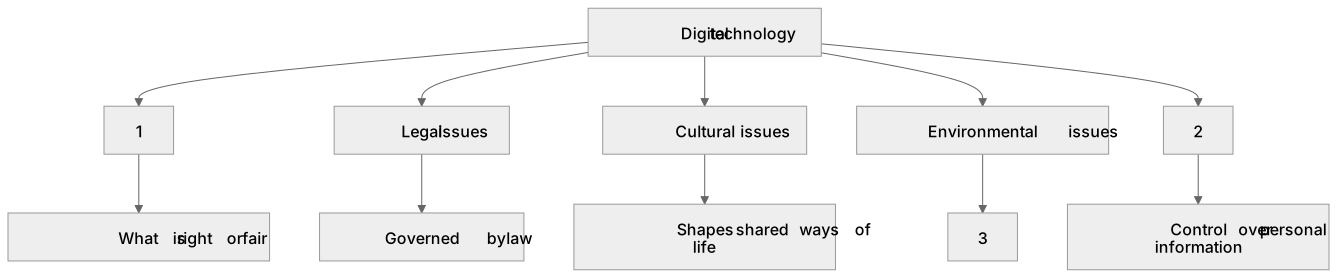
1Box 1
2Box 2
3Box 3
There is more to this lesson
The full lesson goes on to check your understanding and help you earn the marks. Create a free account to carry on, with your progress saved.
A week of Premium from your first lesson · Then the free plan continues · No card, no charge
Test your understanding of Ethical, legal, cultural and environmental impact: Impacts of digital technology on wider society including Ethical issues Legal issues Cultural issues Environmental issues Privacy issues
Active recall beats re-reading. Take an instant quiz now to test what you’ve learned and lock it into long-term memory.
A week of Premium from your first lesson · Then the free plan continues · No card, no charge