OCR · GCSE · Computer Science
Course version: J277 · Version from Sept 2022
The different roles of computers in a client-server and a peer-to- peer…
Full specification wording
Networks and topologies: The different roles of computers in a client-server and a peer-to- peer network
In a client-server network, one or more powerful computers act as servers and the remaining computers are clients.
Checked against the OCR J277 specification on .
- Point 3 of 6
- 4 key terms
Study notes
From the checked teaching notes for this specification point.
The idea
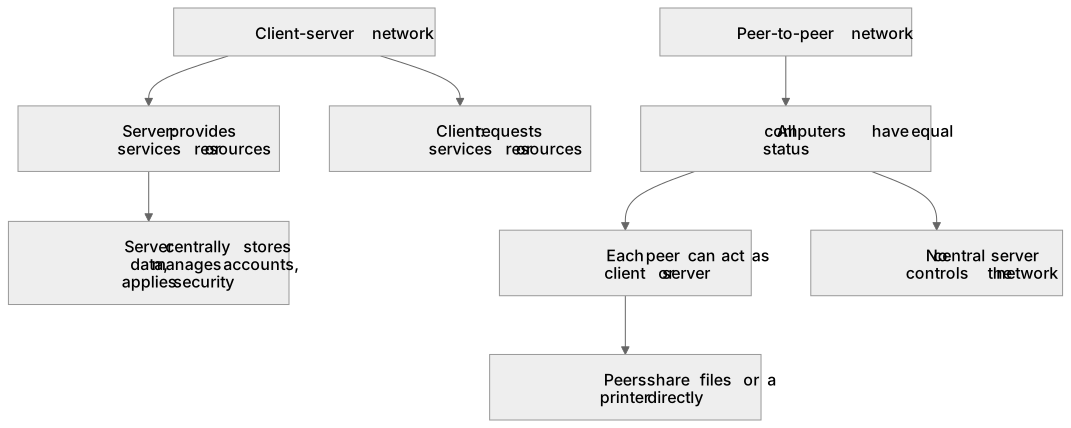
In a client-server network, one or more powerful computers act as servers and the remaining computers are clients. A client requests services or resources; the server stores data, manages user accounts, applies security and responds to requests. For example, a school file server holds pupil work and checks login details before allowing access. In a peer-to-peer network, every computer has an equal role: each can act as both client and server, sharing files or a printer directly with others. No central server controls the network, so each peer must be switched on for its shared resources to be available. The roles differ in where control, storage and security sit, which affects cost, performance, management and suitability for a given task.
What earns the marks
- States that in a client-server network a server provides services or resources and a client requests them.
- Explains that the server centrally stores data, manages accounts or applies security policies.
- States that in a peer-to-peer network all computers have equal status and can share resources directly.
- Explains that a peer can act as both client and server, depending on whether it requests or provides a resource.
- Compares the two models, for example central control and easier backup in client-server against lower cost and no dedicated server in peer-to-peer.
- Links each model to a suitable context, such as a school using a file server or a small home network sharing files between devices.
Common mistakes and how to put them right
Saying that a peer-to-peer network has no server at all.
Put it right by explaining that any peer can provide a service, so a computer can act as a server for a particular request even though no dedicated server exists.
Describing a client as a type of hardware only.
Put it right by explaining that client and server are roles, so the same computer can be a client for one request and a server for another.
Claiming that client-server networks are always faster.
Put it right by explaining that performance depends on the server specification, network traffic and other factors, not on the model alone.
Exam tips
- Use the words client, server and peer precisely, and state which computer requests a resource and which provides it.
- When asked to compare, give one point about each model and then a direct contrast rather than two separate descriptions.
- Apply each model to a named scenario, such as a hospital records system or a home network, to show understanding of suitability.
Try the lesson
The start of the Networks and topologies: The different roles of computers in a client-server and a peer-to- peer network lesson, made from checked teaching notes for this specification point.
Have a go first
In a client-server network, which computer requests a service from another computer?
Listen
In a client-server network, one or more powerful computers act as servers and the remaining computers are clients. A client requests services or resources; the server stores data, manages user accounts, applies security and responds to requests. For example, a school file server holds pupil work and checks login details before allowing access. In a peer-to-peer network, every computer has an equal role: each can act as both client and server, sharing files or a printer directly with others. No central server controls the network, so each peer must be switched on for its shared resources to be available. The roles differ in where control, storage and security sit, which affects cost, performance, management and suitability for a given task. A strong answer earns marks for these points. States that in a client-server network a server provides services or resources and a client requests them. Explains that the server centrally stores data, manages accounts or applies security policies. States that in a peer-to-peer network all computers have equal status and can share resources directly. Explains that a peer can act as both client and server, depending on whether it requests or provides a resource. A common slip: Saying that a peer-to-peer network has no server at all. Instead, explaining that any peer can provide a service, so a computer can act as a server for a particular request even though no dedicated server exists. Exam tip: Use the words client, server and peer precisely, and state which computer requests a resource and which provides it.
See it
Key words
Say what each word means before you turn the card.
Client
Try answering aloud or in your head before turning the card.
Server
Try answering aloud or in your head before turning the card.
Peer
Try answering aloud or in your head before turning the card.
Peer-to-peer network
Try answering aloud or in your head before turning the card.
See every definition
- Client
- A computer that requests services or resources from a server in a client-server network.
- Server
- A powerful computer that stores data, manages user accounts, applies security and responds to requests.
- Peer
- A computer with an equal role that can act as both client and server, sharing resources directly with others.
- Peer-to-peer network
- A network where every computer has an equal role and no central server controls the network.
Label the diagram
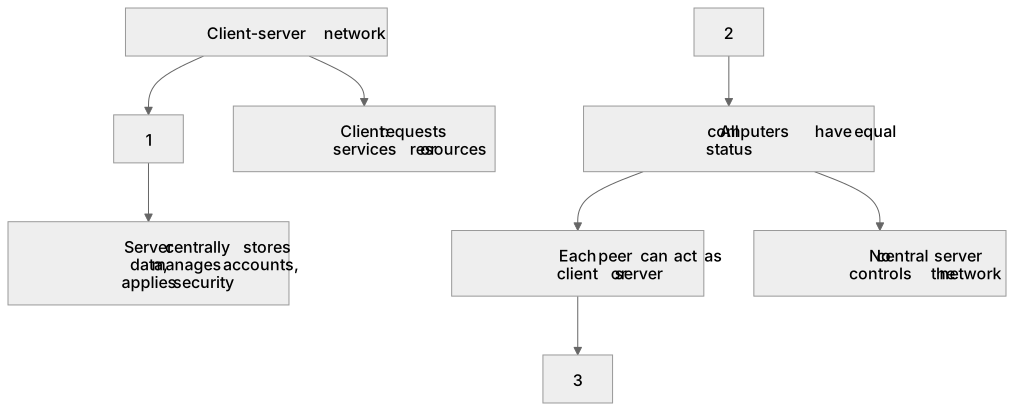
Some boxes have lost their names. Pick the right name for each number.
1Box 1
2Box 2
3Box 3
There is more to this lesson
The full lesson goes on to check your understanding and help you earn the marks. Create a free account to carry on, with your progress saved.
A week of Premium from your first lesson · Then the free plan continues · No card, no charge
Test your understanding of Networks and topologies: The different roles of computers in a client-server and a peer-to- peer network
Active recall beats re-reading. Take an instant quiz now to test what you’ve learned and lock it into long-term memory.
A week of Premium from your first lesson · Then the free plan continues · No card, no charge