OCR · GCSE · Computer Science
Course version: J277 · Version from Sept 2022
The Internet as a worldwide collection of computer networks DNS (Domain…
Full specification wording
Networks and topologies: The Internet as a worldwide collection of computer networks DNS (Domain Name Server) Hosting The Cloud Web servers and clients
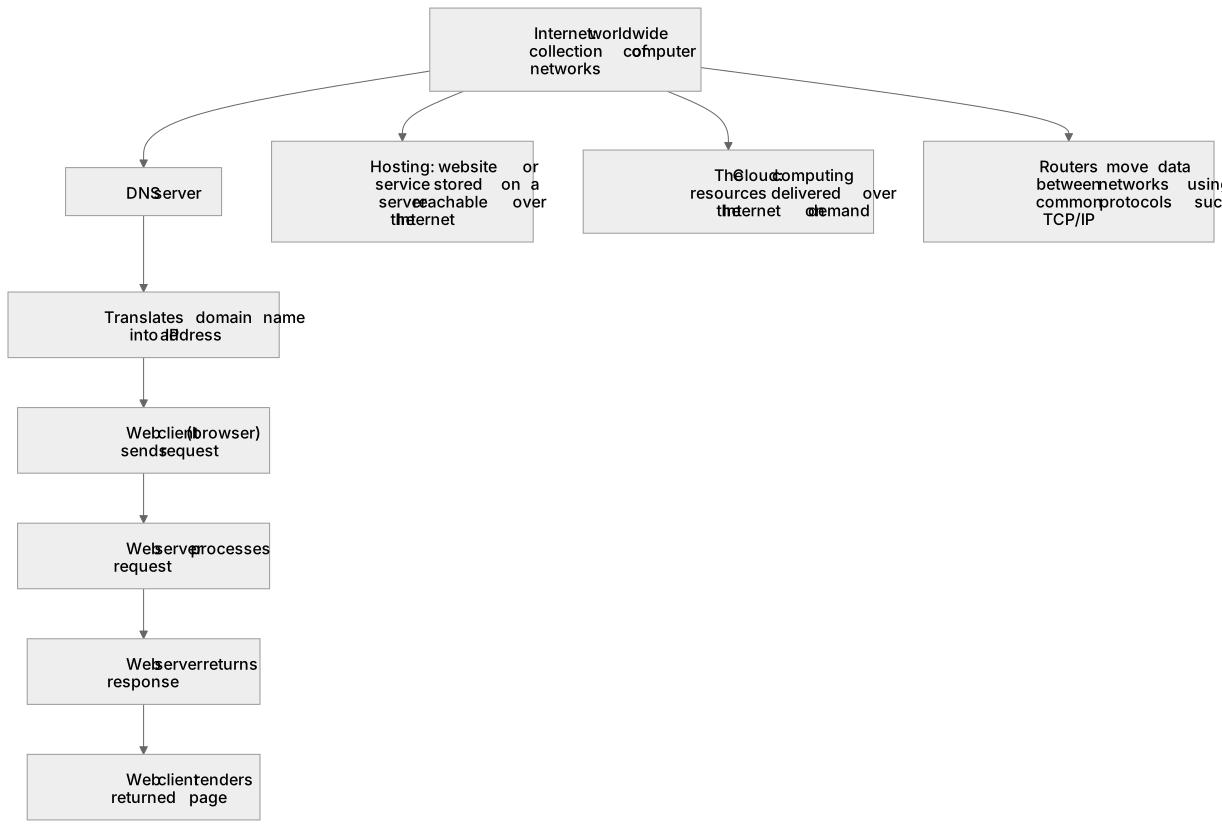
The Internet is a worldwide collection of computer networks, not a single network: independent LANs and WANs interconnect through routers and exchange data using common protocols such as TCP/IP.
Checked against the OCR J277 specification on .
- Point 5 of 6
- 4 key terms
Study notes
From the checked teaching notes for this specification point.
The idea
The Internet is a worldwide collection of computer networks, not a single network: independent LANs and WANs interconnect through routers and exchange data using common protocols such as TCP/IP. When you type a web address, a DNS server translates the human-readable domain name into the numeric IP address that identifies the destination server. Hosting means storing a website or service on a server that is reachable over the Internet; the host may be owned locally or rented from a provider. The Cloud is the delivery of computing resources, such as storage, processing and software, over the Internet on demand, so users access them remotely rather than owning the hardware. Web servers respond to requests from web clients, typically browsers, which send requests and render the returned pages.
What earns the marks
- The Internet is a worldwide collection of interconnected computer networks, often described as a network of networks, rather than one single network.
- DNS servers translate domain names into IP addresses so that clients can locate the correct server.
- Hosting is the storage and provision of a website or service on a server that is accessible over the Internet.
- The Cloud provides computing services such as storage, processing and software over the Internet on demand.
- Web clients, such as browsers, send requests to web servers, which process the requests and return responses.
- Data travels between networks through routers using common protocols, for example TCP/IP.
Common mistakes and how to put them right
Saying the Internet is one large network.
Put it right by describing it as a worldwide collection of interconnected networks.
Confusing DNS with a search engine.
Put it right by stating that DNS resolves domain names to IP addresses.
Treating the Cloud as the same as the Internet.
Put it right by explaining that the Cloud is services delivered over the Internet, not the infrastructure itself.
Exam tips
- Define each term precisely, then link it to a concrete example such as a browser requesting a page.
- When asked about DNS, describe the translation from domain name to IP address in the correct order.
- For Cloud questions, compare remote provision with local storage and mention at least one benefit and one drawback.
Try the lesson
The start of the Networks and topologies: The Internet as a worldwide collection of computer networks DNS (Domain Name Server) Hosting The Cloud Web servers and clients lesson, made from checked teaching notes for this specification point.
Have a go first
Which statement best describes the Internet?
Listen
The Internet is a worldwide collection of computer networks, not a single network: independent LANs and WANs interconnect through routers and exchange data using common protocols such as TCP/IP. When you type a web address, a DNS server translates the human-readable domain name into the numeric IP address that identifies the destination server. Hosting means storing a website or service on a server that is reachable over the Internet; the host may be owned locally or rented from a provider. The Cloud is the delivery of computing resources, such as storage, processing and software, over the Internet on demand, so users access them remotely rather than owning the hardware. Web servers respond to requests from web clients, typically browsers, which send requests and render the returned pages. A strong answer earns marks for these points. The Internet is a worldwide collection of interconnected computer networks, often described as a network of networks, rather than one single network. DNS servers translate domain names into IP addresses so that clients can locate the correct server. Hosting is the storage and provision of a website or service on a server that is accessible over the Internet. The Cloud provides computing services such as storage, processing and software over the Internet on demand. A common slip: Saying the Internet is one large network. Instead, describing it as a worldwide collection of interconnected networks. Exam tip: Define each term precisely, then link it to a concrete example such as a browser requesting a page.
See it
Key words
Say what each word means before you turn the card.
Networks and interconnection
Try answering aloud or in your head before turning the card.
Domain name resolution
Try answering aloud or in your head before turning the card.
Hosting and service provision
Try answering aloud or in your head before turning the card.
Cloud computing
Try answering aloud or in your head before turning the card.
See every definition
- Networks and interconnection
- The Internet is a worldwide collection of computer networks, not a single network, with independent LANs and WANs interconnecting through routers.
- Domain name resolution
- A DNS server translates the human-readable domain name into the numeric IP address that identifies the destination server.
- Hosting and service provision
- Storing a website or service on a server that is reachable over the Internet, which may be owned locally or rented from a provider.
- Cloud computing
- The delivery of computing resources, such as storage, processing and software, over the Internet on demand, so users access them remotely rather than owning the hardware.
Label the diagram
Some boxes have lost their names. Pick the right name for each number.
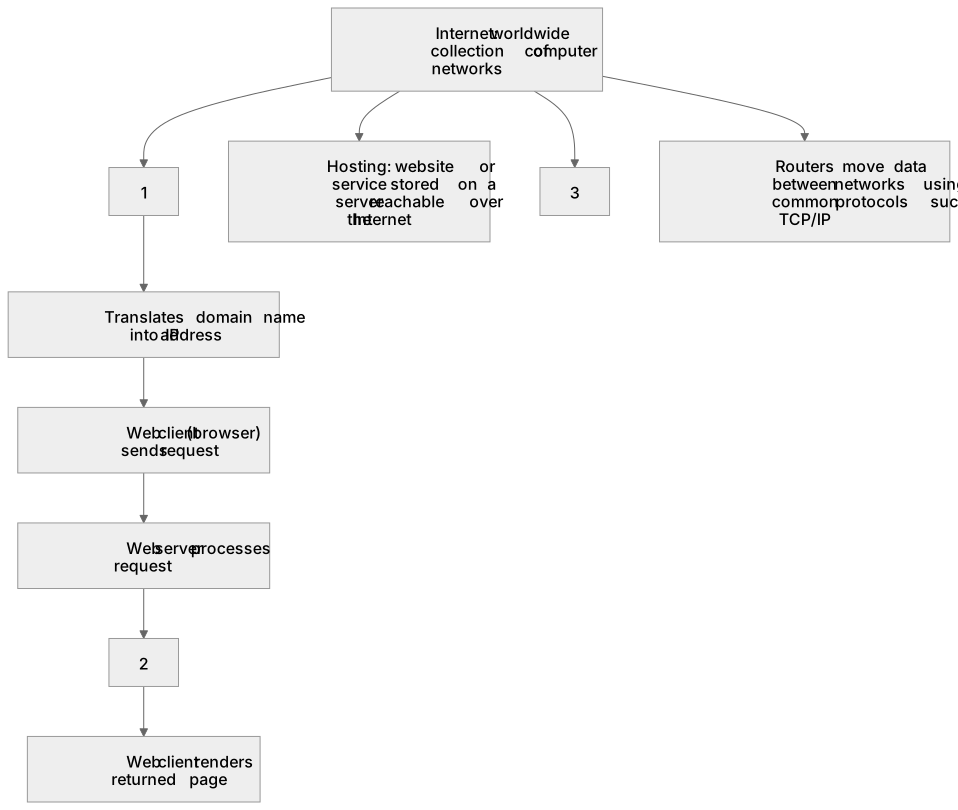
1Box 1
2Box 2
3Box 3
There is more to this lesson
The full lesson goes on to check your understanding and help you earn the marks. Create a free account to carry on, with your progress saved.
A week of Premium from your first lesson · Then the free plan continues · No card, no charge
Test your understanding of Networks and topologies: The Internet as a worldwide collection of computer networks DNS (Domain Name Server) Hosting The Cloud Web servers and clients
Active recall beats re-reading. Take an instant quiz now to test what you’ve learned and lock it into long-term memory.
A week of Premium from your first lesson · Then the free plan continues · No card, no charge