OCR · GCSE · Computer Science
Course version: J277 · Version from Sept 2022
Types of network LAN (Local Area Network) WAN (Wide Area Network)
Full specification wording
Networks and topologies: Types of network LAN (Local Area Network) WAN (Wide Area Network)
A network links devices so they can share data and resources.
Checked against the OCR J277 specification on .
- Point 1 of 6
- 4 key terms
Study notes
From the checked teaching notes for this specification point.
The idea
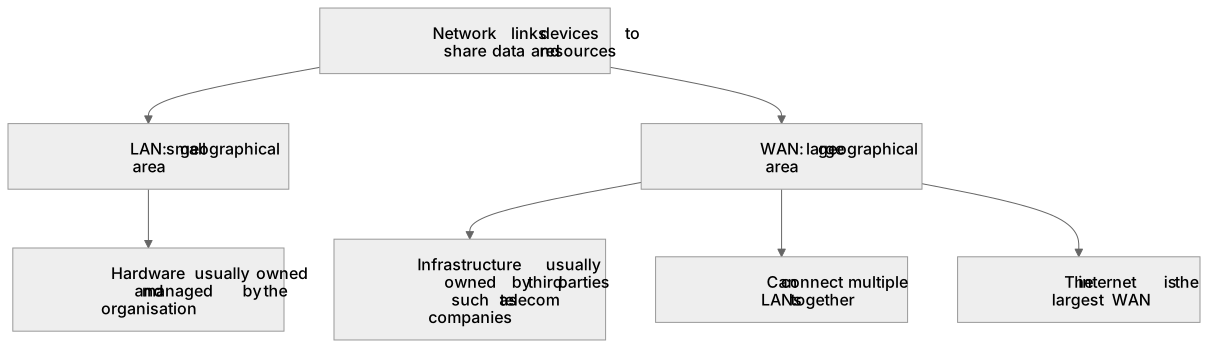
A network links devices so they can share data and resources. A LAN covers a small geographical area such as one school, office or home, and the hardware is usually owned and managed by the organisation. A WAN covers a large geographical area, often connecting LANs across towns, countries or continents; the communication infrastructure is usually owned by third parties such as telecom companies. The internet is the largest WAN. A school with computers in several rooms linked by its own switches and cabling is a LAN; the same school connecting to a branch in another city through leased lines forms a WAN. Performance depends on the type chosen, so identifying LAN or WAN helps explain bandwidth, ownership and cost.
What earns the marks
- States that a LAN covers a small geographical area, such as a single building, school or home.
- States that a WAN covers a large geographical area, such as multiple sites, countries or continents.
- Explains that LAN hardware is typically owned and managed by the organisation, whereas WAN infrastructure is usually owned by third parties such as telecom providers.
- Uses a correct example, such as a home or school network for a LAN and the internet or a bank's national branch network for a WAN.
- Compares the two types by scale, ownership, transmission media or typical connection speed rather than describing only one.
- Recognises that a WAN can connect multiple LANs together, for example a company linking its offices in different cities.
Common mistakes and how to put them right
Saying a WAN is simply a faster or bigger LAN.
Put it right: The key distinction is geographical scale and ownership of the communication infrastructure, not speed alone.
Claiming the internet is a LAN.
Put it right: The internet is the largest example of a WAN because it spans the globe and uses infrastructure owned by many providers.
Assuming all LANs are wireless.
Put it right: A LAN may use wired media such as Ethernet cables, wireless media such as Wi-Fi, or a combination of both.
Exam tips
- Define each term in one precise sentence before adding an example, so the examiner can see the key idea immediately.
- When asked to compare, write about both types in the same sentence or paragraph, for example 'a LAN covers a small area whereas a WAN covers a large area'.
- Use a named context such as a school LAN or a supermarket chain WAN to make the example concrete and creditworthy.
Try the lesson
The start of the Networks and topologies: Types of network LAN (Local Area Network) WAN (Wide Area Network) lesson, made from checked teaching notes for this specification point.
Have a go first
Which type of network covers a small geographical area such as a single school or office building?
Listen
A network links devices so they can share data and resources. A LAN covers a small geographical area such as one school, office or home, and the hardware is usually owned and managed by the organisation. A WAN covers a large geographical area, often connecting LANs across towns, countries or continents; the communication infrastructure is usually owned by third parties such as telecom companies. The internet is the largest WAN. A school with computers in several rooms linked by its own switches and cabling is a LAN; the same school connecting to a branch in another city through leased lines forms a WAN. Performance depends on the type chosen, so identifying LAN or WAN helps explain bandwidth, ownership and cost. A strong answer earns marks for these points. States that a LAN covers a small geographical area, such as a single building, school or home. States that a WAN covers a large geographical area, such as multiple sites, countries or continents. Explains that LAN hardware is typically owned and managed by the organisation, whereas WAN infrastructure is usually owned by third parties such as telecom providers. Uses a correct example, such as a home or school network for a LAN and the internet or a bank's national branch network for a WAN. A common slip: Saying a WAN is simply a faster or bigger LAN. Instead, the key distinction is geographical scale and ownership of the communication infrastructure, not speed alone. Exam tip: Define each term in one precise sentence before adding an example, so the examiner can see the key idea immediately.
See it
Key words
Say what each word means before you turn the card.
LAN
Try answering aloud or in your head before turning the card.
WAN
Try answering aloud or in your head before turning the card.
Ownership and management of network infrastructure
Try answering aloud or in your head before turning the card.
Examples of LANs and WANs in everyday life
Try answering aloud or in your head before turning the card.
See every definition
- LAN
- A network that covers a small geographical area such as one school, office or home, with hardware usually owned and managed by the organisation.
- WAN
- A network that covers a large geographical area, often connecting LANs across towns, countries or continents, with communication infrastructure usually owned by third parties such as telecom companies.
- Ownership and management of network infrastructure
- LAN hardware is typically owned and managed by the organisation, whereas WAN infrastructure is usually owned by third parties such as telecom providers.
- Examples of LANs and WANs in everyday life
- A school with computers in several rooms linked by its own switches and cabling is a LAN, and the internet is the largest WAN.
Label the diagram
Some boxes have lost their names. Pick the right name for each number.
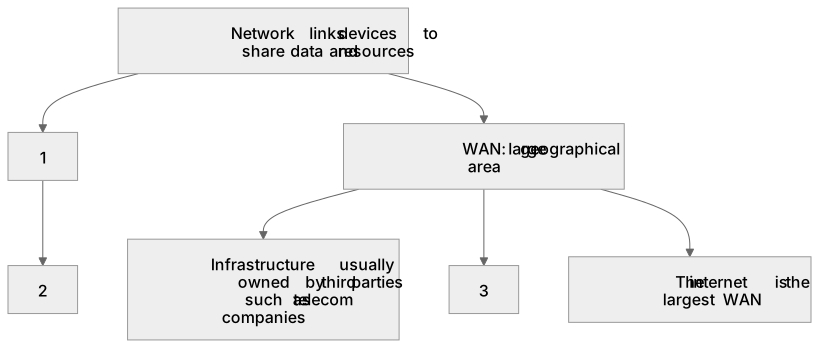
1Box 1
2Box 2
3Box 3
There is more to this lesson
The full lesson goes on to check your understanding and help you earn the marks. Create a free account to carry on, with your progress saved.
A week of Premium from your first lesson · Then the free plan continues · No card, no charge
Test your understanding of Networks and topologies: Types of network LAN (Local Area Network) WAN (Wide Area Network)
Active recall beats re-reading. Take an instant quiz now to test what you’ve learned and lock it into long-term memory.
A week of Premium from your first lesson · Then the free plan continues · No card, no charge