OCR · GCSE · Computer Science
Course version: J277 · Version from Sept 2022
Wired and wireless networks, protocols and layers: Standards
Standards are agreed, documented specifications that allow hardware and software from different manufacturers to interoperate on a network.
Checked against the OCR J277 specification on .
- Point 7 of 9
- 4 key terms
Study notes
From the checked teaching notes for this specification point.
The idea
Standards are agreed, documented specifications that allow hardware and software from different manufacturers to interoperate on a network. Without them, devices could use incompatible signalling or data formats and fail to communicate. Standards cover physical properties, such as Ethernet cable connectors and Wi-Fi radio frequencies, and logical properties, such as data formats and the rules that protocols follow. For example, because manufacturers follow Wi-Fi standards, a smartphone from one vendor can connect to a wireless router from another. Standards therefore improve compatibility and make network behaviour predictable, which simplifies troubleshooting. Note the distinction: a protocol is a specific set of communication rules, while a standard is the broader agreed specification that a protocol may conform to.
What earns the marks
- Define standards as agreed, documented specifications that enable interoperability between equipment from different manufacturers.
- Identify that standards govern both physical properties (e.g., cables, connectors, radio frequencies) and logical properties (e.g., data formats, protocol rules).
- Provide examples of network standards, such as Ethernet for wired connections and IEEE 802.11 for Wi-Fi.
- Explain that without standards, devices might use proprietary, incompatible methods and be unable to communicate.
- State that standards improve compatibility and simplify troubleshooting across different devices.
- Distinguish a standard from a protocol: a protocol is a specific set of communication rules, whereas a standard is the broader agreed specification that protocols may conform to.
Common mistakes and how to put them right
Confusing a standard with a specific piece of hardware.
Put it right: Explain that a standard is a set of rules or specifications that hardware manufacturers follow.
Using 'protocol' and 'standard' interchangeably without distinction.
Put it right: Note that while protocols are specific communication rules, standards are the broader agreed specifications that often encompass protocols.
Assuming standards are legally binding international laws.
Put it right: Explain that standards are voluntary agreements (e.g., by IEEE), though they are widely adopted for market compatibility.
Classifying Wi-Fi radio frequencies as a logical aspect.
Put it right: Radio frequencies are a physical-layer characteristic; use data formats or protocol rules as examples of logical standards.
Exam tips
- When asked for the purpose of standards, always mention interoperability or allowing devices from different manufacturers to communicate.
- Use a concrete example, such as an Ethernet cable fitting into any brand of computer, to illustrate physical standards.
Try the lesson
The start of the Wired and wireless networks, protocols and layers: Standards lesson, made from checked teaching notes for this specification point.
Have a go first
What is the main purpose of a network standard such as Ethernet?
Listen
Standards are agreed, documented specifications that allow hardware and software from different manufacturers to interoperate on a network. Without them, devices could use incompatible signalling or data formats and fail to communicate. Standards cover physical properties, such as Ethernet cable connectors and Wi-Fi radio frequencies, and logical properties, such as data formats and the rules that protocols follow. For example, because manufacturers follow Wi-Fi standards, a smartphone from one vendor can connect to a wireless router from another. Standards therefore improve compatibility and make network behaviour predictable, which simplifies troubleshooting. Note the distinction: a protocol is a specific set of communication rules, while a standard is the broader agreed specification that a protocol may conform to. A strong answer earns marks for these points. Define standards as agreed, documented specifications that enable interoperability between equipment from different manufacturers. Identify that standards govern both physical properties (e.g., cables, connectors, radio frequencies) and logical properties (e.g., data formats, protocol rules). Provide examples of network standards, such as Ethernet for wired connections and IEEE 802.11 for Wi-Fi. Explain that without standards, devices might use proprietary, incompatible methods and be unable to communicate. A common slip: Confusing a standard with a specific piece of hardware: a standard is not a device. Instead, explain that a standard is a set of rules or specifications that hardware manufacturers follow. Exam tip: When asked for the purpose of standards, always mention interoperability or allowing devices from different manufacturers to communicate.
See it

Key words
Say what each word means before you turn the card.
Standards
Try answering aloud or in your head before turning the card.
Interoperability and compatibility
Try answering aloud or in your head before turning the card.
Physical and logical network specifications
Try answering aloud or in your head before turning the card.
The role of agreed rules in networking
Try answering aloud or in your head before turning the card.
See every definition
- Standards
- Agreed, documented specifications that allow hardware and software from different manufacturers to interoperate on a network.
- Interoperability and compatibility
- The ability of equipment from different manufacturers to communicate, which standards improve and which makes network behaviour predictable.
- Physical and logical network specifications
- Standards cover physical properties such as Ethernet cable connectors and Wi-Fi radio frequencies, and logical properties such as data formats and the rules that protocols follow.
- The role of agreed rules in networking
- Without agreed rules, devices could use incompatible signalling or data formats and fail to communicate, while standards simplify troubleshooting.
Label the diagram
Some boxes have lost their names. Pick the right name for each number.
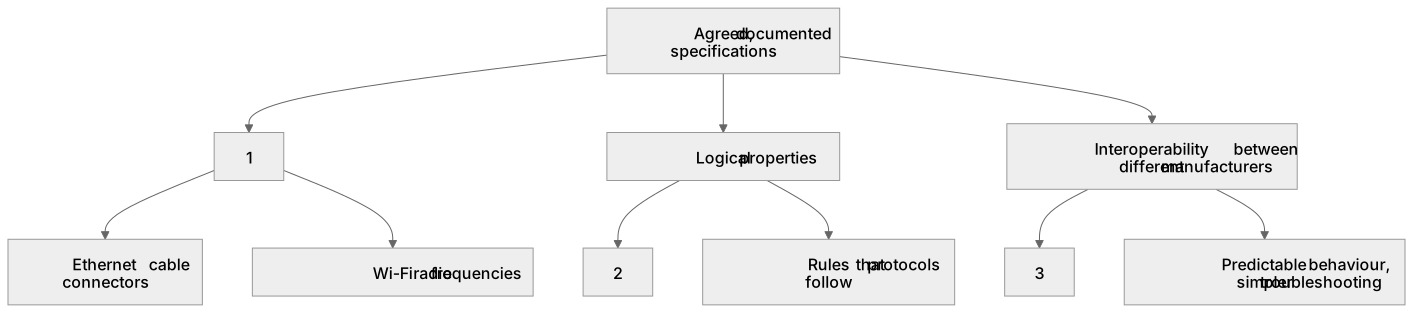
1Box 1
2Box 2
3Box 3
There is more to this lesson
The full lesson goes on to check your understanding and help you earn the marks. Create a free account to carry on, with your progress saved.
A week of Premium from your first lesson · Then the free plan continues · No card, no charge
Test your understanding of Wired and wireless networks, protocols and layers: Standards
Active recall beats re-reading. Take an instant quiz now to test what you’ve learned and lock it into long-term memory.
A week of Premium from your first lesson · Then the free plan continues · No card, no charge