Pearson Edexcel · A-Level · Economics B
Course version: 9EB0 · Version from Sept 2015
Business survival and cash flow: c) Forecasting and interpreting cash flow
Full specification wording
Business survival and cash flow: c) Forecasting and interpreting cash flow
A cash flow forecast predicts future inflows and outflows of cash, allowing a business to anticipate periods of surplus or deficit.
Checked against the Pearson Edexcel 9EB0 specification (opens in a new tab) on .
- Point 3 of 4
Study notes
From the checked teaching notes for this specification point.
The idea
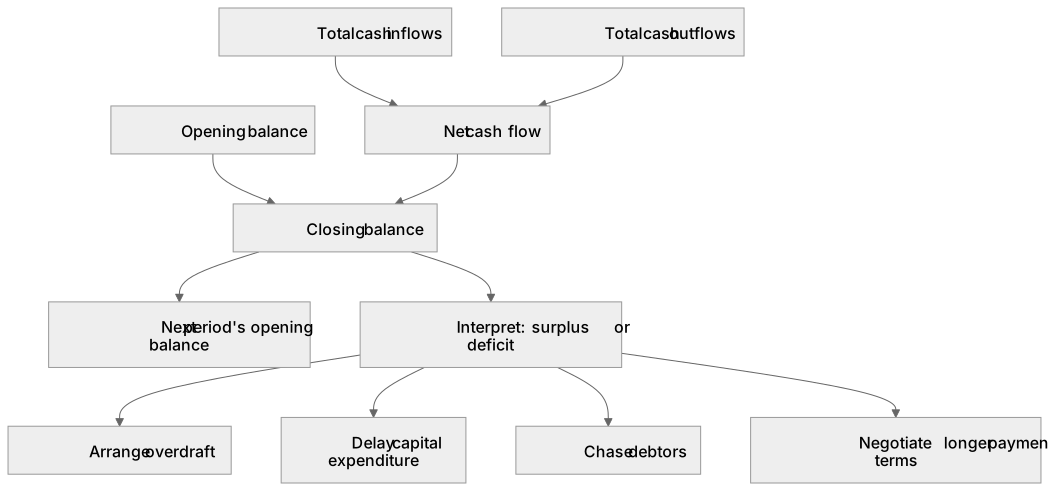
A cash flow forecast predicts future inflows and outflows of cash, allowing a business to anticipate periods of surplus or deficit. To interpret a forecast, one must analyse the net cash flow (total inflows minus total outflows) and the closing balance (opening balance plus net cash flow) for each period. For instance, if a retailer's forecast shows a negative closing balance in March due to purchasing seasonal stock, they can proactively arrange a bank overdraft in January. Interpreting these forecasts enables managers to make informed decisions, such as delaying capital expenditure, chasing debtors, or negotiating longer payment terms, thereby preventing liquidity crises and ensuring solvency.
What earns the marks
- Define a cash flow forecast as a forward-looking statement predicting future cash inflows and outflows.
- Calculate net cash flow by subtracting total cash outflows from total cash inflows for a given period.
- Calculate the closing balance by adding the net cash flow to the opening balance.
- Interpret a negative closing balance as a liquidity shortage requiring intervention, such as arranging an overdraft or delaying payments.
Common mistakes and how to put them right
Including non-cash items like depreciation in a cash flow forecast.
Put it right: Only actual cash movements should be recorded in cash flow forecasting.
Confusing the opening balance with total inflows.
Put it right: The opening balance is the cash available at the start of the period, carried over from the previous period's closing balance.
Assuming a negative net cash flow always means a negative closing balance.
Put it right: A business can have a negative net cash flow but still maintain a positive closing balance if the opening balance is sufficiently large.
Exam tips
- Practise calculating missing figures in a cash flow forecast table, remembering that one month's closing balance is the next month's opening balance.
- When interpreting a forecast, suggest realistic solutions for a projected cash deficit, such as factoring debts or reducing stock levels.
- Pay attention to the timing of cash flows in exam scenarios, especially the difference between cash sales and credit sales.
Try the lesson
The start of the Business survival and cash flow: c) Forecasting and interpreting cash flow lesson, made from checked teaching notes for this specification point.
Have a go first
A business has an opening cash balance of £4,500. During the month, its total cash inflows are £12,000 and its total cash outflows are £14,500. What is the closing cash balance for the month?
Listen
A cash flow forecast predicts future inflows and outflows of cash, allowing a business to anticipate periods of surplus or deficit. To interpret a forecast, one must analyse the net cash flow (total inflows minus total outflows) and the closing balance (opening balance plus net cash flow) for each period. For instance, if a retailer's forecast shows a negative closing balance in March due to purchasing seasonal stock, they can proactively arrange a bank overdraft in January. Interpreting these forecasts enables managers to make informed decisions, such as delaying capital expenditure, chasing debtors, or negotiating longer payment terms, thereby preventing liquidity crises and ensuring solvency. A strong answer earns marks for these points. Define a cash flow forecast as a forward-looking statement predicting future cash inflows and outflows. Calculate net cash flow by subtracting total cash outflows from total cash inflows for a given period. Calculate the closing balance by adding the net cash flow to the opening balance. Interpret a negative closing balance as a liquidity shortage requiring intervention, such as arranging an overdraft or delaying payments. A common slip: Including non-cash items like depreciation in a cash flow forecast. Instead, only actual cash movements should be recorded in cash flow forecasting. Exam tip: Practise calculating missing figures in a cash flow forecast table, remembering that one month's closing balance is the next month's opening balance.
See it
Label the diagram
Some boxes have lost their names. Pick the right name for each number.
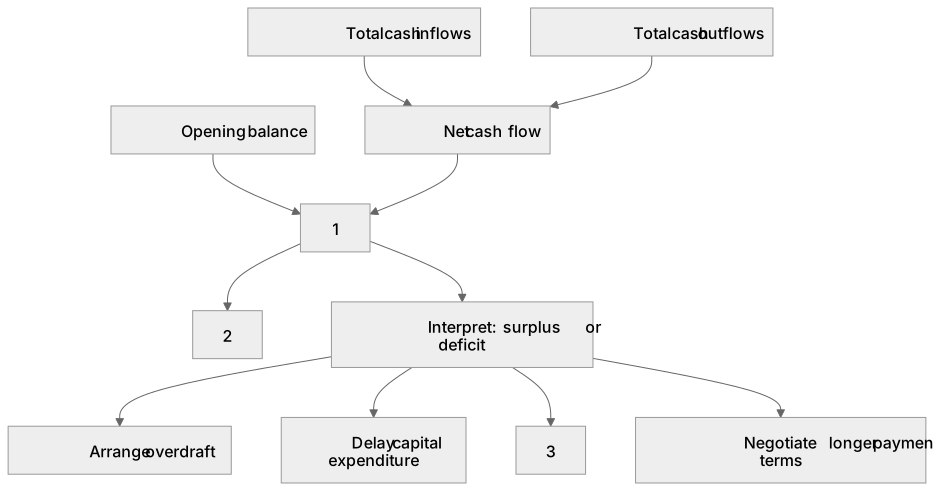
1Box 1
2Box 2
3Box 3
There is more to this lesson
The full lesson goes on to check your understanding and help you earn the marks. Create a free account to carry on, with your progress saved.
A week of Premium from your first lesson · Then the free plan continues · No card, no charge
Test your understanding of Business survival and cash flow: c) Forecasting and interpreting cash flow
Active recall beats re-reading. Take an instant quiz now to test what you’ve learned and lock it into long-term memory.
A week of Premium from your first lesson · Then the free plan continues · No card, no charge