Pearson Edexcel · A-Level · Economics B
Course version: 9EB0 · Version from Sept 2015
D) Use of a cash-flow forecast to identify credit requirements and…
Full specification wording
Business survival and cash flow: d) Use of a cash-flow forecast to identify credit requirements and minimise risk
A cash-flow forecast predicts a business's future inflows and outflows of cash over a specific period.
Checked against the Pearson Edexcel 9EB0 specification (opens in a new tab) on .
- Point 4 of 4
- 4 key terms
Study notes
From the checked teaching notes for this specification point.
The idea
A cash-flow forecast predicts a business's future inflows and outflows of cash over a specific period. By analysing these projections, managers can identify periods where outflows exceed inflows, resulting in a negative net cash flow and a potential cash shortage. This foresight allows the business to identify its exact credit requirements, such as arranging an overdraft or a short-term loan in advance. Consequently, the business can minimise the risk of insolvency or defaulting on supplier payments.
For example: A seasonal retailer might forecast a cash deficit in summer and secure an overdraft facility early, ensuring they can pay staff and suppliers, thereby mitigating operational and financial risks.
What earns the marks
- Defines a cash-flow forecast as a forward-looking statement of expected cash inflows and outflows.
- Explains that negative closing balances indicate a need for external credit, such as an overdraft or short-term loan.
- Identifies that arranging credit in advance is cheaper and more likely to be approved than emergency borrowing.
- Links the use of forecasting to the minimisation of risk, specifically the risk of insolvency due to a lack of liquidity.
Common mistakes and how to put them right
Confusing cash flow with profit.
Put it right: Cash flow is about the timing of receipts and payments, whereas profit is revenue minus costs, meaning a profitable business can still run out of cash.
Assuming a forecast guarantees survival.
Put it right: Forecasts are estimates based on assumptions, so unexpected events can still cause cash shortages.
Believing credit requirements only refer to long-term loans.
Put it right: Credit requirements identified by cash-flow forecasts are typically short-term, such as overdrafts or trade credit extensions.
Exam tips
- Always distinguish between cash and profit when evaluating why a business might fail despite high sales.
- Use the data provided in a cash-flow forecast table to calculate the exact month a business will need an overdraft.
- When discussing risk minimisation, explicitly mention the risk of insolvency or inability to pay day-to-day liabilities.
Try the lesson
The start of the Business survival and cash flow: d) Use of a cash-flow forecast to identify credit requirements and minimise risk lesson, made from checked teaching notes for this specification point.
Have a go first
Which of the following best describes how a business uses a cash-flow forecast to identify its credit requirements?
Listen
A cash-flow forecast predicts a business's future inflows and outflows of cash over a specific period. By analysing these projections, managers can identify periods where outflows exceed inflows, resulting in a negative net cash flow and a potential cash shortage. This foresight allows the business to identify its exact credit requirements, such as arranging an overdraft or a short-term loan in advance. Consequently, the business can minimise the risk of insolvency or defaulting on supplier payments. For example, a seasonal retailer might forecast a cash deficit in summer and secure an overdraft facility early, ensuring they can pay staff and suppliers, thereby mitigating operational and financial risks. A strong answer earns marks for these points. Defines a cash-flow forecast as a forward-looking statement of expected cash inflows and outflows. Explains that negative closing balances indicate a need for external credit, such as an overdraft or short-term loan. Identifies that arranging credit in advance is cheaper and more likely to be approved than emergency borrowing. Links the use of forecasting to the minimisation of risk, specifically the risk of insolvency due to a lack of liquidity. A common slip: Confusing cash flow with profit. Instead, cash flow is about the timing of receipts and payments, whereas profit is revenue minus costs, meaning a profitable business can still run out of cash. Exam tip: Always distinguish between cash and profit when evaluating why a business might fail despite high sales.
See it
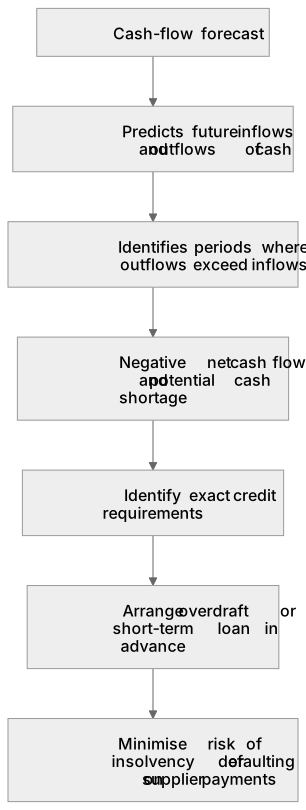
Put it in order
Put these steps in the order they happen.
- 1. Minimise risk of insolvency or defaulting on supplier payments
- 2. Arrange overdraft or short-term loan in advance
- 3. Identifies periods where outflows exceed inflows
- 4. Identify exact credit requirements
- 5. Cash-flow forecast
- 6. Predicts future inflows and outflows of cash
- 7. Negative net cash flow and potential cash shortage
Key words
Say what each word means before you turn the card.
Cash-flow forecast
Try answering aloud or in your head before turning the card.
Credit requirements
Try answering aloud or in your head before turning the card.
Liquidity
Try answering aloud or in your head before turning the card.
Risk management
Try answering aloud or in your head before turning the card.
See every definition
- Cash-flow forecast
- A forward-looking statement of expected cash inflows and outflows over a specific period, used to identify periods where outflows exceed inflows.
- Credit requirements
- The external credit a business needs, such as an overdraft or short-term loan, identified by a negative net cash flow and arranged in advance.
- Liquidity
- Having enough cash to pay day-to-day liabilities, the lack of which creates the risk of insolvency.
- Risk management
- Using foresight from projections to minimise the risk of insolvency or defaulting on supplier payments by arranging credit in advance.
Label the diagram
Some boxes have lost their names. Pick the right name for each number.
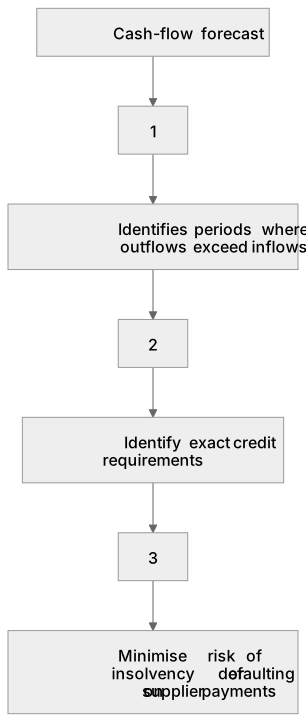
1Box 1
2Box 2
3Box 3
There is more to this lesson
The full lesson goes on to check your understanding and help you earn the marks. Create a free account to carry on, with your progress saved.
A week of Premium from your first lesson · Then the free plan continues · No card, no charge
Test your understanding of Business survival and cash flow: d) Use of a cash-flow forecast to identify credit requirements and minimise risk
Active recall beats re-reading. Take an instant quiz now to test what you’ve learned and lock it into long-term memory.
A week of Premium from your first lesson · Then the free plan continues · No card, no charge