Pearson Edexcel · A-Level · Economics B
Course version: 9EB0 · Version from Sept 2015
Capacity utilisation: a) Full capacity and spare capacity
Full capacity occurs when a business produces at its maximum possible output with its current resources, meaning all factors of production are fully employed.
Checked against the Pearson Edexcel 9EB0 specification (opens in a new tab) on .
- Point 1 of 4
- 2 key terms
Study notes
From the checked teaching notes for this specification point.
The idea
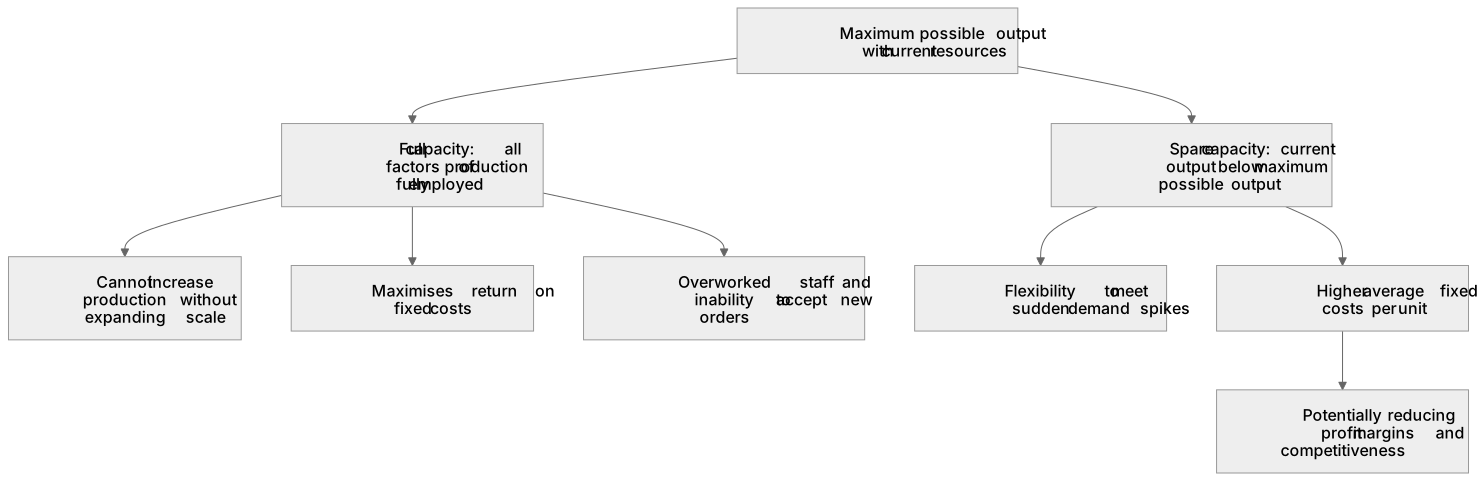
Full capacity occurs when a business produces at its maximum possible output with its current resources, meaning all factors of production are fully employed. The firm cannot increase production without expanding its scale, such as buying new machinery. Spare capacity exists when current output is below the maximum possible output. For example, a hotel with 100 rooms that only has 70 occupied has spare capacity. While full capacity maximises the return on fixed costs, it can lead to overworked staff and an inability to accept new orders. Conversely, spare capacity provides flexibility to meet sudden demand spikes but results in higher average fixed costs per unit, potentially reducing profit margins and competitiveness.
What earns the marks
- Define full capacity as operating at 100% of maximum possible output.
- Define spare capacity as operating below maximum possible output.
- Identify that full capacity spreads fixed costs over the maximum number of units, lowering average fixed costs.
- Recognise that spare capacity allows a business to respond to unexpected increases in demand.
- Explain that persistent spare capacity may indicate falling demand or over-investment in capital.
Common mistakes and how to put them right
Confusing spare capacity with spare inventory.
Put it right: Spare capacity refers to the ability to produce more, not the stock of finished goods.
Assuming full capacity is always ideal.
Put it right: Operating at 100% can cause machine breakdowns and staff burnout, so a slightly lower level is often preferred.
Believing spare capacity means a business is making a loss.
Put it right: It only means average fixed costs are higher than they could be, but the firm may still be profitable.
Exam tips
- Use the context provided in the data response to determine if spare capacity is a deliberate strategy or a result of poor sales.
- When evaluating full capacity, always mention the risk of turning away potential customers due to an inability to increase output.
- Link spare capacity to unit costs; explain how fixed costs are spread over fewer units, increasing the cost per unit.
Try the lesson
The start of the Capacity utilisation: a) Full capacity and spare capacity lesson, made from checked teaching notes for this specification point.
Have a go first
What is the most accurate description of a business operating with 'spare capacity'?
Listen
Full capacity occurs when a business produces at its maximum possible output with its current resources, meaning all factors of production are fully employed. The firm cannot increase production without expanding its scale, such as buying new machinery. Spare capacity exists when current output is below the maximum possible output. For example, a hotel with 100 rooms that only has 70 occupied has spare capacity. While full capacity maximises the return on fixed costs, it can lead to overworked staff and an inability to accept new orders. Conversely, spare capacity provides flexibility to meet sudden demand spikes but results in higher average fixed costs per unit, potentially reducing profit margins and competitiveness. A strong answer earns marks for these points. Define full capacity as operating at 100% of maximum possible output. Define spare capacity as operating below maximum possible output. Identify that full capacity spreads fixed costs over the maximum number of units, lowering average fixed costs. Recognise that spare capacity allows a business to respond to unexpected increases in demand. Exam tip: Use the context provided in the data response to determine if spare capacity is a deliberate strategy or a result of poor sales.
See it
Key words
Say what each word means before you turn the card.
Full capacity
Try answering aloud or in your head before turning the card.
Spare capacity
Try answering aloud or in your head before turning the card.
See every definition
- Full capacity
- Occurs when a business produces at its maximum possible output with its current resources, meaning all factors of production are fully employed.
- Spare capacity
- Exists when current output is below the maximum possible output, providing flexibility to meet sudden demand spikes.
Label the diagram
Some boxes have lost their names. Pick the right name for each number.
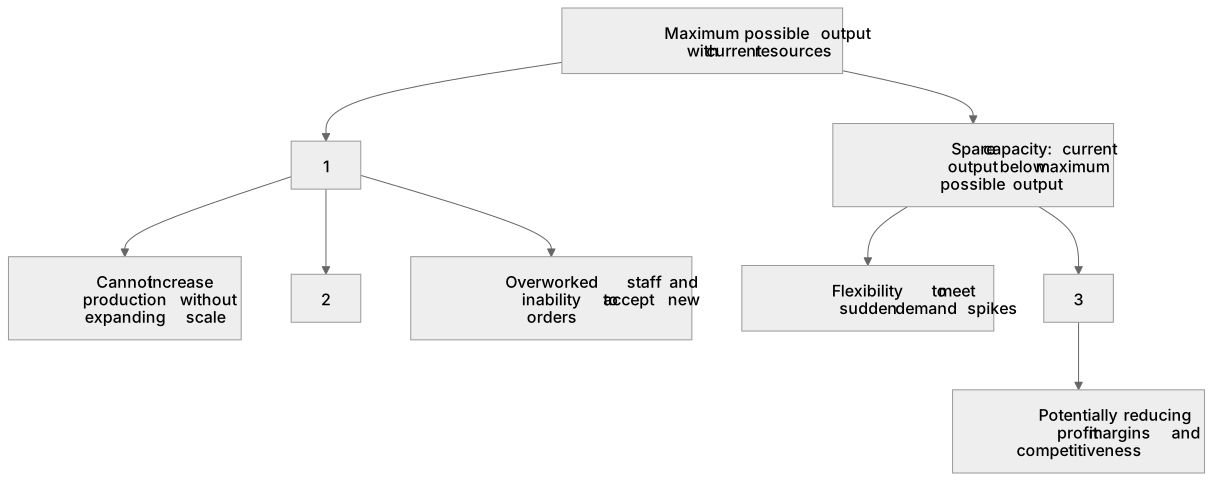
1Box 1
2Box 2
3Box 3
There is more to this lesson
The full lesson goes on to check your understanding and help you earn the marks. Create a free account to carry on, with your progress saved.
A week of Premium from your first lesson · Then the free plan continues · No card, no charge
Test your understanding of Capacity utilisation: a) Full capacity and spare capacity
Active recall beats re-reading. Take an instant quiz now to test what you’ve learned and lock it into long-term memory.
A week of Premium from your first lesson · Then the free plan continues · No card, no charge