Pearson Edexcel · A-Level · Economics B
Course version: 9EB0 · Version from Sept 2015
B) Capacity utilisation: o current output (divided by) maximum possible…
Full specification wording
Capacity utilisation: b) Capacity utilisation: o current output (divided by) maximum possible output (as a percentage)
Capacity utilisation measures the proportion of maximum possible output currently being achieved, expressed as a percentage.
Checked against the Pearson Edexcel 9EB0 specification (opens in a new tab) on .
- Point 2 of 4
Study notes
From the checked teaching notes for this specification point.
The idea
Capacity utilisation measures the proportion of maximum possible output currently being achieved, expressed as a percentage. The formula is current output divided by maximum possible output, multiplied by 100. For example, if a factory has a normal maximum capacity of 5,000 cars a month but currently produces 4,000, its capacity utilisation is (4,000 / 5,000) × 100 = 80%. While often below 100%, capacity utilisation can exceed 100% if a business over-utilises its resources, for instance by running extra overtime shifts or delaying maintenance, making current output temporarily higher than the standard maximum possible output. Calculating this accurately allows managers to assess operational efficiency.
What earns the marks
- State the formula for capacity utilisation: (current output / maximum possible output) × 100.
- Calculate capacity utilisation accurately from given production data, ensuring the result is a percentage.
- Recognise that current output can sometimes exceed normal maximum possible output, leading to a capacity utilisation above 100%.
- Calculate the new capacity utilisation percentage following a change in either current output or maximum capacity.
Common mistakes and how to put them right
Forgetting to multiply by 100.
Put it right: The result must be expressed as a percentage, not a decimal.
Assuming current output must always be the smaller number.
Put it right: Over-utilisation can result in current output exceeding normal maximum capacity.
Using sales volume instead of production volume for current output.
Put it right: Capacity utilisation measures production efficiency, not sales performance.
Exam tips
- Always write down the full formula before substituting the numbers to ensure you pick up method marks if your final calculation is incorrect.
- Check that your final answer is a percentage; if it exceeds 100%, verify that the scenario involves over-utilisation (e.g., overtime).
- Ensure you use the correct figures for maximum possible output, especially if the business has recently expanded or reduced its capacity.
Try the lesson
The start of the Capacity utilisation: b) Capacity utilisation: o current output (divided by) maximum possible output (as a percentage) lesson, made from checked teaching notes for this specification point.
Have a go first
A factory has a maximum possible output of 100,000 units per month. In November, its current output was 80,000 units. What was the factory's capacity utilisation for November?
Listen
Capacity utilisation measures the proportion of maximum possible output currently being achieved, expressed as a percentage. The formula is current output divided by maximum possible output, multiplied by 100. For example, if a factory has a normal maximum capacity of 5,000 cars a month but currently produces 4,000, its capacity utilisation is (4,000 / 5,000) × 100 = 80%. While often below 100%, capacity utilisation can exceed 100% if a business over-utilises its resources, for instance by running extra overtime shifts or delaying maintenance, making current output temporarily higher than the standard maximum possible output. Calculating this accurately allows managers to assess operational efficiency. A strong answer earns marks for these points. State the formula for capacity utilisation: (current output / maximum possible output) × 100. Calculate capacity utilisation accurately from given production data, ensuring the result is a percentage. Recognise that current output can sometimes exceed normal maximum possible output, leading to a capacity utilisation above 100%. Calculate the new capacity utilisation percentage following a change in either current output or maximum capacity. Exam tip: Always write down the full formula before substituting the numbers to ensure you pick up method marks if your final calculation is incorrect.
See it
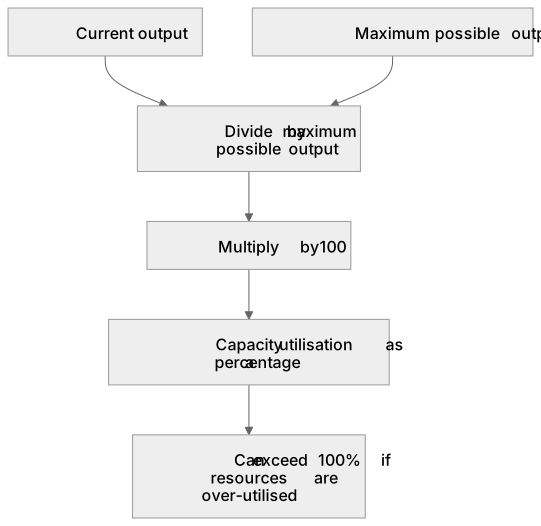
Label the diagram
Some boxes have lost their names. Pick the right name for each number.
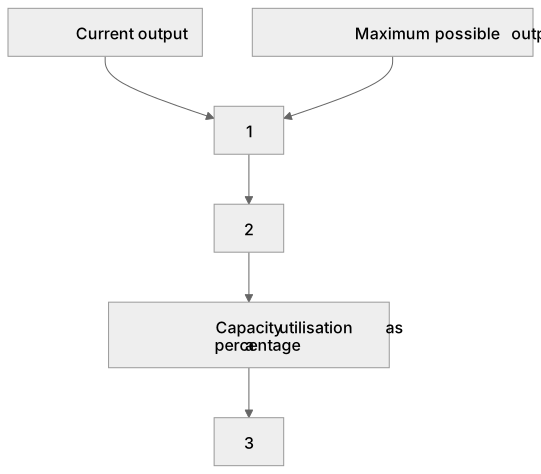
1Box 1
2Box 2
3Box 3
There is more to this lesson
The full lesson goes on to check your understanding and help you earn the marks. Create a free account to carry on, with your progress saved.
A week of Premium from your first lesson · Then the free plan continues · No card, no charge
Test your understanding of Capacity utilisation: b) Capacity utilisation: o current output (divided by) maximum possible output (as a percentage)
Active recall beats re-reading. Take an instant quiz now to test what you’ve learned and lock it into long-term memory.
A week of Premium from your first lesson · Then the free plan continues · No card, no charge