Pearson Edexcel · A-Level · Economics B
Course version: 9EB0 · Version from Sept 2015
A) Push factors: o saturated markets o competition
Full specification wording
Conditions that prompt trade: a) Push factors: o saturated markets o competition
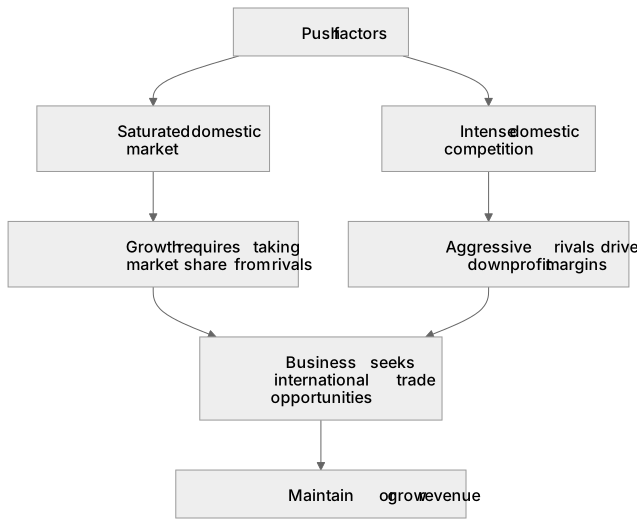
Push factors are negative domestic conditions that compel a business to seek international trade opportunities to maintain or grow revenue.
Checked against the Pearson Edexcel 9EB0 specification (opens in a new tab) on .
- Point 1 of 5
- 3 key terms
Study notes
From the checked teaching notes for this specification point.
The idea
Push factors are negative domestic conditions that compel a business to seek international trade opportunities to maintain or grow revenue. A saturated market occurs when the volume of a product in a domestic market is maximised, meaning further growth requires taking market share from rivals. For example, a smartphone manufacturer facing a saturated UK market might export to emerging economies to find new customers. Similarly, intense domestic competition acts as a push factor. If a market features aggressive rivals driving down profit margins, a firm may look to overseas markets where competition is weaker or where their product offers a unique selling proposition, allowing them to achieve higher margins and secure long-term survival.
What earns the marks
- Define push factors as adverse domestic market conditions that drive a business to trade internationally.
- Explain how a saturated domestic market limits growth potential, forcing firms to seek new customers abroad.
- Describe how intense domestic competition and falling profit margins encourage firms to find less competitive overseas markets.
- Link push factors to the strategic objective of extending a product's life cycle or maintaining profitability.
Common mistakes and how to put them right
Confusing push factors with pull factors.
Put it right: Push factors are negative domestic conditions driving firms away, whereas pull factors are attractive overseas conditions drawing firms in.
Assuming a saturated market means no sales are happening.
Put it right: A saturated market still has sales, but growth has stalled, and new sales mostly come from replacement or taking competitors' market share.
Believing competition is always a pull factor.
Put it right: While weak overseas competition is a pull factor, intense domestic competition is a push factor that forces firms to look elsewhere.
Exam tips
- Always distinguish clearly between push factors (domestic pressures) and pull factors (international opportunities) when analysing reasons for trade.
- Use the product life cycle model to explain why a firm in a saturated domestic market might export to a market where the product is in the growth phase.
- When discussing competition as a push factor, explicitly mention its impact on pricing power and profit margins.
Try the lesson
The start of the Conditions that prompt trade: a) Push factors: o saturated markets o competition lesson, made from checked teaching notes for this specification point.
Have a go first
In the context of international trade, which of the following is classified as a 'push factor' for a business considering exporting?
Listen
Push factors are negative domestic conditions that compel a business to seek international trade opportunities to maintain or grow revenue. A saturated market occurs when the volume of a product in a domestic market is maximised, meaning further growth requires taking market share from rivals. For example, a smartphone manufacturer facing a saturated UK market might export to emerging economies to find new customers. Similarly, intense domestic competition acts as a push factor. If a market features aggressive rivals driving down profit margins, a firm may look to overseas markets where competition is weaker or where their product offers a unique selling proposition, allowing them to achieve higher margins and secure long-term survival. A strong answer earns marks for these points. Define push factors as adverse domestic market conditions that drive a business to trade internationally. Explain how a saturated domestic market limits growth potential, forcing firms to seek new customers abroad. Describe how intense domestic competition and falling profit margins encourage firms to find less competitive overseas markets. Link push factors to the strategic objective of extending a product's life cycle or maintaining profitability. A common slip: Confusing push factors with pull factors. Instead, Push factors are negative domestic conditions driving firms away, whereas pull factors are attractive overseas conditions drawing firms in. Exam tip: Always distinguish clearly between push factors (domestic pressures) and pull factors (international opportunities) when analysing reasons for trade.
See it
Key words
Say what each word means before you turn the card.
Push factors
Try answering aloud or in your head before turning the card.
Saturated market
Try answering aloud or in your head before turning the card.
Domestic competition
Try answering aloud or in your head before turning the card.
See every definition
- Push factors
- Negative domestic conditions that compel a business to seek international trade opportunities to maintain or grow revenue.
- Saturated market
- Occurs when the volume of a product in a domestic market is maximised, meaning further growth requires taking market share from rivals.
- Domestic competition
- Intense rivalry at home, with aggressive rivals driving down profit margins, which may push a firm to look to overseas markets.
Label the diagram
Some boxes have lost their names. Pick the right name for each number.
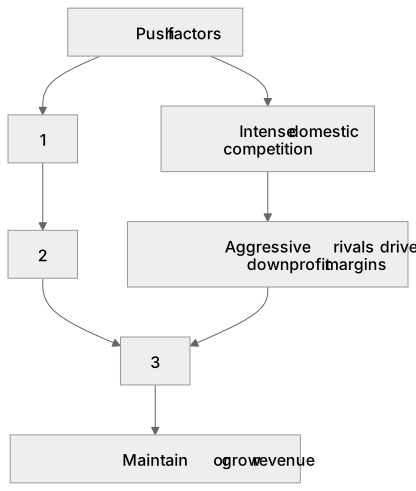
1Box 1
2Box 2
3Box 3
There is more to this lesson
The full lesson goes on to check your understanding and help you earn the marks. Create a free account to carry on, with your progress saved.
A week of Premium from your first lesson · Then the free plan continues · No card, no charge
Test your understanding of Conditions that prompt trade: a) Push factors: o saturated markets o competition
Active recall beats re-reading. Take an instant quiz now to test what you’ve learned and lock it into long-term memory.
A week of Premium from your first lesson · Then the free plan continues · No card, no charge