Pearson Edexcel · A-Level · Economics B
Course version: 9EB0 · Version from Sept 2015
B) Pull factors: o economies of scale o risk spreading
Full specification wording
Conditions that prompt trade: b) Pull factors: o economies of scale o risk spreading
Pull factors are conditions that attract a business to expand into international markets, rather than being pushed out of their domestic market.
Checked against the Pearson Edexcel 9EB0 specification (opens in a new tab) on .
- Point 2 of 5
- 3 key terms
Study notes
From the checked teaching notes for this specification point.
The idea
Pull factors are conditions that attract a business to expand into international markets, rather than being pushed out of their domestic market. One major pull factor is the potential to achieve economies of scale. By entering new markets, a firm can increase its output significantly, which lowers the average cost per unit. For example, a car manufacturer can spread its high fixed costs of research and development over a larger global sales volume. Another key pull factor is risk spreading. Operating in multiple countries means that if one market experiences an economic downturn or a sudden change in consumer tastes, the firm's overall revenue is protected by stable or growing sales in other international markets. This diversification makes the business more resilient to localised shocks.
What earns the marks
- Define pull factors as attractive opportunities in foreign markets that encourage international trade.
- Explain how entering new markets increases output, leading to economies of scale and lower average costs.
- Identify that lower average costs can improve profit margins or allow for more competitive pricing globally.
- Explain risk spreading as the reduction of reliance on a single domestic market.
- Describe how operating in multiple countries protects a firm from localised economic downturns or demand shocks.
Common mistakes and how to put them right
Confusing pull factors with push factors.
Put it right: Pull factors attract a firm to a new market (e.g. economies of scale), whereas push factors drive them away from a domestic market (e.g. saturated local demand).
Assuming economies of scale only relate to manufacturing.
Put it right: Service industries can also achieve economies of scale, such as spreading IT infrastructure costs over a larger global customer base.
Believing risk spreading eliminates all business risk.
Put it right: Risk spreading mitigates localised risks but exposes the firm to new international risks, such as exchange rate fluctuations or global recessions.
Exam tips
- When evaluating the decision to trade internationally, weigh the benefits of economies of scale against the potential diseconomies of scale, such as communication issues.
- Use a specific industry example, like pharmaceuticals or technology, to illustrate how high fixed costs make economies of scale a powerful pull factor.
- Link risk spreading to the concept of the economic cycle, explaining how different countries may be at different stages of the cycle at any given time.
Try the lesson
The start of the Conditions that prompt trade: b) Pull factors: o economies of scale o risk spreading lesson, made from checked teaching notes for this specification point.
Have a go first
Which of the following is an example of a pull factor that encourages a business to trade internationally?
Listen
Pull factors are conditions that attract a business to expand into international markets, rather than being pushed out of their domestic market. One major pull factor is the potential to achieve economies of scale. By entering new markets, a firm can increase its output significantly, which lowers the average cost per unit. For example, a car manufacturer can spread its high fixed costs of research and development over a larger global sales volume. Another key pull factor is risk spreading. Operating in multiple countries means that if one market experiences an economic downturn or a sudden change in consumer tastes, the firm's overall revenue is protected by stable or growing sales in other international markets. This diversification makes the business more resilient to localised shocks. A strong answer earns marks for these points. Define pull factors as attractive opportunities in foreign markets that encourage international trade. Explain how entering new markets increases output, leading to economies of scale and lower average costs. Identify that lower average costs can improve profit margins or allow for more competitive pricing globally. Explain risk spreading as the reduction of reliance on a single domestic market. A common slip: Confusing pull factors with push factors. Instead, Pull factors attract a firm to a new market (e.g. economies of scale), whereas push factors drive them away from a domestic market (e.g. saturated local demand). Exam tip: When evaluating the decision to trade internationally, weigh the benefits of economies of scale against the potential diseconomies of scale, such as communication issues.
See it
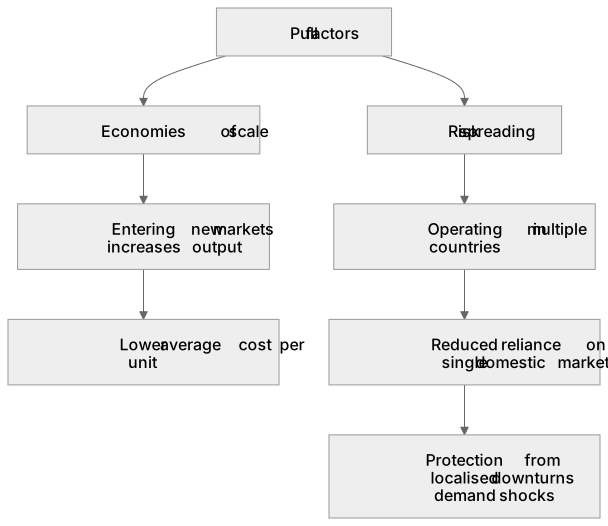
Key words
Say what each word means before you turn the card.
Pull factors
Try answering aloud or in your head before turning the card.
Economies of scale
Try answering aloud or in your head before turning the card.
Risk spreading
Try answering aloud or in your head before turning the card.
See every definition
- Pull factors
- Conditions that attract a business to expand into international markets rather than being pushed out of its domestic market.
- Economies of scale
- A pull factor achieved by entering new markets, where increased output significantly lowers the average cost per unit.
- Risk spreading
- A pull factor where operating in multiple countries protects overall revenue through stable or growing sales in other international markets when one market suffers a downturn or change in consumer tastes.
Label the diagram
Some boxes have lost their names. Pick the right name for each number.
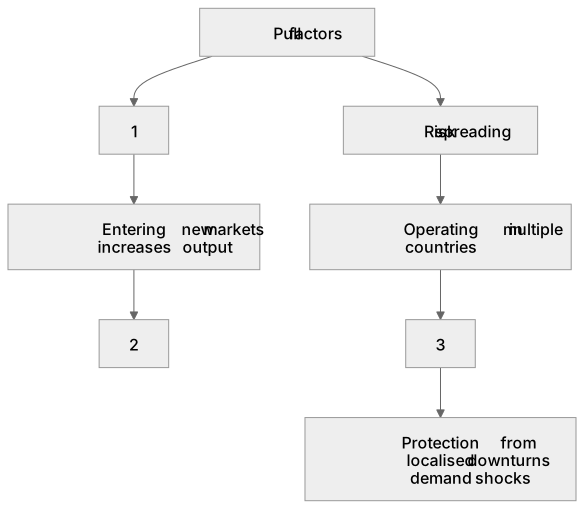
1Box 1
2Box 2
3Box 3
There is more to this lesson
The full lesson goes on to check your understanding and help you earn the marks. Create a free account to carry on, with your progress saved.
A week of Premium from your first lesson · Then the free plan continues · No card, no charge
Test your understanding of Conditions that prompt trade: b) Pull factors: o economies of scale o risk spreading
Active recall beats re-reading. Take an instant quiz now to test what you’ve learned and lock it into long-term memory.
A week of Premium from your first lesson · Then the free plan continues · No card, no charge