Pearson Edexcel · A-Level · Economics B
Course version: 9EB0 · Version from Sept 2015
Conditions that prompt trade: e) Raising capacity utilisation
Full specification wording
Conditions that prompt trade: e) Raising capacity utilisation
Raising capacity utilisation is a key condition prompting firms to engage in international trade.
Checked against the Pearson Edexcel 9EB0 specification (opens in a new tab) on .
- Point 5 of 5
- 4 key terms
Study notes
From the checked teaching notes for this specification point.
The idea
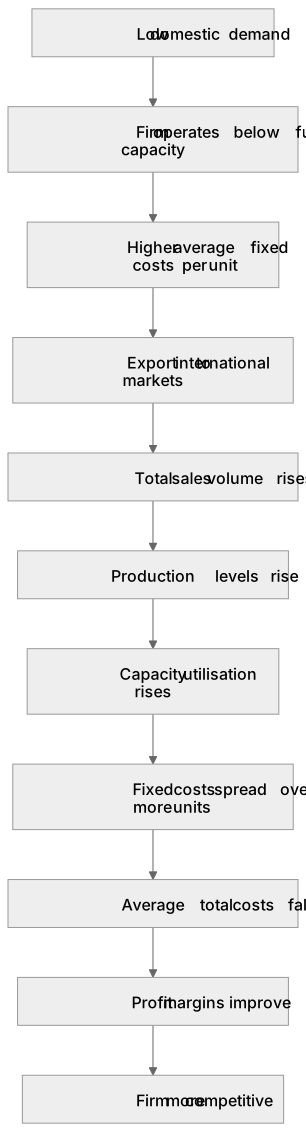
Raising capacity utilisation is a key condition prompting firms to engage in international trade. Capacity utilisation measures the proportion of maximum possible output currently being produced. If a business faces low domestic demand, it operates below full capacity, causing higher average fixed costs per unit. By exporting to international markets, the firm increases production volume to meet overseas demand. For instance, a manufacturer operating at 60% capacity can export goods, pushing utilisation closer to 100%. This spreads fixed costs over a larger number of units, reducing average costs, improving profit margins, and making the firm more competitive without needing new capital investment.
What earns the marks
- Defines capacity utilisation as the current output divided by maximum possible output, expressed as a percentage.
- Explains that exporting increases total sales volume, thereby raising production levels and capacity utilisation.
- Links higher capacity utilisation to the spreading of fixed costs over a greater number of units.
- Concludes that raising capacity utilisation through trade lowers average total costs and increases competitiveness.
Common mistakes and how to put them right
Confusing capacity utilisation with labour productivity.
Put it right: Capacity utilisation refers to the use of existing capital and infrastructure, whereas productivity measures output per worker.
Assuming 100% capacity utilisation is always the ideal target.
Put it right: Operating at exactly 100% leaves no room for maintenance or sudden spikes in demand, which can cause operational stress.
Stating that higher capacity utilisation reduces variable costs.
Put it right: Higher utilisation reduces average fixed costs, while average variable costs may remain constant or even rise if overtime is required.
Exam tips
- Always link an increase in capacity utilisation to a fall in average fixed costs when explaining the benefits of trade.
- Use the formula (Current Output / Maximum Possible Output) × 100 to demonstrate your understanding of the concept.
- Consider the risks of overtrading or supply chain strain if a firm attempts to raise capacity utilisation too quickly via exports.
Try the lesson
The start of the Conditions that prompt trade: e) Raising capacity utilisation lesson, made from checked teaching notes for this specification point.
Have a go first
How does entering international markets typically help a business to raise its capacity utilisation?
Listen
Raising capacity utilisation is a key condition prompting firms to engage in international trade. Capacity utilisation measures the proportion of maximum possible output currently being produced. If a business faces low domestic demand, it operates below full capacity, causing higher average fixed costs per unit. By exporting to international markets, the firm increases production volume to meet overseas demand. For instance, a manufacturer operating at 60% capacity can export goods, pushing utilisation closer to 100%. This spreads fixed costs over a larger number of units, reducing average costs, improving profit margins, and making the firm more competitive without needing new capital investment. A strong answer earns marks for these points. Defines capacity utilisation as the current output divided by maximum possible output, expressed as a percentage. Explains that exporting increases total sales volume, thereby raising production levels and capacity utilisation. Links higher capacity utilisation to the spreading of fixed costs over a greater number of units. Concludes that raising capacity utilisation through trade lowers average total costs and increases competitiveness. A common slip: Confusing capacity utilisation with labour productivity. Instead, capacity utilisation refers to the use of existing capital and infrastructure, whereas productivity measures output per worker. Exam tip: Always link an increase in capacity utilisation to a fall in average fixed costs when explaining the benefits of trade.
See it
Key words
Say what each word means before you turn the card.
Capacity utilisation
Try answering aloud or in your head before turning the card.
Average fixed costs
Try answering aloud or in your head before turning the card.
International competitiveness
Try answering aloud or in your head before turning the card.
Fixed costs
Try answering aloud or in your head before turning the card.
See every definition
- Capacity utilisation
- The proportion of maximum possible output currently being produced, calculated as current output divided by maximum possible output and expressed as a percentage.
- Average fixed costs
- Fixed costs spread over a larger number of units, so that they fall per unit as production volume increases.
- International competitiveness
- The ability of a firm to compete, which improves when lower average costs raise profit margins.
- Fixed costs
- Costs that are spread over a greater number of units when production volume rises, reducing average costs.
Label the diagram
Some boxes have lost their names. Pick the right name for each number.
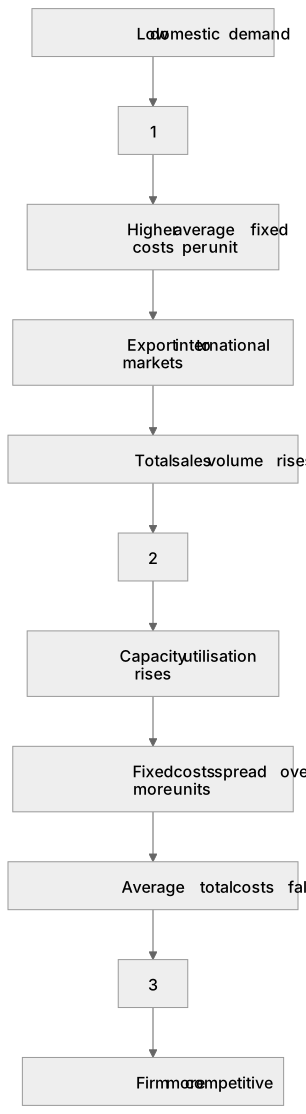
1Box 1
2Box 2
3Box 3
There is more to this lesson
The full lesson goes on to check your understanding and help you earn the marks. Create a free account to carry on, with your progress saved.
A week of Premium from your first lesson · Then the free plan continues · No card, no charge
Test your understanding of Conditions that prompt trade: e) Raising capacity utilisation
Active recall beats re-reading. Take an instant quiz now to test what you’ve learned and lock it into long-term memory.
A week of Premium from your first lesson · Then the free plan continues · No card, no charge