Pearson Edexcel · A-Level · Economics B
Course version: 9EB0 · Version from Sept 2015
D) Extending the product life cycles by selling in multiple markets
Full specification wording
Conditions that prompt trade: d) Extending the product life cycles by selling in multiple markets
Firms often engage in international trade to extend the product life cycle of their goods.
Checked against the Pearson Edexcel 9EB0 specification (opens in a new tab) on .
- Point 4 of 5
- 4 key terms
Study notes
From the checked teaching notes for this specification point.
The idea
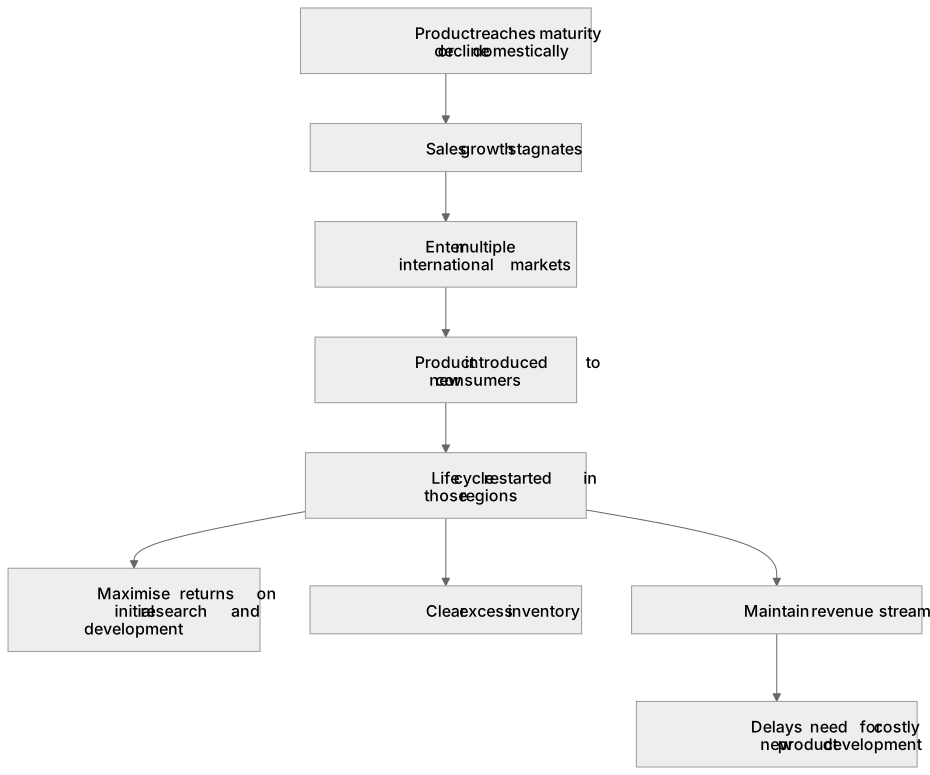
Firms often engage in international trade to extend the product life cycle of their goods. When a product reaches the maturity or decline stage domestically, sales growth stagnates. By entering multiple international markets, a business introduces the product to new consumers, effectively restarting the life cycle in those regions. For example, a smartphone model facing declining sales in the UK due to market saturation might be exported to emerging economies where demand for that technology is just growing. This strategy allows the firm to maximise returns on initial research and development, clear excess inventory, and maintain revenue streams without immediately needing to develop a replacement product.
What earns the marks
- Identifies that entering new international markets can act as an extension strategy for a product in decline.
- Explains that different countries may be at different stages of economic development, creating new demand for older products.
- Links selling in multiple markets to the recovery of research and development costs over a longer period.
- Recognises that extending the product life cycle delays the need for costly new product development.
Common mistakes and how to put them right
Assuming the product life cycle is identical in all global markets.
Put it right: Recognise that a product in decline domestically may be in the introduction or growth phase elsewhere.
Confusing product life cycle extension with product adaptation.
Put it right: Extending the life cycle by selling in multiple markets often involves selling the exact same product to a new demographic, rather than changing the product itself.
Believing that extending the life cycle guarantees increased profit margins.
Put it right: Understand that entering new markets incurs marketing and distribution costs which may offset revenue gains.
Exam tips
- Use a diagram of the product life cycle to illustrate how entering a new market creates a secondary growth phase.
- When evaluating this strategy, consider the costs of market entry against the potential revenue from extending the product's life.
- Link this concept to the saturation of domestic markets as a primary push factor for international trade.
Try the lesson
The start of the Conditions that prompt trade: d) Extending the product life cycles by selling in multiple markets lesson, made from checked teaching notes for this specification point.
Have a go first
Which of the following best describes how selling in multiple international markets can extend a product's life cycle?
Listen
Firms often engage in international trade to extend the product life cycle of their goods. When a product reaches the maturity or decline stage domestically, sales growth stagnates. By entering multiple international markets, a business introduces the product to new consumers, effectively restarting the life cycle in those regions. For example, a smartphone model facing declining sales in the UK due to market saturation might be exported to emerging economies where demand for that technology is just growing. This strategy allows the firm to maximise returns on initial research and development, clear excess inventory, and maintain revenue streams without immediately needing to develop a replacement product. A strong answer earns marks for these points. Identifies that entering new international markets can act as an extension strategy for a product in decline. Explains that different countries may be at different stages of economic development, creating new demand for older products. Links selling in multiple markets to the recovery of research and development costs over a longer period. Recognises that extending the product life cycle delays the need for costly new product development. A common slip: Assuming the product life cycle is identical in all global markets. Instead, recognise that a product in decline domestically may be in the introduction or growth phase elsewhere. Exam tip: Use a diagram of the product life cycle to illustrate how entering a new market creates a secondary growth phase.
See it
Key words
Say what each word means before you turn the card.
International trade
Try answering aloud or in your head before turning the card.
Product life cycle
Try answering aloud or in your head before turning the card.
Market saturation
Try answering aloud or in your head before turning the card.
Extension strategies
Try answering aloud or in your head before turning the card.
See every definition
- International trade
- Firms often engage in this to extend the product life cycle of their goods by entering multiple international markets.
- Product life cycle
- The life of a good, which can be restarted in new regions when a business introduces the product to new consumers there.
- Market saturation
- A condition in which sales growth stagnates, for example when a product reaches the maturity or decline stage domestically.
- Extension strategies
- Entering new international markets can act as one of these for a product in decline.
Label the diagram
Some boxes have lost their names. Pick the right name for each number.
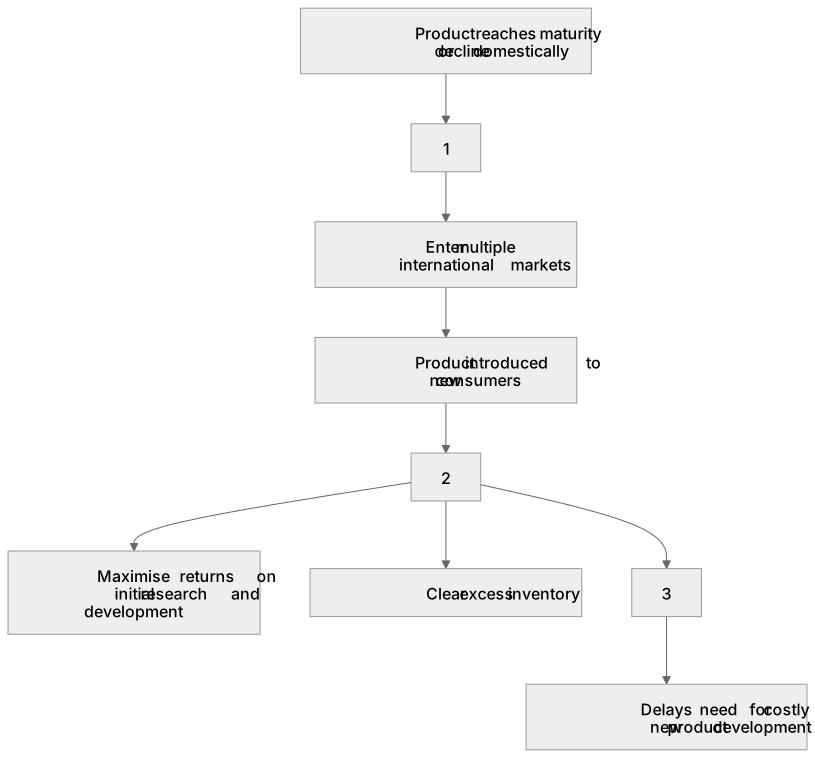
1Box 1
2Box 2
3Box 3
There is more to this lesson
The full lesson goes on to check your understanding and help you earn the marks. Create a free account to carry on, with your progress saved.
A week of Premium from your first lesson · Then the free plan continues · No card, no charge
Test your understanding of Conditions that prompt trade: d) Extending the product life cycles by selling in multiple markets
Active recall beats re-reading. Take an instant quiz now to test what you’ve learned and lock it into long-term memory.
A week of Premium from your first lesson · Then the free plan continues · No card, no charge