Pearson Edexcel · A-Level · Economics B
Course version: 9EB0 · Version from Sept 2015
A) Factors to consider: o political influence o legal control o pressure…
Full specification wording
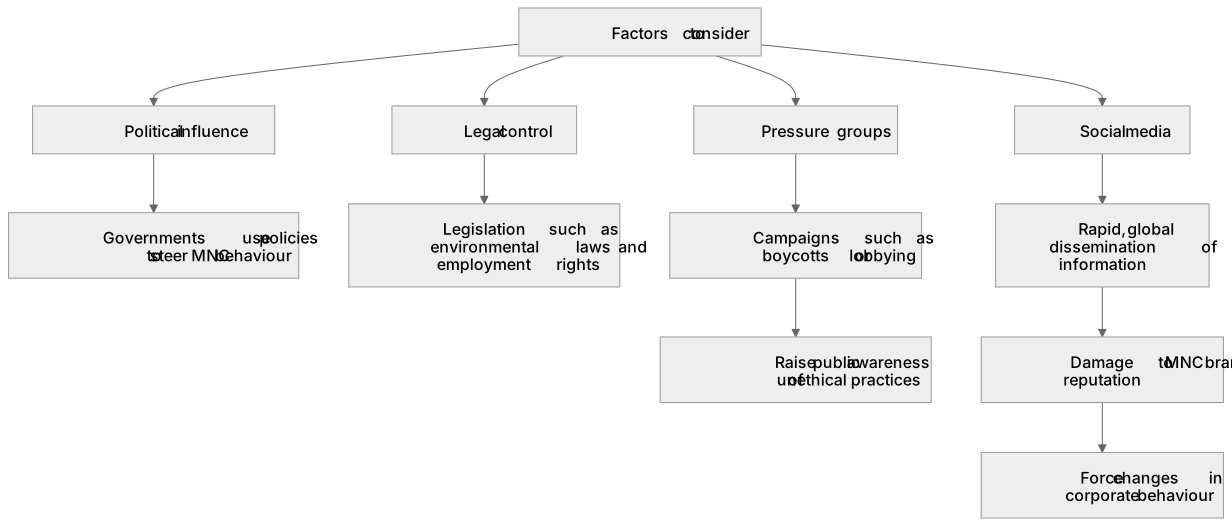
Controlling MNCs: a) Factors to consider: o political influence o legal control o pressure groups o social media
Controlling Multinational Corporations (MNCs) involves various external factors.
Checked against the Pearson Edexcel 9EB0 specification (opens in a new tab) on .
- Point 1 of 2
- 4 key terms
Study notes
From the checked teaching notes for this specification point.
The idea
Controlling Multinational Corporations (MNCs) involves various external factors. Political influence occurs when governments use policies to steer MNC behaviour, though MNCs often hold significant bargaining power due to the jobs they provide. Legal control involves legislation such as environmental laws and employment rights to restrict harmful practices. However, MNCs may exploit regulatory arbitrage by relocating to countries with weaker laws. Pressure groups campaign to change MNC behaviour through boycotts or lobbying, raising public awareness of unethical practices. Social media amplifies these campaigns, allowing rapid, global dissemination of information that can severely damage an MNC's brand reputation and force changes in corporate behaviour.
What earns the marks
- Identify how political influence can restrict MNC operations through taxation or trade barriers.
- Explain the role of legal controls, such as competition law or environmental regulations, in limiting MNC power.
- Evaluate the effectiveness of pressure groups in organising consumer boycotts to force ethical changes.
- Analyse how social media accelerates reputational damage, compelling MNCs to alter their practices.
Common mistakes and how to put them right
Assuming legal controls are universally effective.
Put it right: Recognise that MNCs can move operations to countries with less stringent legal frameworks, known as regulatory arbitrage.
Confusing pressure groups with political parties.
Put it right: Understand that pressure groups seek to influence those in power or corporate behaviour directly, rather than seeking election to government.
Overestimating the power of host governments.
Put it right: Acknowledge that host governments, especially in developing nations, may lack the political influence to control MNCs due to reliance on foreign direct investment.
Exam tips
- Use specific examples of pressure group campaigns or social media backlashes when evaluating controls on MNCs.
- Consider the limitations of legal controls, particularly the difficulty of enforcing domestic laws on global entities.
- Evaluate the balance of power between an MNC and a host country's government when discussing political influence.
Try the lesson
The start of the Controlling MNCs: a) Factors to consider: o political influence o legal control o pressure groups o social media lesson, made from checked teaching notes for this specification point.
Have a go first
Which of the following is an example of a legal control used by a host country to restrict the activities of a multinational corporation (MNC)?
Listen
Controlling Multinational Corporations (MNCs) involves various external factors. Political influence occurs when governments use policies to steer MNC behaviour, though MNCs often hold significant bargaining power due to the jobs they provide. Legal control involves legislation such as environmental laws and employment rights to restrict harmful practices. However, MNCs may exploit regulatory arbitrage by relocating to countries with weaker laws. Pressure groups campaign to change MNC behaviour through boycotts or lobbying, raising public awareness of unethical practices. Social media amplifies these campaigns, allowing rapid, global dissemination of information that can severely damage an MNC's brand reputation and force changes in corporate behaviour. A strong answer earns marks for these points. Identify how political influence can restrict MNC operations through taxation or trade barriers. Explain the role of legal controls, such as competition law or environmental regulations, in limiting MNC power. Evaluate the effectiveness of pressure groups in organising consumer boycotts to force ethical changes. Analyse how social media accelerates reputational damage, compelling MNCs to alter their practices. A common slip: Assuming legal controls are universally effective. Instead, Recognise that MNCs can move operations to countries with less stringent legal frameworks, known as regulatory arbitrage. Exam tip: Use specific examples of pressure group campaigns or social media backlashes when evaluating controls on MNCs.
See it
Key words
Say what each word means before you turn the card.
Political influence
Try answering aloud or in your head before turning the card.
Legal control
Try answering aloud or in your head before turning the card.
Pressure groups
Try answering aloud or in your head before turning the card.
Social media
Try answering aloud or in your head before turning the card.
See every definition
- Political influence
- Occurs when governments use policies to steer MNC behaviour, though MNCs often hold significant bargaining power due to the jobs they provide.
- Legal control
- Involves legislation such as environmental laws and employment rights to restrict harmful practices, though MNCs may exploit regulatory arbitrage by relocating to countries with weaker laws.
- Pressure groups
- Campaign to change MNC behaviour through boycotts or lobbying, raising public awareness of unethical practices.
- Social media
- Amplifies campaigns, allowing rapid, global dissemination of information that can severely damage an MNC's brand reputation and force changes in corporate behaviour.
Label the diagram
Some boxes have lost their names. Pick the right name for each number.
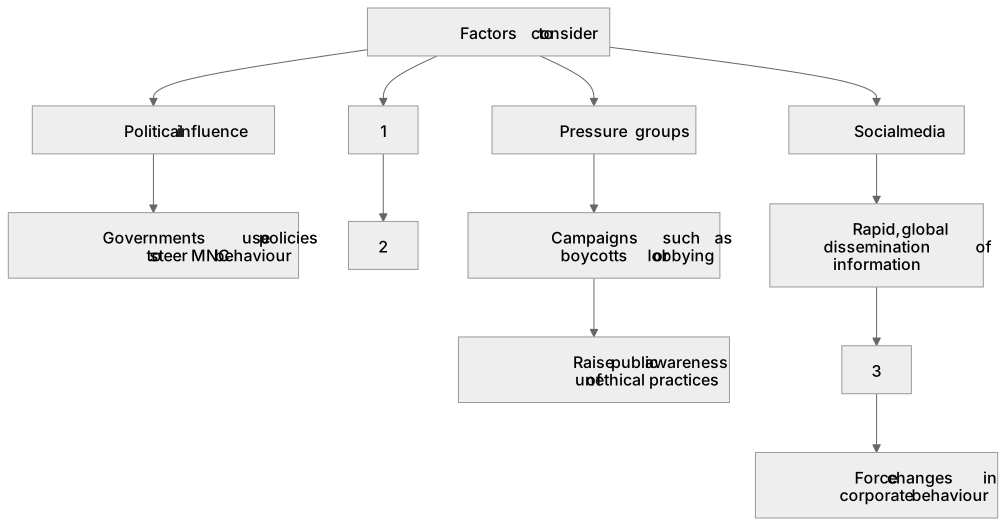
1Box 1
2Box 2
3Box 3
There is more to this lesson
The full lesson goes on to check your understanding and help you earn the marks. Create a free account to carry on, with your progress saved.
A week of Premium from your first lesson · Then the free plan continues · No card, no charge
Test your understanding of Controlling MNCs: a) Factors to consider: o political influence o legal control o pressure groups o social media
Active recall beats re-reading. Take an instant quiz now to test what you’ve learned and lock it into long-term memory.
A week of Premium from your first lesson · Then the free plan continues · No card, no charge