Pearson Edexcel · A-Level · Economics B
Course version: 9EB0 · Version from Sept 2015
Controlling MNCs: b) Self-regulation
Self-regulation occurs when a Multinational Corporation (MNC) voluntarily monitors its adherence to ethical and safety standards, rather than being compelled by external legislation.
Checked against the Pearson Edexcel 9EB0 specification (opens in a new tab) on .
- Point 2 of 2
- 2 key terms
Study notes
From the checked teaching notes for this specification point.
The idea
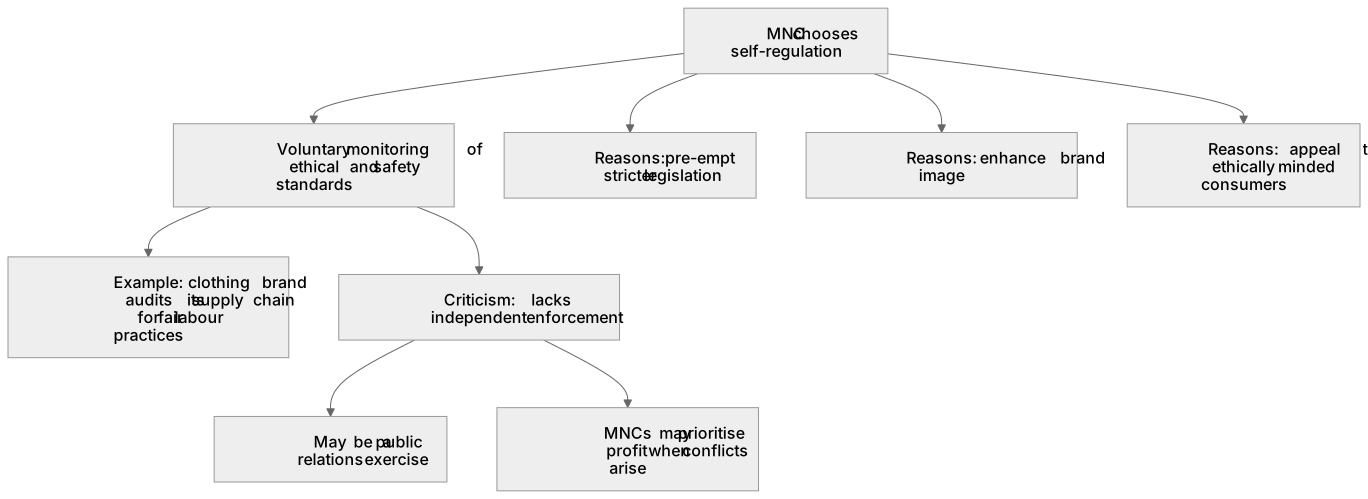
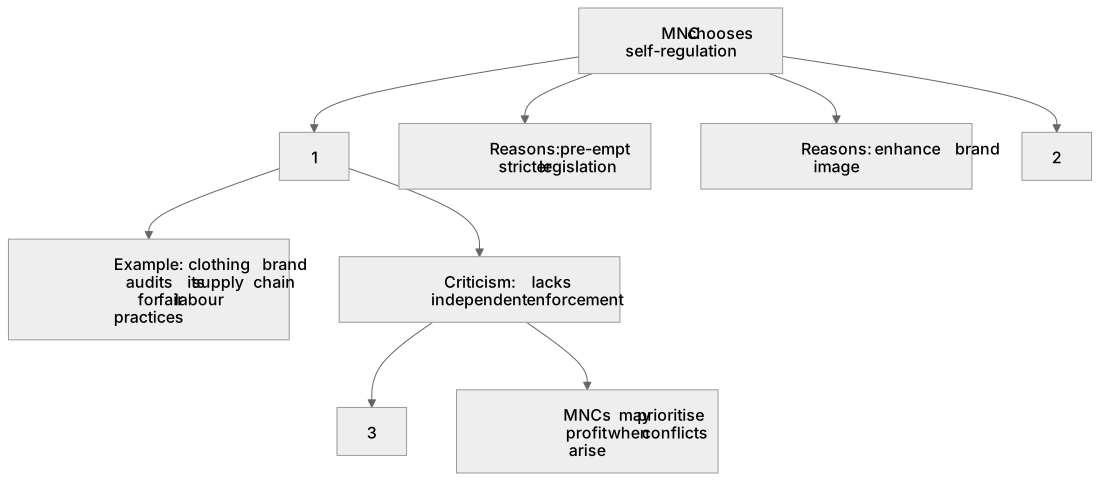
Self-regulation occurs when a Multinational Corporation (MNC) voluntarily monitors its adherence to ethical and safety standards, rather than being compelled by external legislation. This often takes the form of Corporate Social Responsibility (CSR) policies or industry-wide voluntary agreements. An MNC might adopt self-regulation to pre-empt stricter government legislation, enhance its brand image, or appeal to ethically minded consumers. For example, a clothing brand might independently audit its supply chain to ensure fair labour practices. However, critics argue that self-regulation can be a public relations exercise lacking independent enforcement, meaning MNCs may prioritise profit over genuine compliance when conflicts arise.
What earns the marks
- Define self-regulation as voluntary adherence to ethical, environmental, or social standards by an MNC.
- Explain that self-regulation can be used strategically to avoid the imposition of formal legal controls.
- Identify that self-regulation can improve brand loyalty and attract ethical investment.
- Evaluate the limitation that self-regulation lacks independent enforcement and may lead to greenwashing.
Common mistakes and how to put them right
Confusing self-regulation with legal control.
Put it right: Self-regulation is voluntary and internally managed, whereas legal control is enforced by the state.
Assuming self-regulation always leads to ethical behaviour.
Put it right: Recognise that without external audits, self-regulation can be superficial and used primarily for public relations.
Believing self-regulation is legally binding.
Put it right: Understand that voluntary codes of conduct do not carry the same legal penalties as statutory regulations if breached.
Exam tips
- Contrast self-regulation with external legal controls to evaluate which is more effective in controlling MNCs.
- Use the concept of 'greenwashing' to critically assess the motives behind an MNC's self-regulatory policies.
- Discuss how the threat of social media backlash can act as an informal enforcement mechanism for self-regulation.
Try the lesson
The start of the Controlling MNCs: b) Self-regulation lesson, made from checked teaching notes for this specification point.
Have a go first
In the context of controlling multinational corporations, what is meant by the term 'self-regulation'?
Listen
Self-regulation occurs when a Multinational Corporation (MNC) voluntarily monitors its adherence to ethical and safety standards, rather than being compelled by external legislation. This often takes the form of Corporate Social Responsibility (CSR) policies or industry-wide voluntary agreements. An MNC might adopt self-regulation to pre-empt stricter government legislation, enhance its brand image, or appeal to ethically minded consumers. For example, a clothing brand might independently audit its supply chain to ensure fair labour practices. However, critics argue that self-regulation can be a public relations exercise lacking independent enforcement, meaning MNCs may prioritise profit over genuine compliance when conflicts arise. A strong answer earns marks for these points. Define self-regulation as voluntary adherence to ethical, environmental, or social standards by an MNC. Explain that self-regulation can be used strategically to avoid the imposition of formal legal controls. Identify that self-regulation can improve brand loyalty and attract ethical investment. Evaluate the limitation that self-regulation lacks independent enforcement and may lead to greenwashing. A common slip: Confusing self-regulation with legal control. Instead, self-regulation is voluntary and internally managed, whereas legal control is enforced by the state. Exam tip: Contrast self-regulation with external legal controls to evaluate which is more effective in controlling MNCs.
See it
Key words
Say what each word means before you turn the card.
Self-regulation
Try answering aloud or in your head before turning the card.
Corporate Social Responsibility (CSR)
Try answering aloud or in your head before turning the card.
See every definition
- Self-regulation
- When a Multinational Corporation voluntarily monitors its adherence to ethical and safety standards, rather than being compelled by external legislation.
- Corporate Social Responsibility (CSR)
- Policies through which an MNC voluntarily monitors its adherence to ethical and safety standards, often forming the basis of self-regulation.
Label the diagram
Some boxes have lost their names. Pick the right name for each number.
1Box 1
2Box 2
3Box 3
There is more to this lesson
The full lesson goes on to check your understanding and help you earn the marks. Create a free account to carry on, with your progress saved.
A week of Premium from your first lesson · Then the free plan continues · No card, no charge
Test your understanding of Controlling MNCs: b) Self-regulation
Active recall beats re-reading. Take an instant quiz now to test what you’ve learned and lock it into long-term memory.
A week of Premium from your first lesson · Then the free plan continues · No card, no charge