Pearson Edexcel · A-Level · Economics B
Course version: 9EB0 · Version from Sept 2015
Demand: a) Consumer objectives and decisions
In traditional economic theory, the primary objective of consumers is to maximise utility, or satisfaction, from the goods and services they purchase, subject to budget constraints.
Checked against the Pearson Edexcel 9EB0 specification (opens in a new tab) on .
- Point 1 of 4
- 3 key terms
Study notes
From the checked teaching notes for this specification point.
The idea
In traditional economic theory, the primary objective of consumers is to maximise utility, or satisfaction, from the goods and services they purchase, subject to budget constraints. Consumers make rational decisions at the margin, weighing the marginal utility of an additional unit against its opportunity cost. For example, a consumer deciding whether to buy a second coffee considers if the added satisfaction outweighs the benefit of spending that money elsewhere. However, consumer decisions are often influenced by bounded rationality, emotional factors, and social norms, meaning they do not always act as perfect utility maximisers. Understanding these objectives helps firms predict demand curves and set effective pricing strategies.
What earns the marks
- Define utility maximisation as the primary objective of rational consumers.
- Identify how budget constraints limit consumer choices and force trade-offs.
- Explain the concept of opportunity cost in the context of consumer decision-making.
- Recognise that bounded rationality and imperfect information can prevent perfect utility maximisation.
Common mistakes and how to put them right
Assuming consumers always make perfectly rational decisions.
Put it right: Consumers often face bounded rationality due to limited time, information, or cognitive processing ability.
Confusing total utility with marginal utility.
Put it right: Decisions are made based on marginal utility, which is the satisfaction gained from consuming one extra unit, not total utility.
Forgetting that consumer choices are constrained.
Put it right: Factor in the budget constraint and the resulting opportunity cost of any purchase.
Exam tips
- When analysing demand, explicitly state that consumers aim to maximise utility given their limited income.
- Use the concept of opportunity cost to explain why a consumer might choose one product over another.
- Be prepared to contrast traditional rational decision-making with real-world behavioural factors.
Try the lesson
The start of the Demand: a) Consumer objectives and decisions lesson, made from checked teaching notes for this specification point.
Have a go first
In traditional economic theory, what is assumed to be the primary objective of a consumer when making purchasing decisions?
Listen
In traditional economic theory, the primary objective of consumers is to maximise utility, or satisfaction, from the goods and services they purchase, subject to budget constraints. Consumers make rational decisions at the margin, weighing the marginal utility of an additional unit against its opportunity cost. For example, a consumer deciding whether to buy a second coffee considers if the added satisfaction outweighs the benefit of spending that money elsewhere. However, consumer decisions are often influenced by bounded rationality, emotional factors, and social norms, meaning they do not always act as perfect utility maximisers. Understanding these objectives helps firms predict demand curves and set effective pricing strategies. A strong answer earns marks for these points. Define utility maximisation as the primary objective of rational consumers. Identify how budget constraints limit consumer choices and force trade-offs. Explain the concept of opportunity cost in the context of consumer decision-making. Recognise that bounded rationality and imperfect information can prevent perfect utility maximisation. A common slip: Assuming consumers always make perfectly rational decisions. Instead, Consumers often face bounded rationality due to limited time, information, or cognitive processing ability. Exam tip: When analysing demand, explicitly state that consumers aim to maximise utility given their limited income.
See it
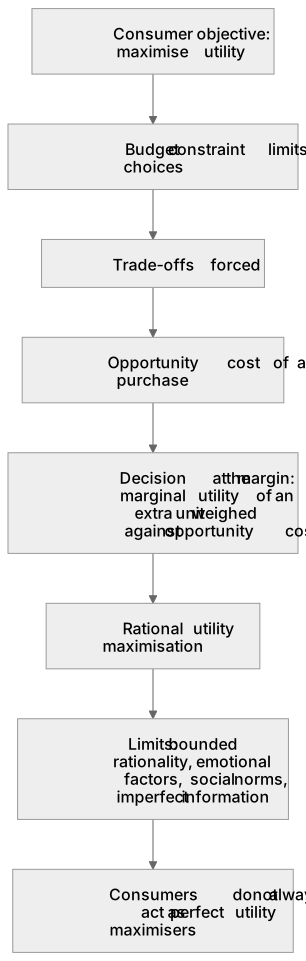
Put it in order
Put these steps in the order they happen.
- 1. Decision at the margin: marginal utility of an extra unit weighed against opportunity cost
- 2. Consumers do not always act as perfect utility maximisers
- 3. Rational utility maximisation
- 4. Consumer objective: maximise utility
- 5. Budget constraint limits choices
- 6. Limits: bounded rationality, emotional factors, social norms, imperfect information
- 7. Trade-offs forced
- 8. Opportunity cost of a purchase
Key words
Say what each word means before you turn the card.
Utility maximisation
Try answering aloud or in your head before turning the card.
Rational decision making
Try answering aloud or in your head before turning the card.
Opportunity cost
Try answering aloud or in your head before turning the card.
See every definition
- Utility maximisation
- The primary objective of consumers in traditional economic theory, being to maximise satisfaction from the goods and services they purchase, subject to budget constraints.
- Rational decision making
- Making decisions at the margin by weighing the marginal utility of an additional unit against its opportunity cost.
- Opportunity cost
- The benefit of spending money elsewhere that a consumer weighs against the marginal utility of an additional unit.
Label the diagram
Some boxes have lost their names. Pick the right name for each number.
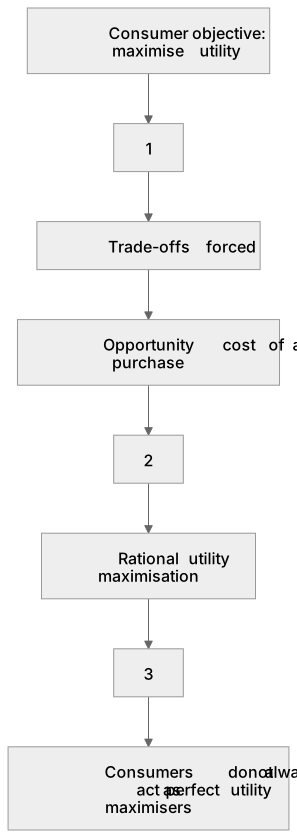
1Box 1
2Box 2
3Box 3
There is more to this lesson
The full lesson goes on to check your understanding and help you earn the marks. Create a free account to carry on, with your progress saved.
A week of Premium from your first lesson · Then the free plan continues · No card, no charge
Test your understanding of Demand: a) Consumer objectives and decisions
Active recall beats re-reading. Take an instant quiz now to test what you’ve learned and lock it into long-term memory.
A week of Premium from your first lesson · Then the free plan continues · No card, no charge