Pearson Edexcel · A-Level · Economics B
Course version: 9EB0 · Version from Sept 2015
A) Cultural/social factors: o cultural differences o different tastes
Full specification wording
Demand-side factors in global markets: a) Cultural/social factors: o cultural differences o different tastes
When expanding globally, businesses must analyse demand-side cultural and social factors influencing consumer behaviour.
Checked against the Pearson Edexcel 9EB0 specification (opens in a new tab) on .
- Point 1 of 3
- 4 key terms
Study notes
From the checked teaching notes for this specification point.
The idea
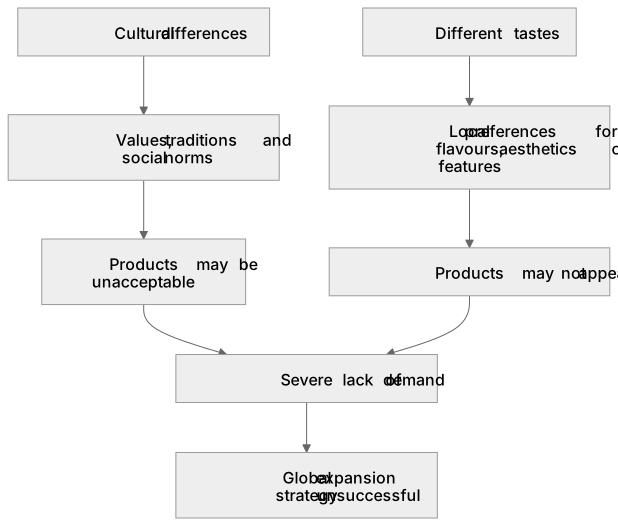
When expanding globally, businesses must analyse demand-side cultural and social factors influencing consumer behaviour. Cultural differences encompass varying values, traditions, and social norms, dictating which products are acceptable. For instance, a clothing line popular in one country might violate modesty norms in another. Different tastes refer to local preferences for flavours, aesthetics, or features. A multinational fast-food chain often adapts its menu to cater to regional tastes, offering spicier or vegetarian alternatives where demanded. Failing to adapt to these cultural differences and distinct consumer tastes can lead to a severe lack of demand, rendering a global expansion strategy entirely unsuccessful.
What earns the marks
- Identify cultural differences that act as barriers or opportunities in global markets.
- Explain how different tastes require product adaptation to maintain demand.
- Analyse the impact of social norms on consumer purchasing decisions.
- Evaluate the cost of adapting products to local tastes against the potential revenue from new markets.
Common mistakes and how to put them right
Assuming that a product successful in a domestic market will automatically appeal to global consumers without adaptation. (Correction.
Put it right: Recognise that cultural differences and different tastes necessitate market research and potential product modification.).
Confusing cultural factors with economic factors like income levels. (Correction.
Put it right: Focus on values, traditions, and preferences rather than purchasing power when discussing cultural and social factors.).
Believing that globalisation has completely homogenised consumer tastes worldwide. (Correction.
Put it right: Acknowledge that while some global brands exist, local tastes and cultural differences remain significant drivers of demand.).
Exam tips
- Use specific examples of multinational companies adapting their products to local tastes to illustrate your points.
- When evaluating global expansion, weigh the benefits of standardisation against the necessity of cultural adaptation.
- Read case study contexts carefully to identify specific cultural or social barriers to demand.
Try the lesson
The start of the Demand-side factors in global markets: a) Cultural/social factors: o cultural differences o different tastes lesson, made from checked teaching notes for this specification point.
Have a go first
Which of the following is a cultural factor that can directly affect the demand for a consumer product in a global market?
Listen
When expanding globally, businesses must analyse demand-side cultural and social factors influencing consumer behaviour. Cultural differences encompass varying values, traditions, and social norms, dictating which products are acceptable. For instance, a clothing line popular in one country might violate modesty norms in another. Different tastes refer to local preferences for flavours, aesthetics, or features. A multinational fast-food chain often adapts its menu to cater to regional tastes, offering spicier or vegetarian alternatives where demanded. Failing to adapt to these cultural differences and distinct consumer tastes can lead to a severe lack of demand, rendering a global expansion strategy entirely unsuccessful. A strong answer earns marks for these points. Identify cultural differences that act as barriers or opportunities in global markets. Explain how different tastes require product adaptation to maintain demand. Analyse the impact of social norms on consumer purchasing decisions. Evaluate the cost of adapting products to local tastes against the potential revenue from new markets. Exam tip: Use specific examples of multinational companies adapting their products to local tastes to illustrate your points.
See it
Key words
Say what each word means before you turn the card.
Cultural differences
Try answering aloud or in your head before turning the card.
Different tastes
Try answering aloud or in your head before turning the card.
Consumer behaviour
Try answering aloud or in your head before turning the card.
Product adaptation
Try answering aloud or in your head before turning the card.
See every definition
- Cultural differences
- Varying values, traditions and social norms that dictate which products are acceptable in a country.
- Different tastes
- Local preferences for flavours, aesthetics or features that a business must cater to.
- Consumer behaviour
- The way demand-side cultural and social factors influence how consumers act in global markets.
- Product adaptation
- Modifying a product to cater to regional tastes, such as offering spicier or vegetarian alternatives where demanded.
Label the diagram
Some boxes have lost their names. Pick the right name for each number.
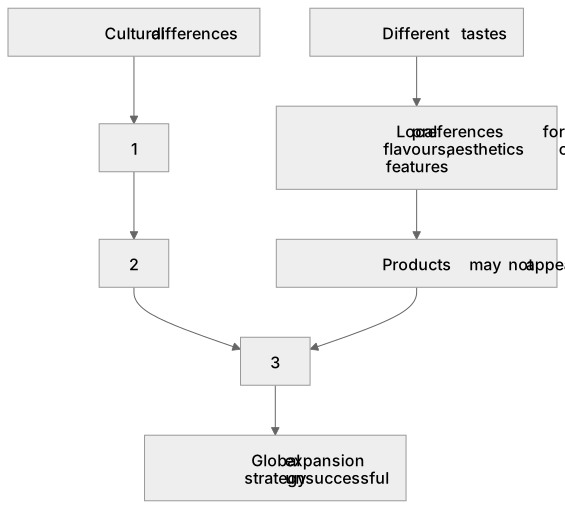
1Box 1
2Box 2
3Box 3
There is more to this lesson
The full lesson goes on to check your understanding and help you earn the marks. Create a free account to carry on, with your progress saved.
A week of Premium from your first lesson · Then the free plan continues · No card, no charge
Test your understanding of Demand-side factors in global markets: a) Cultural/social factors: o cultural differences o different tastes
Active recall beats re-reading. Take an instant quiz now to test what you’ve learned and lock it into long-term memory.
A week of Premium from your first lesson · Then the free plan continues · No card, no charge