Pearson Edexcel · A-Level · Economics B
Course version: 9EB0 · Version from Sept 2015
C) How firms respond to these demand-side factors o adapting marketing…
Full specification wording
Demand-side factors in global markets: c) How firms respond to these demand-side factors o adapting marketing strategies for niche and mass markets
Firms expanding globally must adapt marketing strategies to respond to demand-side factors like cultural differences and income levels.
Checked against the Pearson Edexcel 9EB0 specification (opens in a new tab) on .
- Point 3 of 3
- 4 key terms
Study notes
From the checked teaching notes for this specification point.
The idea
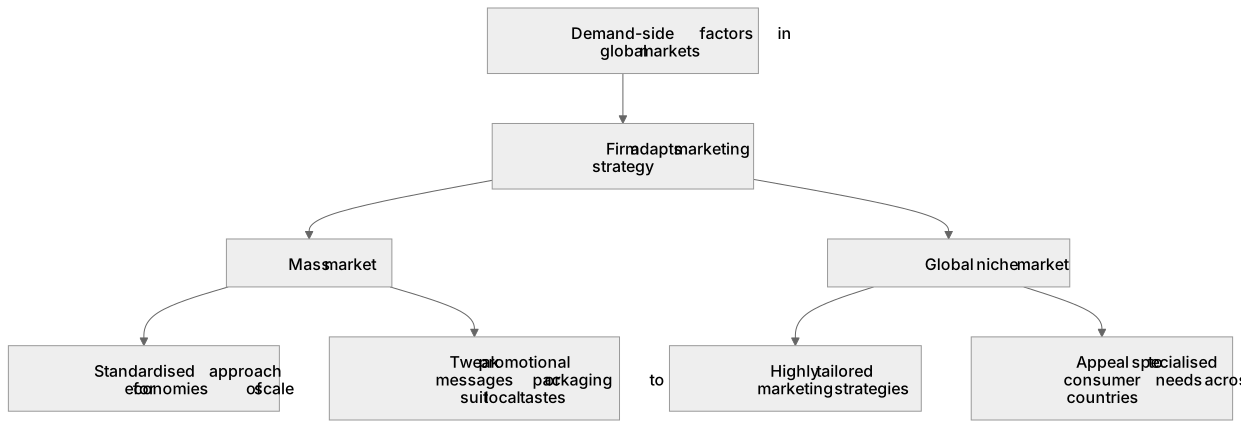
Firms expanding globally must adapt marketing strategies to respond to demand-side factors like cultural differences and income levels. For mass markets, businesses often employ a standardised approach to achieve economies of scale, tweaking promotional messages or packaging to suit local tastes. Conversely, targeting a global niche market requires highly tailored marketing strategies appealing to specialised consumer needs across countries.
For example: A luxury watchmaker (niche) might focus on exclusive promotional events and selective distribution globally, whereas a fast-food chain (mass) might use widespread advertising and adapt its menu to reflect local dietary habits while maintaining its core brand identity.
What earns the marks
- Identify the characteristics of mass and niche markets in a global context.
- Explain how demand-side factors such as culture and demographics necessitate changes to the marketing mix.
- Analyse the benefits of standardising marketing for mass markets to achieve economies of scale.
- Evaluate the necessity of adapting products or promotions to meet specific niche market requirements globally.
Common mistakes and how to put them right
Assuming mass marketing requires no adaptation globally.
Put it right: Even mass market products often require slight localisation in promotion or packaging.
Confusing niche markets with small domestic markets.
Put it right: Global niche markets can be highly profitable and large in absolute terms when aggregated across countries.
Believing that demand-side factors only affect the product.
Put it right: Demand-side factors can influence all elements of the marketing mix, including price, place, and promotion.
Exam tips
- Use the 'glocalisation' concept to explain how mass market firms balance global scale with local adaptation.
- When evaluating marketing strategies, always link the chosen strategy back to the specific demand-side factor mentioned in the case study.
- Contrast the price inelasticity often found in global niche markets with the price sensitivity typical of mass markets.
Try the lesson
The start of the Demand-side factors in global markets: c) How firms respond to these demand-side factors o adapting marketing strategies for niche and mass markets lesson, made from checked teaching notes for this specification point.
Have a go first
Which of the following best describes how a multinational firm might adapt its marketing strategy when targeting a global niche market rather than a mass market?
Listen
Firms expanding globally must adapt marketing strategies to respond to demand-side factors like cultural differences and income levels. For mass markets, businesses often employ a standardised approach to achieve economies of scale, tweaking promotional messages or packaging to suit local tastes. Conversely, targeting a global niche market requires highly tailored marketing strategies appealing to specialised consumer needs across countries. For example, a luxury watchmaker (niche) might focus on exclusive promotional events and selective distribution globally, whereas a fast-food chain (mass) might use widespread advertising and adapt its menu to reflect local dietary habits while maintaining its core brand identity. A strong answer earns marks for these points. Identify the characteristics of mass and niche markets in a global context. Explain how demand-side factors such as culture and demographics necessitate changes to the marketing mix. Analyse the benefits of standardising marketing for mass markets to achieve economies of scale. Evaluate the necessity of adapting products or promotions to meet specific niche market requirements globally. A common slip: Assuming mass marketing requires no adaptation globally. Instead, even mass market products often require slight localisation in promotion or packaging. Exam tip: Use the 'glocalisation' concept to explain how mass market firms balance global scale with local adaptation.
See it
Key words
Say what each word means before you turn the card.
Mass market
Try answering aloud or in your head before turning the card.
Global niche market
Try answering aloud or in your head before turning the card.
Standardisation
Try answering aloud or in your head before turning the card.
Demand-side factors
Try answering aloud or in your head before turning the card.
See every definition
- Mass market
- A market in which businesses often employ a standardised approach to achieve economies of scale, tweaking promotional messages or packaging to suit local tastes.
- Global niche market
- A market requiring highly tailored marketing strategies appealing to specialised consumer needs across countries.
- Standardisation
- An approach used for mass markets to achieve economies of scale, with promotional messages or packaging tweaked to suit local tastes.
- Demand-side factors
- Influences such as cultural differences and income levels to which firms expanding globally must adapt their marketing strategies.
Label the diagram
Some boxes have lost their names. Pick the right name for each number.
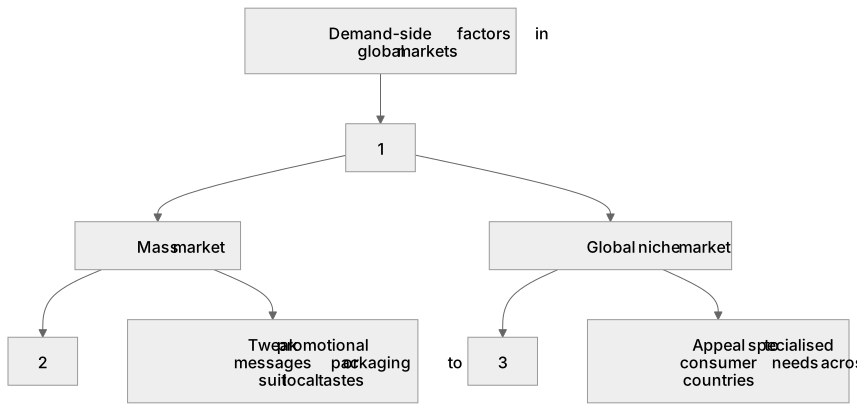
1Box 1
2Box 2
3Box 3
There is more to this lesson
The full lesson goes on to check your understanding and help you earn the marks. Create a free account to carry on, with your progress saved.
A week of Premium from your first lesson · Then the free plan continues · No card, no charge
Test your understanding of Demand-side factors in global markets: c) How firms respond to these demand-side factors o adapting marketing strategies for niche and mass markets
Active recall beats re-reading. Take an instant quiz now to test what you’ve learned and lock it into long-term memory.
A week of Premium from your first lesson · Then the free plan continues · No card, no charge