Pearson Edexcel · A-Level · Economics B
Course version: 9EB0 · Version from Sept 2015
B) Indicators of growth: o GDP per capita o literacy o health o Human…
Full specification wording
Developed, emerging and developing economies: b) Indicators of growth: o GDP per capita o literacy o health o Human Development Index (HDI)
GDP per capita measures average income, calculated as total GDP divided by population.
Checked against the Pearson Edexcel 9EB0 specification (opens in a new tab) on .
- Point 2 of 4
- 4 key terms
Study notes
From the checked teaching notes for this specification point.
The idea
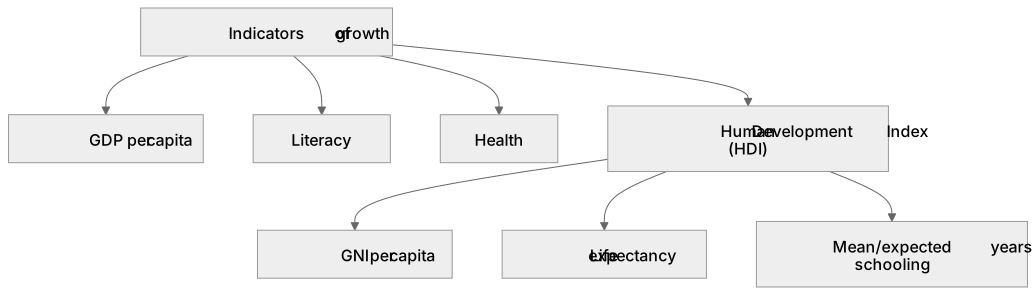
GDP per capita measures average income, calculated as total GDP divided by population. It indicates economic growth but ignores income distribution. Literacy rates (percentage of adults who can read and write) and health indicators (like life expectancy at birth or infant mortality rates) reflect the quality of human capital and standard of living. The Human Development Index (HDI) is a composite measure combining GNI per capita, life expectancy, and mean/expected years of schooling. It provides a broader measure of economic development than GDP alone, scoring countries between 0 and 1.
What earns the marks
- Identify GDP per capita as total economic output divided by population size.
- Recognise that literacy rates indicate the educational attainment and skill level of the workforce.
- Explain how health indicators, such as life expectancy, reflect living standards and healthcare quality.
- Define the HDI as a composite index of life expectancy, education, and per capita income.
- Evaluate the limitations of using single indicators compared to composite measures like the HDI.
Common mistakes and how to put them right
Confusing GDP with GDP per capita.
Put it right: GDP is total output, whereas GDP per capita divides this by the population to show average income.
Assuming HDI includes environmental factors.
Put it right: HDI only measures health, education, and income, ignoring environmental sustainability.
Believing high GDP per capita guarantees high living standards for all.
Put it right: GDP per capita is an average and does not account for income inequality within a country.
Exam tips
- When evaluating growth, always contrast single economic measures like GDP per capita with broader development measures like HDI.
- Remember the three specific components of the HDI: life expectancy, education (mean and expected years of schooling), and GNI per capita.
- Use specific examples of countries where GDP growth has not translated into improved health or literacy to demonstrate analytical depth.
Try the lesson
The start of the Developed, emerging and developing economies: b) Indicators of growth: o GDP per capita o literacy o health o Human Development Index (HDI) lesson, made from checked teaching notes for this specification point.
Have a go first
The Human Development Index (HDI) is a composite statistic used to measure a country's overall achievement in its social and economic dimensions. Which of the following indicators are used to calculate the HDI?
Listen
GDP per capita measures average income, calculated as total GDP divided by population. It indicates economic growth but ignores income distribution. Literacy rates (percentage of adults who can read and write) and health indicators (like life expectancy at birth or infant mortality rates) reflect the quality of human capital and standard of living. The Human Development Index (HDI) is a composite measure combining GNI per capita, life expectancy, and mean/expected years of schooling. It provides a broader measure of economic development than GDP alone, scoring countries between 0 and 1. A strong answer earns marks for these points. Identify GDP per capita as total economic output divided by population size. Recognise that literacy rates indicate the educational attainment and skill level of the workforce. Explain how health indicators, such as life expectancy, reflect living standards and healthcare quality. Define the HDI as a composite index of life expectancy, education, and per capita income. A common slip: Confusing GDP with GDP per capita. Instead, GDP is total output, whereas GDP per capita divides this by the population to show average income. Exam tip: When evaluating growth, always contrast single economic measures like GDP per capita with broader development measures like HDI.
See it
Key words
Say what each word means before you turn the card.
GDP per capita
Try answering aloud or in your head before turning the card.
Literacy rates
Try answering aloud or in your head before turning the card.
Health indicators
Try answering aloud or in your head before turning the card.
Human Development Index (HDI)
Try answering aloud or in your head before turning the card.
See every definition
- GDP per capita
- Total GDP divided by population, measuring average income and indicating economic growth but ignoring income distribution.
- Literacy rates
- The percentage of adults who can read and write, reflecting the quality of human capital and standard of living.
- Health indicators
- Measures such as life expectancy at birth or infant mortality rates that reflect the quality of human capital and standard of living.
- Human Development Index (HDI)
- A composite measure combining GNI per capita, life expectancy, and mean/expected years of schooling, scoring countries between 0 and 1 and providing a broader measure of economic development than GDP alone.
Label the diagram
Some boxes have lost their names. Pick the right name for each number.

1Box 1
2Box 2
3Box 3
There is more to this lesson
The full lesson goes on to check your understanding and help you earn the marks. Create a free account to carry on, with your progress saved.
A week of Premium from your first lesson · Then the free plan continues · No card, no charge
Test your understanding of Developed, emerging and developing economies: b) Indicators of growth: o GDP per capita o literacy o health o Human Development Index (HDI)
Active recall beats re-reading. Take an instant quiz now to test what you’ve learned and lock it into long-term memory.
A week of Premium from your first lesson · Then the free plan continues · No card, no charge