Pearson Edexcel · A-Level · Economics B
Course version: 9EB0 · Version from Sept 2015
C) Just in time (JIT) management of stock
Full specification wording
Efficiency and competitiveness using lean production: c) Just in time (JIT) management of stock
Just in time (JIT) is a lean production method of stock management where materials and components are delivered exactly when they are needed in the production process, rather than being stored in…
Checked against the Pearson Edexcel 9EB0 specification (opens in a new tab) on .
- Point 3 of 4
- 3 key terms
Study notes
From the checked teaching notes for this specification point.
The idea
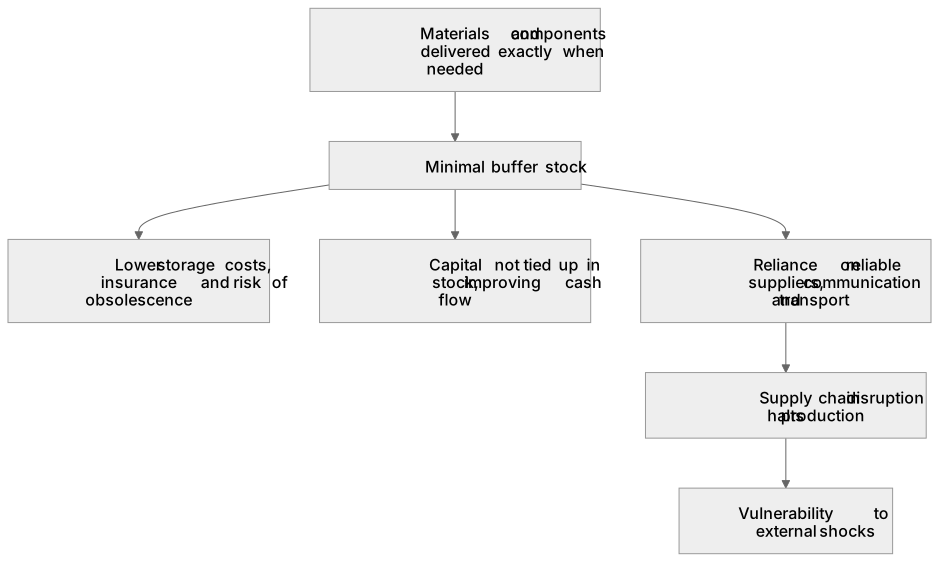
Just in time (JIT) is a lean production method of stock management where materials and components are delivered exactly when they are needed in the production process, rather than being stored in large quantities. This approach minimises buffer stock, significantly reducing storage costs, insurance, and the risk of obsolescence. For example, a car manufacturer using JIT will receive seats from a supplier on the same day they are fitted to the vehicles. However, JIT requires highly reliable suppliers, excellent communication, and robust transport infrastructure. Any disruption in the supply chain can halt production immediately, making the business vulnerable to external shocks like strikes or extreme weather.
What earns the marks
- JIT reduces the need for warehousing space, lowering fixed costs.
- JIT relies heavily on strong, integrated relationships with dependable suppliers.
- A major disadvantage is the lack of buffer stock to handle sudden spikes in demand or supply chain disruptions.
Common mistakes and how to put them right
Believing JIT eliminates all costs.
Put it right: JIT reduces storage costs but may increase transport and ordering costs due to more frequent, smaller deliveries.
Confusing JIT with just-in-case (JIC) stock management.
Put it right: JIC holds buffer stocks to mitigate risk, whereas JIT aims for zero buffer stock.
Assuming JIT is suitable for all businesses.
Put it right: JIT is risky for businesses with unpredictable demand or unreliable supply chains.
Exam tips
- Always link JIT to its impact on cash flow and working capital in your answers.
- Evaluate the risks of JIT by considering external factors like transport strikes or global supply chain issues.
- Use a specific industry example, such as automotive manufacturing, to illustrate how JIT operates in practice.
Try the lesson
The start of the Efficiency and competitiveness using lean production: c) Just in time (JIT) management of stock lesson, made from checked teaching notes for this specification point.
Have a go first
What is the main objective of a Just in Time (JIT) stock management system?
Listen
Just in time (JIT) is a lean production method of stock management where materials and components are delivered exactly when they are needed in the production process, rather than being stored in large quantities. This approach minimises buffer stock, significantly reducing storage costs, insurance, and the risk of obsolescence. For example, a car manufacturer using JIT will receive seats from a supplier on the same day they are fitted to the vehicles. However, JIT requires highly reliable suppliers, excellent communication, and robust transport infrastructure. Any disruption in the supply chain can halt production immediately, making the business vulnerable to external shocks like strikes or extreme weather. A strong answer earns marks for these points. JIT reduces the need for warehousing space, lowering fixed costs. JIT relies heavily on strong, integrated relationships with dependable suppliers. A major disadvantage is the lack of buffer stock to handle sudden spikes in demand or supply chain disruptions. A common slip: Believing JIT eliminates all costs. Instead, JIT reduces storage costs but may increase transport and ordering costs due to more frequent, smaller deliveries. Exam tip: Always link JIT to its impact on cash flow and working capital in your answers.
See it
Key words
Say what each word means before you turn the card.
Just in time (JIT)
Try answering aloud or in your head before turning the card.
Buffer stock
Try answering aloud or in your head before turning the card.
Lean production
Try answering aloud or in your head before turning the card.
See every definition
- Just in time (JIT)
- A lean production method of stock management where materials and components are delivered exactly when they are needed in the production process, rather than being stored in large quantities.
- Buffer stock
- Stock held in reserve; JIT aims for zero buffer stock, so a lack of it leaves a business unable to handle sudden spikes in demand or supply chain disruptions.
- Lean production
- The approach to production under which just in time is a method of stock management.
Label the diagram
Some boxes have lost their names. Pick the right name for each number.
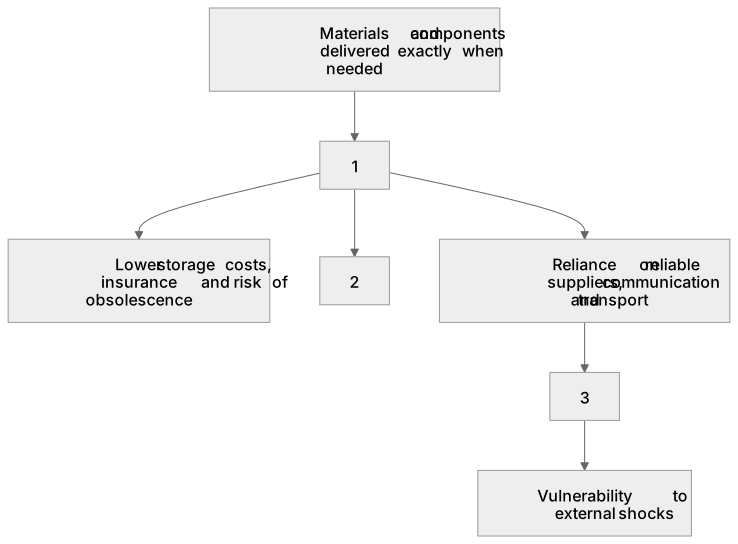
1Box 1
2Box 2
3Box 3
There is more to this lesson
The full lesson goes on to check your understanding and help you earn the marks. Create a free account to carry on, with your progress saved.
A week of Premium from your first lesson · Then the free plan continues · No card, no charge
Test your understanding of Efficiency and competitiveness using lean production: c) Just in time (JIT) management of stock
Active recall beats re-reading. Take an instant quiz now to test what you’ve learned and lock it into long-term memory.
A week of Premium from your first lesson · Then the free plan continues · No card, no charge