Pearson Edexcel · A-Level · Economics B
Course version: 9EB0 · Version from Sept 2015
D) Competitive advantage from lean production
Full specification wording
Efficiency and competitiveness using lean production: d) Competitive advantage from lean production
Lean production techniques, such as Just in time (JIT), Kaizen, and Total Quality Management (TQM), aim to eliminate waste and improve efficiency.
Checked against the Pearson Edexcel 9EB0 specification (opens in a new tab) on .
- Point 4 of 4
- 4 key terms
Study notes
From the checked teaching notes for this specification point.
The idea
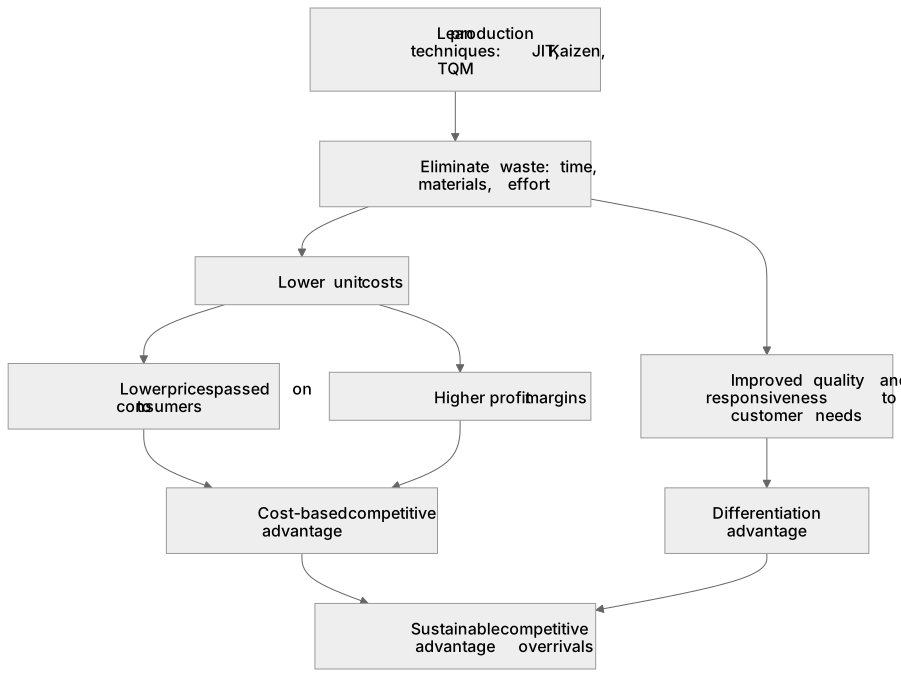
Lean production techniques, such as Just in time (JIT), Kaizen, and Total Quality Management (TQM), aim to eliminate waste and improve efficiency. By reducing waste (time, materials, and effort), a business can significantly lower its unit costs. This cost reduction can be passed on to consumers through lower prices, creating a cost-based competitive advantage. Alternatively, the business can maintain prices and enjoy higher profit margins. Furthermore, lean production often improves product quality and responsiveness to customer needs, fostering a differentiation advantage. For instance, a technology firm using lean methods can bring updated products to market faster than rivals, securing greater market share and customer loyalty.
What earns the marks
- Lean production reduces unit costs by minimising waste, allowing for competitive pricing.
- Improved efficiency can lead to faster delivery times, enhancing customer satisfaction.
- Higher quality standards achieved through lean methods reduce defect rates and returns.
- The combination of lower costs and higher quality creates a sustainable competitive advantage over rivals.
Common mistakes and how to put them right
Assuming lean production only benefits the business through cost cutting.
Put it right: Lean production also enhances quality and customer responsiveness, which are key to competitive advantage.
Stating that lean production guarantees a competitive advantage.
Put it right: Competitive advantage is relative; if all competitors adopt lean methods, the advantage is neutralised.
Confusing lean production with mass production.
Put it right: Mass production focuses on volume and economies of scale, while lean production focuses on waste reduction and flexibility.
Exam tips
- Connect lean production methods directly to specific types of competitive advantage, such as cost leadership or differentiation.
- Discuss the impact of lean production on both price and non-price competition.
- Consider the short-term costs of implementing lean production against the long-term competitive benefits.
Try the lesson
The start of the Efficiency and competitiveness using lean production: d) Competitive advantage from lean production lesson, made from checked teaching notes for this specification point.
Have a go first
How does implementing lean production techniques, such as Just-In-Time (JIT) inventory management, primarily create a competitive advantage for a manufacturing firm?
Listen
Lean production techniques, such as Just in time (JIT), Kaizen, and Total Quality Management (TQM), aim to eliminate waste and improve efficiency. By reducing waste (time, materials, and effort), a business can significantly lower its unit costs. This cost reduction can be passed on to consumers through lower prices, creating a cost-based competitive advantage. Alternatively, the business can maintain prices and enjoy higher profit margins. Furthermore, lean production often improves product quality and responsiveness to customer needs, fostering a differentiation advantage. For instance, a technology firm using lean methods can bring updated products to market faster than rivals, securing greater market share and customer loyalty. A strong answer earns marks for these points. Lean production reduces unit costs by minimising waste, allowing for competitive pricing. Improved efficiency can lead to faster delivery times, enhancing customer satisfaction. Higher quality standards achieved through lean methods reduce defect rates and returns. The combination of lower costs and higher quality creates a sustainable competitive advantage over rivals. A common slip: Assuming lean production only benefits the business through cost cutting. Instead, Lean production also enhances quality and customer responsiveness, which are key to competitive advantage. Exam tip: Connect lean production methods directly to specific types of competitive advantage, such as cost leadership or differentiation.
See it
Key words
Say what each word means before you turn the card.
Competitive advantage
Try answering aloud or in your head before turning the card.
Efficiency
Try answering aloud or in your head before turning the card.
Waste reduction
Try answering aloud or in your head before turning the card.
Quality management
Try answering aloud or in your head before turning the card.
See every definition
- Competitive advantage
- An edge over rivals that can be cost-based, through lower prices, or based on differentiation, through improved quality and responsiveness to customer needs.
- Efficiency
- Improved by lean production techniques, which aim to eliminate waste of time, materials and effort.
- Waste reduction
- Minimising time, materials and effort, which allows a business to lower its unit costs significantly.
- Quality management
- Total Quality Management is a lean production technique that, along with lean methods, often improves product quality and reduces defect rates and returns.
Label the diagram
Some boxes have lost their names. Pick the right name for each number.
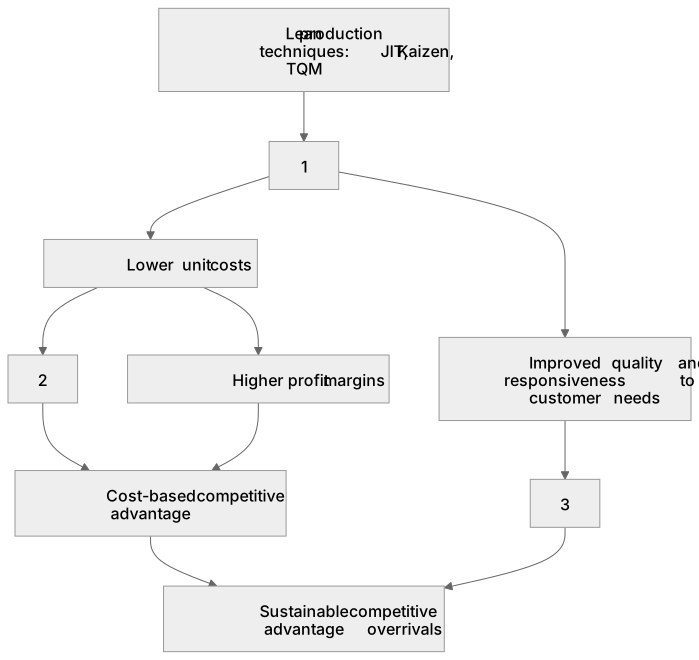
1Box 1
2Box 2
3Box 3
There is more to this lesson
The full lesson goes on to check your understanding and help you earn the marks. Create a free account to carry on, with your progress saved.
A week of Premium from your first lesson · Then the free plan continues · No card, no charge
Test your understanding of Efficiency and competitiveness using lean production: d) Competitive advantage from lean production
Active recall beats re-reading. Take an instant quiz now to test what you’ve learned and lock it into long-term memory.
A week of Premium from your first lesson · Then the free plan continues · No card, no charge