Pearson Edexcel · A-Level · Economics B
Course version: 9EB0 · Version from Sept 2015
Employment and unemployment: a) Employment, underemployment and unemployment
Full specification wording
Employment and unemployment: a) Employment, underemployment and unemployment
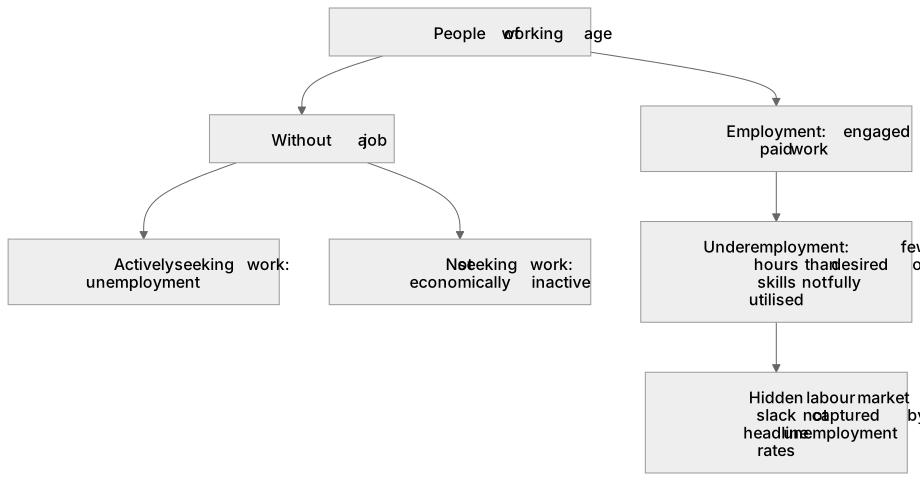
Employment refers to individuals of working age engaged in paid work.
Checked against the Pearson Edexcel 9EB0 specification (opens in a new tab) on .
- Point 1 of 4
- 4 key terms
Study notes
From the checked teaching notes for this specification point.
The idea
Employment refers to individuals of working age engaged in paid work. Unemployment occurs when people of working age are actively seeking work but cannot find a job. Underemployment is a crucial intermediate concept: it describes workers who are employed but working fewer hours than they would like, such as a part-time retail assistant wanting full-time hours, or those in jobs that do not fully utilise their skills, like a graduate working as a barista. Understanding these three states is essential for analysing labour market health. High employment indicates a strong economy, while high unemployment suggests wasted resources. Underemployment often masks the true extent of labour market slack, as employment figures might look healthy even if many workers are underutilised.
What earns the marks
- Define employment as the number of people of working age engaged in paid work.
- Define unemployment as those of working age without a job who are actively seeking work.
- Define underemployment as workers who are overqualified for their current role or working fewer hours than desired.
- Explain that underemployment represents hidden slack in the labour market not captured by headline unemployment rates.
Common mistakes and how to put them right
Confusing unemployment with economic inactivity.
Put it right: Unemployment requires the individual to be actively seeking work, whereas the economically inactive are not looking for a job.
Assuming underemployment only refers to part-time workers.
Put it right: Underemployment also includes full-time workers whose skills are not fully utilised in their current role.
Believing that a fall in unemployment always means a rise in employment.
Put it right: Unemployment can fall if people leave the labour force and become economically inactive.
Exam tips
- Always specify that unemployment involves being 'actively seeking work' to distinguish it from economic inactivity.
- Use underemployment as an evaluative point when discussing the limitations of headline employment statistics.
- Remember that the rise of the gig economy and zero-hour contracts has significantly increased underemployment in recent years.
Try the lesson
The start of the Employment and unemployment: a) Employment, underemployment and unemployment lesson, made from checked teaching notes for this specification point.
Have a go first
Which of the following individuals is officially classified as underemployed?
Listen
Employment refers to individuals of working age engaged in paid work. Unemployment occurs when people of working age are actively seeking work but cannot find a job. Underemployment is a crucial intermediate concept: it describes workers who are employed but working fewer hours than they would like, such as a part-time retail assistant wanting full-time hours, or those in jobs that do not fully utilise their skills, like a graduate working as a barista. Understanding these three states is essential for analysing labour market health. High employment indicates a strong economy, while high unemployment suggests wasted resources. Underemployment often masks the true extent of labour market slack, as employment figures might look healthy even if many workers are underutilised. A strong answer earns marks for these points. Define employment as the number of people of working age engaged in paid work. Define unemployment as those of working age without a job who are actively seeking work. Define underemployment as workers who are overqualified for their current role or working fewer hours than desired. Explain that underemployment represents hidden slack in the labour market not captured by headline unemployment rates. A common slip: Confusing unemployment with economic inactivity. Instead, unemployment requires the individual to be actively seeking work, whereas the economically inactive are not looking for a job. Exam tip: Always specify that unemployment involves being 'actively seeking work' to distinguish it from economic inactivity.
See it
Key words
Say what each word means before you turn the card.
Employment
Try answering aloud or in your head before turning the card.
Unemployment
Try answering aloud or in your head before turning the card.
Underemployment
Try answering aloud or in your head before turning the card.
Labour market slack
Try answering aloud or in your head before turning the card.
See every definition
- Employment
- The number of people of working age engaged in paid work.
- Unemployment
- People of working age without a job who are actively seeking work.
- Underemployment
- Workers who are overqualified for their current role or working fewer hours than desired.
- Labour market slack
- Hidden underutilisation of workers that is not captured by headline unemployment rates.
Label the diagram
Some boxes have lost their names. Pick the right name for each number.
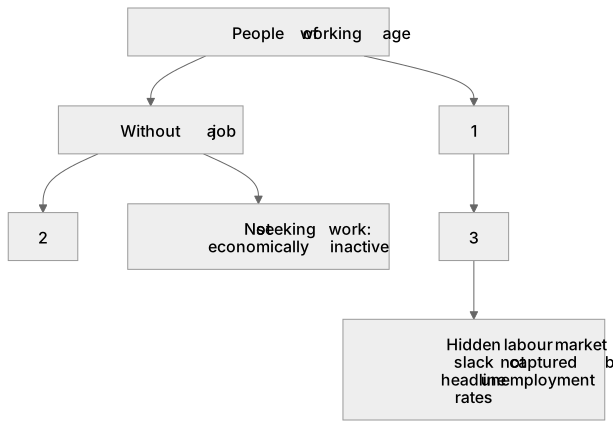
1Box 1
2Box 2
3Box 3
There is more to this lesson
The full lesson goes on to check your understanding and help you earn the marks. Create a free account to carry on, with your progress saved.
A week of Premium from your first lesson · Then the free plan continues · No card, no charge
Test your understanding of Employment and unemployment: a) Employment, underemployment and unemployment
Active recall beats re-reading. Take an instant quiz now to test what you’ve learned and lock it into long-term memory.
A week of Premium from your first lesson · Then the free plan continues · No card, no charge