Pearson Edexcel · A-Level · Economics B
Course version: 9EB0 · Version from Sept 2015
B) Measures of unemployment: o the claimant count o the International…
Full specification wording
Employment and unemployment: b) Measures of unemployment: o the claimant count o the International Labour Organisation (ILO) measure
The UK uses two main measures of unemployment: the Claimant Count and the International Labour Organisation (ILO) measure.
Checked against the Pearson Edexcel 9EB0 specification (opens in a new tab) on .
- Point 2 of 4
- 3 key terms
Study notes
From the checked teaching notes for this specification point.
The idea
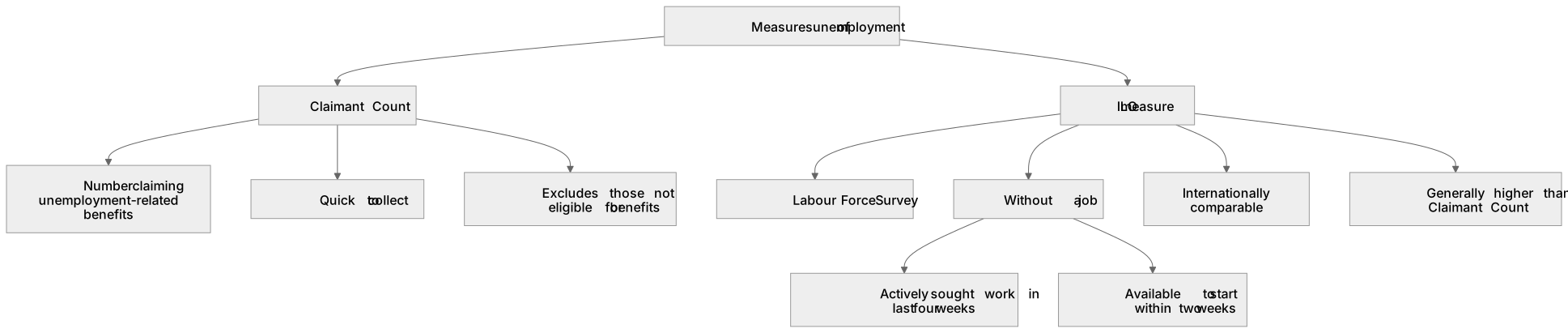
The UK uses two main measures of unemployment: the Claimant Count and the International Labour Organisation (ILO) measure. The Claimant Count records the number of people claiming unemployment-related benefits, such as Jobseeker's Allowance. It is quick to collect but excludes those not eligible for benefits. The ILO measure, gathered via the Labour Force Survey, defines unemployment as someone without a job who has actively sought work in the last four weeks and is available to start within two weeks. The ILO measure is internationally comparable and generally yields a higher figure than the Claimant Count, as it includes individuals seeking work who cannot claim government benefits, such as partners of high earners or students looking for part-time work.
What earns the marks
- Identify the Claimant Count as a measure based on the number of people claiming unemployment benefits.
- Identify the ILO measure as a survey-based measure defining unemployment by active search and availability.
- State the ILO criteria: actively sought work in the past four weeks and available to start within two weeks.
- Compare the two measures, noting that the ILO measure is usually higher because not all unemployed people claim benefits.
Common mistakes and how to put them right
Assuming the Claimant Count and the ILO measure produce the same figure.
Put it right: The ILO measure is typically higher because it includes job seekers who are ineligible for benefits.
Believing the Claimant Count is internationally comparable.
Put it right: Benefit systems vary wildly between countries, making the ILO measure the standard for international comparisons.
Forgetting the specific timeframes of the ILO measure.
Put it right: The ILO definition strictly requires having looked for work in the last four weeks and being available to start in two weeks.
Exam tips
- When evaluating unemployment data, mention that the ILO measure is subject to sampling errors because it relies on a survey.
- Use the difference between the Claimant Count and the ILO measure to discuss the strictness of the welfare system.
- Memorise the exact timeframes (four weeks looking, two weeks to start) for the ILO definition, as these are frequently tested in multiple-choice questions.
Try the lesson
The start of the Employment and unemployment: b) Measures of unemployment: o the claimant count o the International Labour Organisation (ILO) measure lesson, made from checked teaching notes for this specification point.
Have a go first
What is the primary difference between the Claimant Count and the International Labour Organisation (ILO) measure of unemployment in the UK?
Listen
The UK uses two main measures of unemployment: the Claimant Count and the International Labour Organisation (ILO) measure. The Claimant Count records the number of people claiming unemployment-related benefits, such as Jobseeker's Allowance. It is quick to collect but excludes those not eligible for benefits. The ILO measure, gathered via the Labour Force Survey, defines unemployment as someone without a job who has actively sought work in the last four weeks and is available to start within two weeks. The ILO measure is internationally comparable and generally yields a higher figure than the Claimant Count, as it includes individuals seeking work who cannot claim government benefits, such as partners of high earners or students looking for part-time work. A strong answer earns marks for these points. Identify the Claimant Count as a measure based on the number of people claiming unemployment benefits. Identify the ILO measure as a survey-based measure defining unemployment by active search and availability. State the ILO criteria: actively sought work in the past four weeks and available to start within two weeks. Compare the two measures, noting that the ILO measure is usually higher because not all unemployed people claim benefits. A common slip: Assuming the Claimant Count and the ILO measure produce the same figure. Instead, the ILO measure is typically higher because it includes job seekers who are ineligible for benefits. Exam tip: When evaluating unemployment data, mention that the ILO measure is subject to sampling errors because it relies on a survey.
See it
Key words
Say what each word means before you turn the card.
Claimant Count
Try answering aloud or in your head before turning the card.
ILO measure
Try answering aloud or in your head before turning the card.
International comparisons
Try answering aloud or in your head before turning the card.
See every definition
- Claimant Count
- A measure recording the number of people claiming unemployment-related benefits, such as Jobseeker's Allowance.
- ILO measure
- A survey-based measure, gathered via the Labour Force Survey, defining unemployment as someone without a job who has actively sought work in the last four weeks and is available to start within two weeks.
- International comparisons
- Comparing unemployment figures between countries, for which the ILO measure is the standard because benefit systems vary wildly between countries.
Label the diagram
Some boxes have lost their names. Pick the right name for each number.
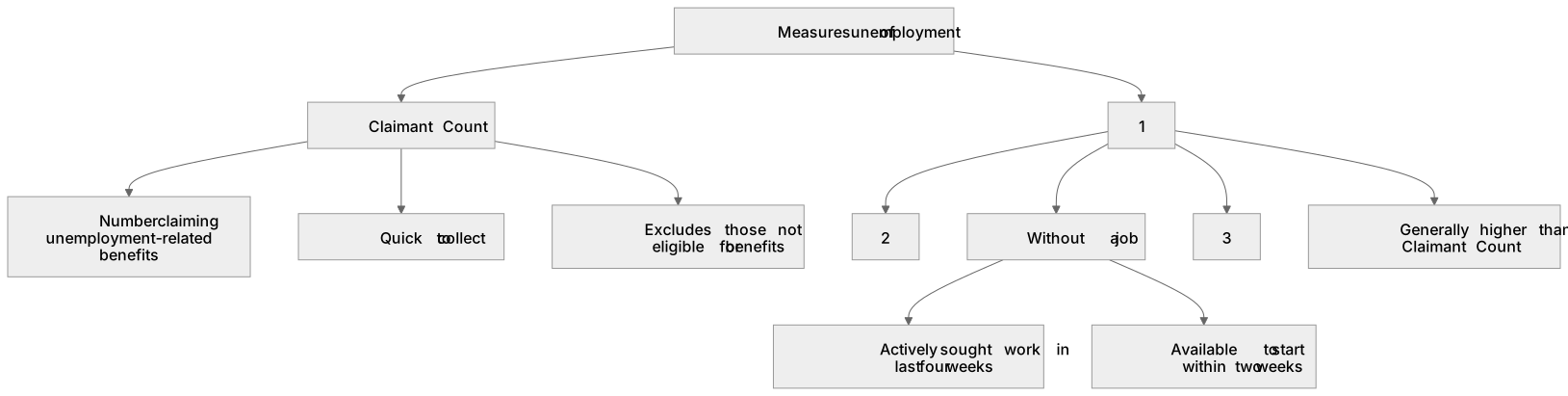
1Box 1
2Box 2
3Box 3
There is more to this lesson
The full lesson goes on to check your understanding and help you earn the marks. Create a free account to carry on, with your progress saved.
A week of Premium from your first lesson · Then the free plan continues · No card, no charge
Test your understanding of Employment and unemployment: b) Measures of unemployment: o the claimant count o the International Labour Organisation (ILO) measure
Active recall beats re-reading. Take an instant quiz now to test what you’ve learned and lock it into long-term memory.
A week of Premium from your first lesson · Then the free plan continues · No card, no charge