Pearson Edexcel · A-Level · Economics B
Course version: 9EB0 · Version from Sept 2015
D) The impact of unemployment on firms and individuals
Full specification wording
Employment and unemployment: d) The impact of unemployment on firms and individuals
Unemployment has profound and contrasting impacts on both firms and individuals.
Checked against the Pearson Edexcel 9EB0 specification (opens in a new tab) on .
- Point 4 of 4
Study notes
From the checked teaching notes for this specification point.
The idea
Unemployment has profound and contrasting impacts on both firms and individuals. For individuals, job loss leads to an immediate fall in income and living standards, often causing psychological distress, loss of status, and a deterioration in skills (hysteresis) if they remain out of work for extended periods. This makes future re-employment harder. For firms, the impact is mixed. High unemployment reduces aggregate demand, meaning businesses selling income-elastic goods may see falling sales and profits. However, a larger pool of unemployed workers increases the labour supply, allowing firms to recruit more easily and potentially suppress wage growth, thereby reducing their operating costs and increasing competitiveness.
What earns the marks
- Explain that individuals suffer a loss of income, leading to reduced living standards and potential debt accumulation.
- Identify the long-term scarring effects on individuals, including loss of skills and reduced employability over time.
- Analyse how high unemployment can benefit firms by increasing the pool of available labour and reducing upward pressure on wages.
- Evaluate the negative impact on firms through reduced consumer spending, particularly for businesses selling normal or luxury goods.
Common mistakes and how to put them right
Assuming unemployment is entirely negative for all economic agents.
Put it right: Firms may benefit from lower wage demands and easier recruitment when unemployment is high.
Stating that all firms lose sales equally during periods of high unemployment.
Put it right: Firms selling inferior goods may actually see an increase in sales as consumer incomes fall.
Ignoring the non-financial impacts on individuals.
Put it right: Consider social and psychological effects, such as deteriorating mental health and loss of motivation.
Exam tips
- Differentiate between the short-term and long-term impacts of unemployment on an individual's earning potential and skill level.
- Use the concept of income elasticity of demand to explain which firms are most negatively affected by rising unemployment.
- When evaluating the impact on firms, contrast the benefit of lower wage costs against the drawback of reduced aggregate demand.
Try the lesson
The start of the Employment and unemployment: d) The impact of unemployment on firms and individuals lesson, made from checked teaching notes for this specification point.
Have a go first
Which of the following is a direct financial impact of long-term unemployment on an individual?
Listen
Unemployment has profound and contrasting impacts on both firms and individuals. For individuals, job loss leads to an immediate fall in income and living standards, often causing psychological distress, loss of status, and a deterioration in skills (hysteresis) if they remain out of work for extended periods. This makes future re-employment harder. For firms, the impact is mixed. High unemployment reduces aggregate demand, meaning businesses selling income-elastic goods may see falling sales and profits. However, a larger pool of unemployed workers increases the labour supply, allowing firms to recruit more easily and potentially suppress wage growth, thereby reducing their operating costs and increasing competitiveness. A strong answer earns marks for these points. Explain that individuals suffer a loss of income, leading to reduced living standards and potential debt accumulation. Identify the long-term scarring effects on individuals, including loss of skills and reduced employability over time. Analyse how high unemployment can benefit firms by increasing the pool of available labour and reducing upward pressure on wages. Evaluate the negative impact on firms through reduced consumer spending, particularly for businesses selling normal or luxury goods. A common slip: Assuming unemployment is entirely negative for all economic agents. Instead, firms may benefit from lower wage demands and easier recruitment when unemployment is high. Exam tip: Differentiate between the short-term and long-term impacts of unemployment on an individual's earning potential and skill level.
See it
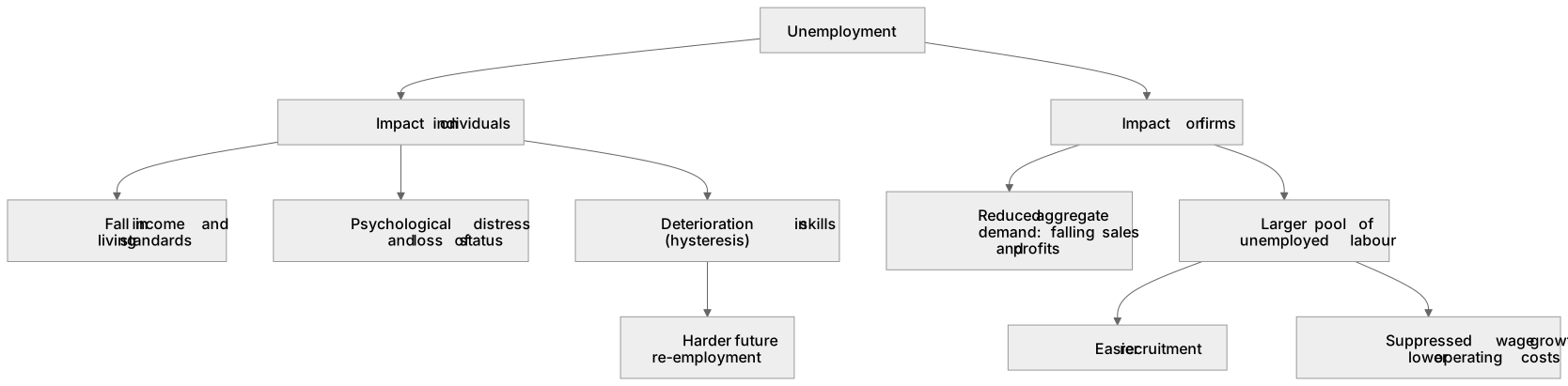
Label the diagram
Some boxes have lost their names. Pick the right name for each number.

1Box 1
2Box 2
3Box 3
There is more to this lesson
The full lesson goes on to check your understanding and help you earn the marks. Create a free account to carry on, with your progress saved.
A week of Premium from your first lesson · Then the free plan continues · No card, no charge
Test your understanding of Employment and unemployment: d) The impact of unemployment on firms and individuals
Active recall beats re-reading. Take an instant quiz now to test what you’ve learned and lock it into long-term memory.
A week of Premium from your first lesson · Then the free plan continues · No card, no charge