Pearson Edexcel · A-Level · Economics B
Course version: 9EB0 · Version from Sept 2015
C) The causes of unemployment: o structural unemployment o occupational…
Full specification wording
Employment and unemployment: c) The causes of unemployment: o structural unemployment o occupational immobility o geographical immobility o technological unemployment o demand deficiency and cyclical unemployment
Unemployment arises from distinct causes requiring different policy responses.
Checked against the Pearson Edexcel 9EB0 specification (opens in a new tab) on .
- Point 3 of 4
- 4 key terms
Study notes
From the checked teaching notes for this specification point.
The idea
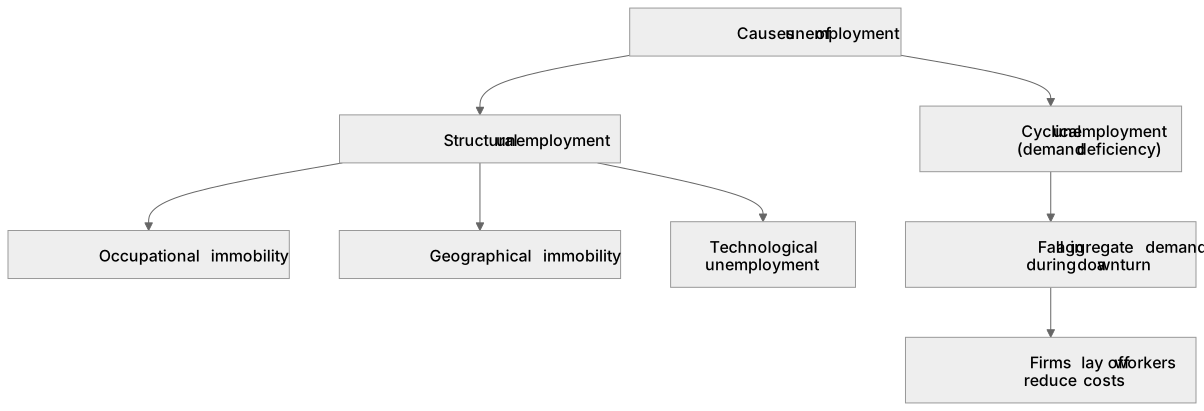
Unemployment arises from distinct causes requiring different policy responses. Structural unemployment occurs when an industry declines, leaving workers with skills that no longer match available jobs. This links to occupational immobility, where workers cannot easily retrain, and geographical immobility, where high housing costs prevent relocation to areas with vacancies. Technological unemployment is a structural issue where automation replaces human labour, such as self-checkouts replacing cashiers. Conversely, cyclical unemployment, or demand deficiency, happens during an economic downturn. When aggregate demand falls, firms across multiple sectors lay off workers to reduce costs, as seen during a recession.
What earns the marks
- Identify structural unemployment as a mismatch of skills due to long-term industrial decline.
- Explain occupational immobility as the inability of workers to transfer their skills to new industries.
- Explain geographical immobility as physical or financial barriers preventing workers from moving to locations with job vacancies.
- Define technological unemployment as job losses resulting from capital replacing human labour.
- Link cyclical unemployment to a deficiency in aggregate demand during the negative output gap of a business cycle.
Common mistakes and how to put them right
Confusing structural and cyclical unemployment.
Put it right: Structural is a long-term skill mismatch, whereas cyclical is caused by a temporary fall in aggregate demand.
Assuming technological unemployment only affects manufacturing.
Put it right: Technological unemployment also impacts service sectors, such as artificial intelligence replacing administrative roles.
Treating occupational and geographical immobility as the same concept.
Put it right: Occupational relates to a lack of transferable skills, while geographical relates to physical relocation barriers like housing costs.
Exam tips
- Always link cyclical unemployment explicitly to a fall in aggregate demand or a recessionary phase of the economic cycle.
- Use specific examples, such as the decline of traditional manufacturing, to illustrate structural unemployment and occupational immobility.
- When evaluating policies to reduce unemployment, ensure the proposed policy matches the specific cause, such as retraining grants for occupational immobility.
Try the lesson
The start of the Employment and unemployment: c) The causes of unemployment: o structural unemployment o occupational immobility o geographical immobility o technological unemployment o demand deficiency and cyclical unemployment lesson, made from checked teaching notes for this specification point.
Have a go first
A large manufacturing plant closes down because its machinery has been replaced by automated robotic systems. Which type of unemployment does this specific situation primarily represent?
Listen
Unemployment arises from distinct causes requiring different policy responses. Structural unemployment occurs when an industry declines, leaving workers with skills that no longer match available jobs. This links to occupational immobility, where workers cannot easily retrain, and geographical immobility, where high housing costs prevent relocation to areas with vacancies. Technological unemployment is a structural issue where automation replaces human labour, such as self-checkouts replacing cashiers. Conversely, cyclical unemployment, or demand deficiency, happens during an economic downturn. When aggregate demand falls, firms across multiple sectors lay off workers to reduce costs, as seen during a recession. A strong answer earns marks for these points. Identify structural unemployment as a mismatch of skills due to long-term industrial decline. Explain occupational immobility as the inability of workers to transfer their skills to new industries. Explain geographical immobility as physical or financial barriers preventing workers from moving to locations with job vacancies. Define technological unemployment as job losses resulting from capital replacing human labour. A common slip: Confusing structural and cyclical unemployment. Instead, structural is a long-term skill mismatch, whereas cyclical is caused by a temporary fall in aggregate demand. Exam tip: Always link cyclical unemployment explicitly to a fall in aggregate demand or a recessionary phase of the economic cycle.
See it
Key words
Say what each word means before you turn the card.
Structural unemployment
Try answering aloud or in your head before turning the card.
Occupational immobility
Try answering aloud or in your head before turning the card.
Geographical immobility
Try answering aloud or in your head before turning the card.
Technological unemployment
Try answering aloud or in your head before turning the card.
See every definition
- Structural unemployment
- A mismatch of skills due to long-term industrial decline, leaving workers with skills that no longer match available jobs.
- Occupational immobility
- The inability of workers to transfer their skills to new industries, meaning they cannot easily retrain.
- Geographical immobility
- Physical or financial barriers, such as high housing costs, that prevent workers from moving to locations with job vacancies.
- Technological unemployment
- A structural issue where automation replaces human labour, such as self-checkouts replacing cashiers.
Label the diagram
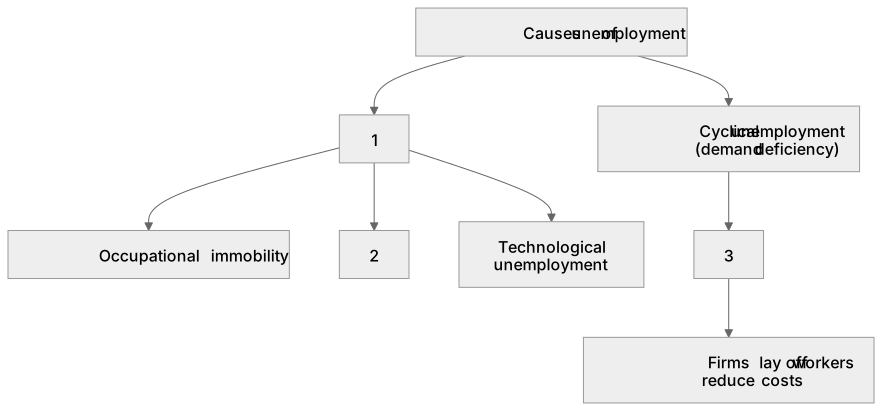
Some boxes have lost their names. Pick the right name for each number.
1Box 1
2Box 2
3Box 3
There is more to this lesson
The full lesson goes on to check your understanding and help you earn the marks. Create a free account to carry on, with your progress saved.
A week of Premium from your first lesson · Then the free plan continues · No card, no charge
Test your understanding of Employment and unemployment: c) The causes of unemployment: o structural unemployment o occupational immobility o geographical immobility o technological unemployment o demand deficiency and cyclical unemployment
Active recall beats re-reading. Take an instant quiz now to test what you’ve learned and lock it into long-term memory.
A week of Premium from your first lesson · Then the free plan continues · No card, no charge