Pearson Edexcel · A-Level · Economics B
Course version: 9EB0 · Version from Sept 2015
Employment patterns: c) Interdependence of labour markets
Full specification wording
Employment patterns: c) Interdependence of labour markets
Labour markets do not operate in isolation; they are highly interdependent.
Checked against the Pearson Edexcel 9EB0 specification (opens in a new tab) on .
- Point 3 of 3
- 4 key terms
Study notes
From the checked teaching notes for this specification point.
The idea
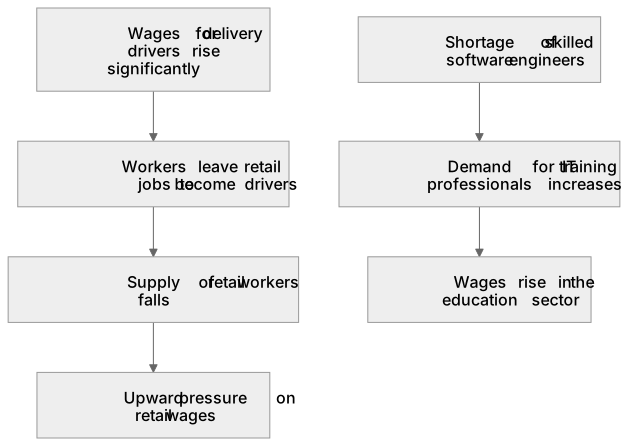
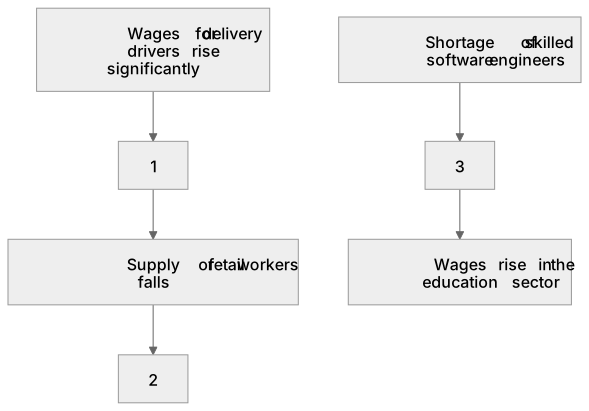
Labour markets do not operate in isolation; they are highly interdependent. Changes in one labour market often have direct or indirect effects on others. For example, a shortage of skilled software engineers can increase demand for IT training professionals, driving up wages in the education sector. Similarly, if wages for delivery drivers rise significantly, workers may leave retail jobs to become drivers, reducing the supply of retail workers and putting upward pressure on retail wages. This interdependence means that shifts in demand or supply in one occupation, industry, or geographical region can ripple through the economy, affecting employment patterns, wage rates, and the allocation of human resources across different sectors.
What earns the marks
- Identify how a change in demand for one type of labour affects the demand for complementary labour.
- Explain how wage increases in one sector can reduce the supply of labour in competing sectors.
- Recognise the impact of geographical mobility on the interdependence of regional labour markets.
- Analyse how occupational mobility determines the extent to which labour markets are interdependent.
Common mistakes and how to put them right
Assuming labour markets function completely independently of one another.
Put it right: Recognise that workers can move between sectors and that industries rely on complementary skills, linking different markets.
Confusing complementary labour with substitute labour.
Put it right: Complementary labour is demanded together (e.g. pilots and cabin crew), whereas substitute labour can replace another (e.g. automated checkouts and cashiers).
Ignoring the role of occupational mobility.
Put it right: Consider that the degree of interdependence depends on how easily workers can transfer their skills between different jobs.
Exam tips
- When analysing a shock to one labour market, always consider the knock-on effects on related industries or occupations.
- Use the concepts of occupational and geographical mobility to evaluate the strength of interdependence between two labour markets.
- In multiple-choice questions, look for the option that correctly traces the chain of reasoning from a change in one market to the outcome in another.
Try the lesson
The start of the Employment patterns: c) Interdependence of labour markets lesson, made from checked teaching notes for this specification point.
Have a go first
Which of the following best describes the economic concept of the interdependence of labour markets?
Listen
Labour markets do not operate in isolation; they are highly interdependent. Changes in one labour market often have direct or indirect effects on others. For example, a shortage of skilled software engineers can increase demand for IT training professionals, driving up wages in the education sector. Similarly, if wages for delivery drivers rise significantly, workers may leave retail jobs to become drivers, reducing the supply of retail workers and putting upward pressure on retail wages. This interdependence means that shifts in demand or supply in one occupation, industry, or geographical region can ripple through the economy, affecting employment patterns, wage rates, and the allocation of human resources across different sectors. A strong answer earns marks for these points. Identify how a change in demand for one type of labour affects the demand for complementary labour. Explain how wage increases in one sector can reduce the supply of labour in competing sectors. Recognise the impact of geographical mobility on the interdependence of regional labour markets. Analyse how occupational mobility determines the extent to which labour markets are interdependent. A common slip: Assuming labour markets function completely independently of one another. Instead, Recognise that workers can move between sectors and that industries rely on complementary skills, linking different markets. Exam tip: When analysing a shock to one labour market, always consider the knock-on effects on related industries or occupations.
See it
Key words
Say what each word means before you turn the card.
Labour mobility
Try answering aloud or in your head before turning the card.
Occupational mobility
Try answering aloud or in your head before turning the card.
Geographical mobility
Try answering aloud or in your head before turning the card.
Complementary labour
Try answering aloud or in your head before turning the card.
See every definition
- Labour mobility
- The ease with which workers can transfer their skills between different jobs, or move between geographical regions, determining how interdependent labour markets are.
- Occupational mobility
- How easily workers can transfer their skills between different jobs, which determines the extent to which labour markets are interdependent.
- Geographical mobility
- The movement of workers between regional labour markets, which affects the interdependence of those regional labour markets.
- Complementary labour
- Labour that is demanded together, such as pilots and cabin crew, so that a change in demand for one type affects demand for the other.
Label the diagram
Some boxes have lost their names. Pick the right name for each number.
1Box 1
2Box 2
3Box 3
There is more to this lesson
The full lesson goes on to check your understanding and help you earn the marks. Create a free account to carry on, with your progress saved.
A week of Premium from your first lesson · Then the free plan continues · No card, no charge
Test your understanding of Employment patterns: c) Interdependence of labour markets
Active recall beats re-reading. Take an instant quiz now to test what you’ve learned and lock it into long-term memory.
A week of Premium from your first lesson · Then the free plan continues · No card, no charge