Pearson Edexcel · A-Level · Economics B
Course version: 9EB0 · Version from Sept 2015
Employment patterns: b) Structural change
Full specification wording
Employment patterns: b) Structural change
Structural change is the shift in the relative share of economic sectors—primary, secondary, tertiary, and quaternary—in an economy's output and employment.
Checked against the Pearson Edexcel 9EB0 specification (opens in a new tab) on .
- Point 2 of 3
- 3 key terms
Study notes
From the checked teaching notes for this specification point.
The idea
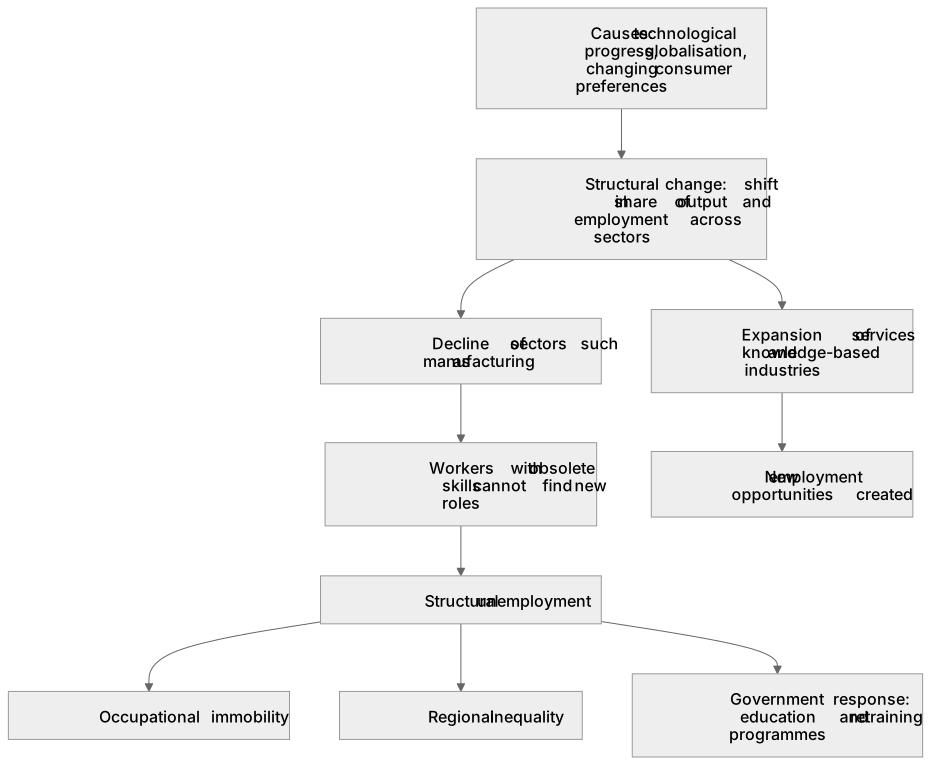
Structural change is the shift in the relative share of economic sectors—primary, secondary, tertiary, and quaternary—in an economy's output and employment. Developed economies often experience deindustrialisation, where manufacturing declines while services and knowledge-based industries expand. This alters employment patterns, causing structural unemployment when workers with obsolete skills cannot find new roles.
For example: The decline of UK coal mining required workers to retrain for the service sector.
What earns the marks
- Define structural change as the shift in the proportion of output and employment across different economic sectors.
- Explain the causes of structural change, including technological progress, globalisation, and changing consumer preferences.
- Analyse the consequences of structural change on employment patterns, specifically the rise of structural unemployment.
- Evaluate the policies governments can implement to mitigate the negative effects of structural change, such as investment in retraining.
Common mistakes and how to put them right
Confusing structural change with cyclical economic fluctuations.
Put it right: Understand that structural change is a long-term shift in the economy's makeup, whereas cyclical changes are short-term boom and bust periods.
Assuming structural change only causes job losses.
Put it right: Recognise that while jobs are lost in declining sectors, new employment opportunities are created in expanding sectors.
Overlooking the geographical impact of structural change.
Put it right: Acknowledge that structural change often leads to regional disparities, as declining industries may be concentrated in specific areas.
Exam tips
- Apply the concept of occupational immobility when explaining why structural unemployment occurs during structural change.
- Use historical or contemporary examples, such as the shift from manufacturing to services in the UK, to illustrate your points.
- Discuss the role of supply-side policies, like education and training, in helping the workforce adapt to structural changes.
Try the lesson
The start of the Employment patterns: b) Structural change lesson, made from checked teaching notes for this specification point.
Have a go first
Which development represents a structural change in an economy?
Listen
Structural change is the shift in the relative share of economic sectors—primary, secondary, tertiary, and quaternary—in an economy's output and employment. Developed economies often experience deindustrialisation, where manufacturing declines while services and knowledge-based industries expand. This alters employment patterns, causing structural unemployment when workers with obsolete skills cannot find new roles. For example, the decline of UK coal mining required workers to retrain for the service sector. A strong answer earns marks for these points. Define structural change as the shift in the proportion of output and employment across different economic sectors. Explain the causes of structural change, including technological progress, globalisation, and changing consumer preferences. Analyse the consequences of structural change on employment patterns, specifically the rise of structural unemployment. Evaluate the policies governments can implement to mitigate the negative effects of structural change, such as investment in retraining. A common slip: Confusing structural change with cyclical economic fluctuations. Instead, Understand that structural change is a long-term shift in the economy's makeup, whereas cyclical changes are short-term boom and bust periods. Exam tip: Apply the concept of occupational immobility when explaining why structural unemployment occurs during structural change.
See it
Key words
Say what each word means before you turn the card.
Structural change
Try answering aloud or in your head before turning the card.
Economic sectors
Try answering aloud or in your head before turning the card.
Structural unemployment
Try answering aloud or in your head before turning the card.
See every definition
- Structural change
- The shift in the relative share of economic sectors—primary, secondary, tertiary, and quaternary—in an economy's output and employment.
- Economic sectors
- The primary, secondary, tertiary, and quaternary parts of an economy whose relative share of output and employment shifts during structural change.
- Structural unemployment
- Arises when workers with obsolete skills cannot find new roles as employment patterns alter.
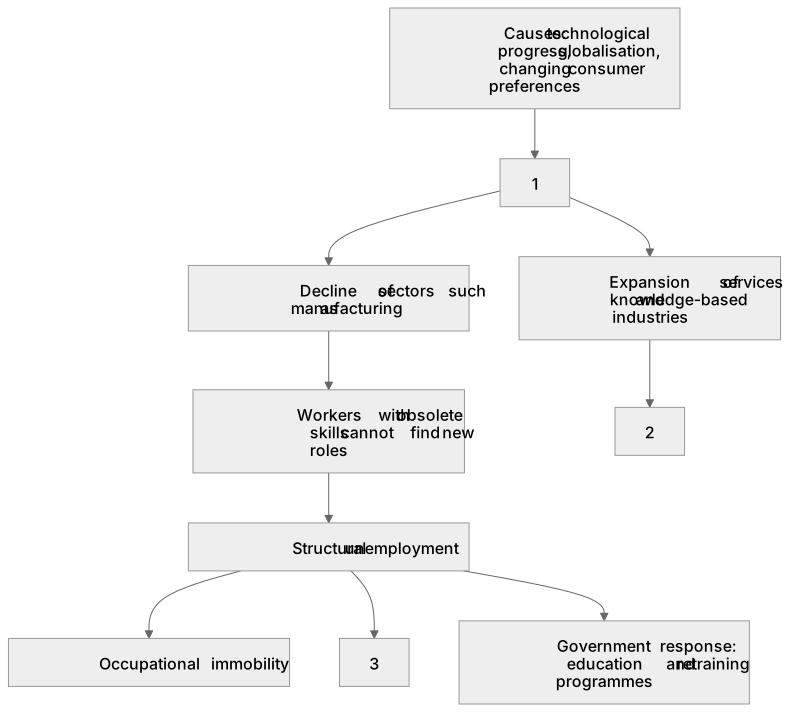
Label the diagram
Some boxes have lost their names. Pick the right name for each number.
1Box 1
2Box 2
3Box 3
There is more to this lesson
The full lesson goes on to check your understanding and help you earn the marks. Create a free account to carry on, with your progress saved.
A week of Premium from your first lesson · Then the free plan continues · No card, no charge
Test your understanding of Employment patterns: b) Structural change
Active recall beats re-reading. Take an instant quiz now to test what you’ve learned and lock it into long-term memory.
A week of Premium from your first lesson · Then the free plan continues · No card, no charge