Pearson Edexcel · A-Level · Economics B
Course version: 9EB0 · Version from Sept 2015
B) Non-financial motives: ethical stance, social entrepreneurship,…
Full specification wording
Entrepreneurial motives: b) Non-financial motives: ethical stance, social entrepreneurship, independence, home working
Entrepreneurs are frequently driven by non-financial motives alongside or instead of profit.
Checked against the Pearson Edexcel 9EB0 specification (opens in a new tab) on .
- Point 2 of 2
- 3 key terms
Study notes
From the checked teaching notes for this specification point.
The idea
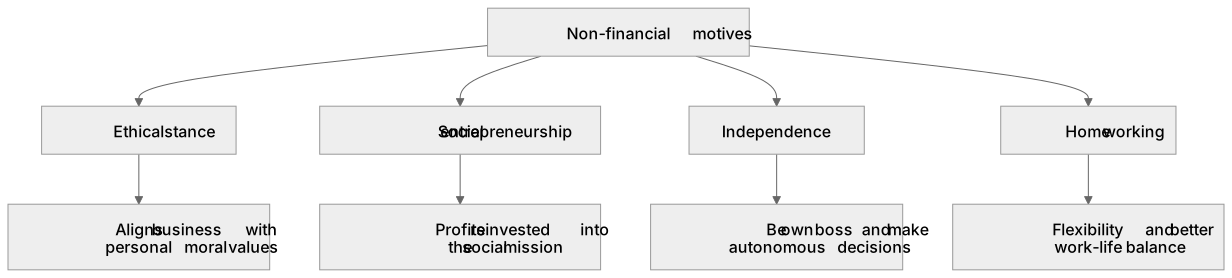
Entrepreneurs are frequently driven by non-financial motives alongside or instead of profit. An ethical stance involves running a business to align with personal moral values, such as fair trade or environmental sustainability. Social entrepreneurship focuses on solving community or societal problems, where profits are reinvested into the social mission rather than distributed to owners. Independence is a powerful motivator, allowing individuals to be their own boss, make autonomous decisions, and control their working hours. Home working offers flexibility, reducing commuting time and improving work-life balance, which is particularly attractive for those with caring responsibilities or seeking a specific lifestyle.
What earns the marks
- Non-financial motives can be the primary driver for business creation, especially in the tertiary and quaternary sectors.
- An ethical stance dictates business operations, such as sourcing sustainable materials or ensuring fair labour practices.
- Social enterprises aim to maximise social or environmental impact, using commercial strategies to fund their objectives.
- The desire for independence allows entrepreneurs to escape corporate hierarchies and control their own strategic direction.
- Home working provides flexibility, lowers initial startup costs, and supports a better work-life balance.
Common mistakes and how to put them right
Assuming social enterprises are charities.
Put it right: Social enterprises generate revenue through trade, whereas charities rely primarily on donations.
Believing non-financial motives mean a business does not need to make a profit.
Put it right: All businesses must generate sufficient revenue to cover costs and survive, even if profit is not the primary goal.
Confusing an ethical stance with legal compliance.
Put it right: An ethical stance goes beyond minimum legal requirements to actively pursue moral objectives.
Exam tips
- When evaluating business objectives, contrast non-financial motives with the traditional assumption of profit maximisation.
- Use specific examples, such as a local community café (social entrepreneurship) or a freelance graphic designer (independence and home working), to illustrate these motives.
- Consider how non-financial motives might affect business decisions, such as choosing more expensive but ethical suppliers.
Try the lesson
The start of the Entrepreneurial motives: b) Non-financial motives: ethical stance, social entrepreneurship, independence, home working lesson, made from checked teaching notes for this specification point.
Have a go first
Which of the following is an example of a non-financial motive for an entrepreneur starting a new business?
Listen
Entrepreneurs are frequently driven by non-financial motives alongside or instead of profit. An ethical stance involves running a business to align with personal moral values, such as fair trade or environmental sustainability. Social entrepreneurship focuses on solving community or societal problems, where profits are reinvested into the social mission rather than distributed to owners. Independence is a powerful motivator, allowing individuals to be their own boss, make autonomous decisions, and control their working hours. Home working offers flexibility, reducing commuting time and improving work-life balance, which is particularly attractive for those with caring responsibilities or seeking a specific lifestyle. A strong answer earns marks for these points. Non-financial motives can be the primary driver for business creation, especially in the tertiary and quaternary sectors. An ethical stance dictates business operations, such as sourcing sustainable materials or ensuring fair labour practices. Social enterprises aim to maximise social or environmental impact, using commercial strategies to fund their objectives. The desire for independence allows entrepreneurs to escape corporate hierarchies and control their own strategic direction. A common slip: Assuming social enterprises are charities. Instead, social enterprises generate revenue through trade, whereas charities rely primarily on donations. Exam tip: When evaluating business objectives, contrast non-financial motives with the traditional assumption of profit maximisation.
See it
Key words
Say what each word means before you turn the card.
Social enterprise
Try answering aloud or in your head before turning the card.
Ethical stance
Try answering aloud or in your head before turning the card.
Independence
Try answering aloud or in your head before turning the card.
See every definition
- Social enterprise
- A business that aims to maximise social or environmental impact, using commercial strategies to fund its objectives and reinvesting profits into the social mission rather than distributing them to owners.
- Ethical stance
- Running a business to align with personal moral values, going beyond minimum legal requirements to actively pursue moral objectives such as fair trade or environmental sustainability.
- Independence
- A motive allowing individuals to be their own boss, make autonomous decisions, escape corporate hierarchies and control their own strategic direction and working hours.
Label the diagram
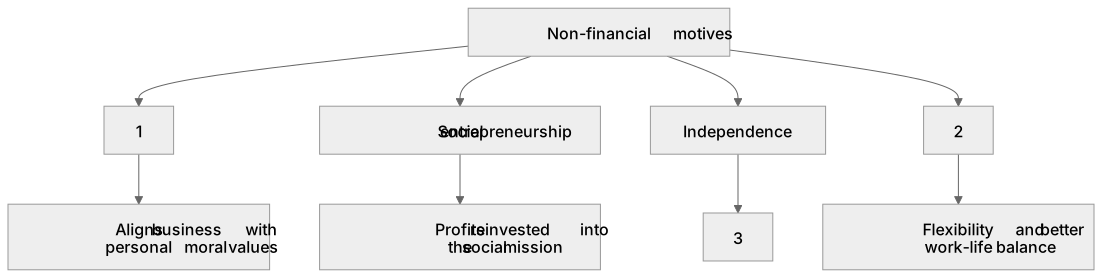
Some boxes have lost their names. Pick the right name for each number.
1Box 1
2Box 2
3Box 3
There is more to this lesson
The full lesson goes on to check your understanding and help you earn the marks. Create a free account to carry on, with your progress saved.
A week of Premium from your first lesson · Then the free plan continues · No card, no charge
Test your understanding of Entrepreneurial motives: b) Non-financial motives: ethical stance, social entrepreneurship, independence, home working
Active recall beats re-reading. Take an instant quiz now to test what you’ve learned and lock it into long-term memory.
A week of Premium from your first lesson · Then the free plan continues · No card, no charge