Pearson Edexcel · A-Level · Economics B
Course version: 9EB0 · Version from Sept 2015
Factors of production: a) Enterprise
Full specification wording
Factors of production: a) Enterprise
Enterprise is the factor of production that organises the other three factors (land, labour, and capital) to produce goods and services.
Checked against the Pearson Edexcel 9EB0 specification (opens in a new tab) on .
- Point 1 of 2
- 4 key terms
Study notes
From the checked teaching notes for this specification point.
The idea
Enterprise is the factor of production that organises the other three factors (land, labour, and capital) to produce goods and services. It involves the willingness of an entrepreneur to take calculated risks in pursuit of profit. Entrepreneurs identify market gaps, innovate, and make strategic decisions about resource allocation. For example, an entrepreneur starting a tech company combines software developers (labour), servers (capital), and office space (land) to create a new app. The reward for enterprise is profit, which compensates for the risk of failure. Understanding enterprise is crucial for analysing how businesses start, grow, and respond to changing market conditions.
What earns the marks
- Define enterprise as the factor of production that organises land, labour, and capital.
- Identify profit as the financial reward for enterprise.
- Explain the role of the entrepreneur as a risk-taker and decision-maker.
- Recognise that enterprise involves innovation and identifying market opportunities.
Common mistakes and how to put them right
Confusing enterprise with capital.
Put it right: Enterprise is the human skill of organising resources and taking risks, whereas capital refers to man-made physical assets used in production.
Assuming all managers are entrepreneurs.
Put it right: Entrepreneurs take the financial risk of the business, whereas managers are employees (labour) paid a salary to run operations.
Believing the reward for enterprise is a wage.
Put it right: The reward for enterprise is profit, while the reward for labour is wages or salaries.
Exam tips
- When defining enterprise, always mention its role in organising the other three factors of production.
- Link enterprise explicitly to risk-taking and the pursuit of profit in multiple-choice questions.
- Use the concept of enterprise to explain why some businesses are more innovative or adaptable than others.
Try the lesson
The start of the Factors of production: a) Enterprise lesson, made from checked teaching notes for this specification point.
Have a go first
Which of the following best describes the role of enterprise as a factor of production?
Listen
Enterprise is the factor of production that organises the other three factors (land, labour, and capital) to produce goods and services. It involves the willingness of an entrepreneur to take calculated risks in pursuit of profit. Entrepreneurs identify market gaps, innovate, and make strategic decisions about resource allocation. For example, an entrepreneur starting a tech company combines software developers (labour), servers (capital), and office space (land) to create a new app. The reward for enterprise is profit, which compensates for the risk of failure. Understanding enterprise is crucial for analysing how businesses start, grow, and respond to changing market conditions. A strong answer earns marks for these points. Define enterprise as the factor of production that organises land, labour, and capital. Identify profit as the financial reward for enterprise. Explain the role of the entrepreneur as a risk-taker and decision-maker. Recognise that enterprise involves innovation and identifying market opportunities. A common slip: Confusing enterprise with capital. Instead, Enterprise is the human skill of organising resources and taking risks, whereas capital refers to man-made physical assets used in production. Exam tip: When defining enterprise, always mention its role in organising the other three factors of production.
See it
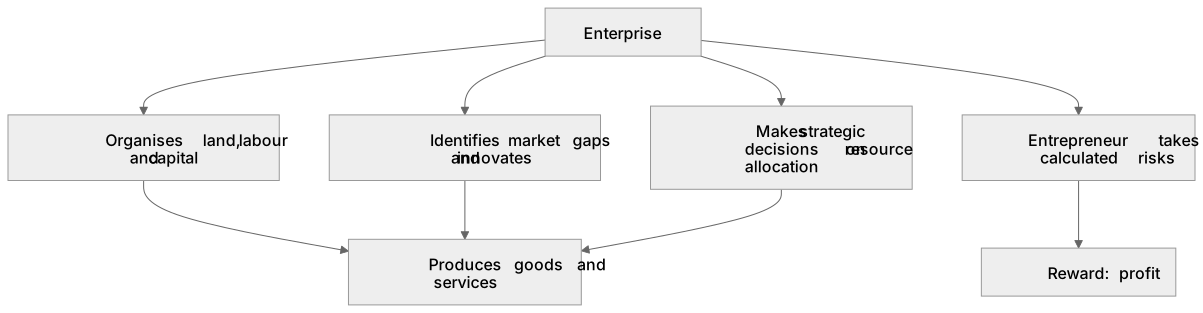
Key words
Say what each word means before you turn the card.
Enterprise
Try answering aloud or in your head before turning the card.
Entrepreneurship
Try answering aloud or in your head before turning the card.
Resource allocation
Try answering aloud or in your head before turning the card.
Profit
Try answering aloud or in your head before turning the card.
See every definition
- Enterprise
- The factor of production that organises land, labour, and capital to produce goods and services.
- Entrepreneurship
- The willingness of an entrepreneur to take calculated risks in pursuit of profit.
- Resource allocation
- The strategic decisions entrepreneurs make about how resources are used.
- Profit
- The reward for enterprise, which compensates for the risk of failure.
Label the diagram
Some boxes have lost their names. Pick the right name for each number.
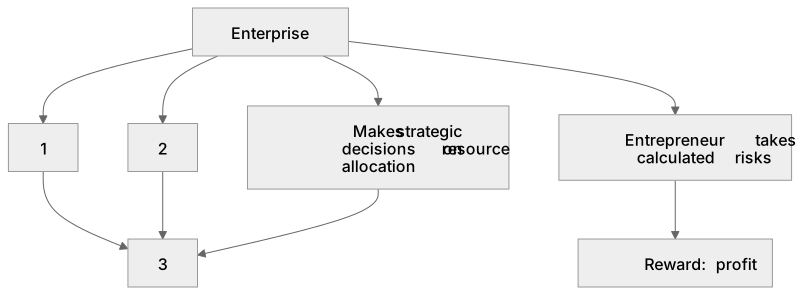
1Box 1
2Box 2
3Box 3
There is more to this lesson
The full lesson goes on to check your understanding and help you earn the marks. Create a free account to carry on, with your progress saved.
A week of Premium from your first lesson · Then the free plan continues · No card, no charge
Test your understanding of Factors of production: a) Enterprise
Active recall beats re-reading. Take an instant quiz now to test what you’ve learned and lock it into long-term memory.
A week of Premium from your first lesson · Then the free plan continues · No card, no charge