Pearson Edexcel · A-Level · Economics B
Course version: 9EB0 · Version from Sept 2015
B) Capital, land and labour: o premises o equipment o raw materials o…
Full specification wording
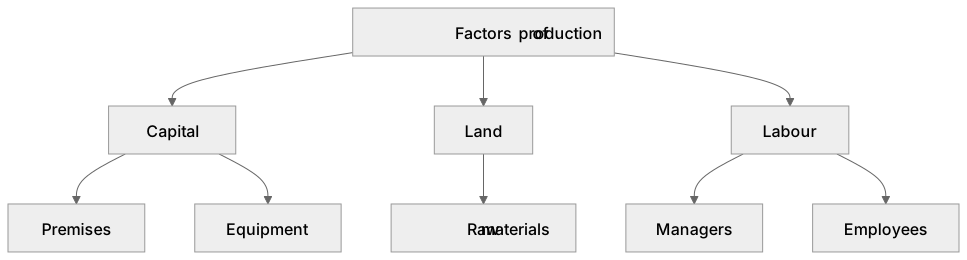
Factors of production: b) Capital, land and labour: o premises o equipment o raw materials o managers and employees
The production of goods and services requires three core factors alongside enterprise: capital, land, and labour.
Checked against the Pearson Edexcel 9EB0 specification (opens in a new tab) on .
- Point 2 of 2
- 4 key terms
Study notes
From the checked teaching notes for this specification point.
The idea
The production of goods and services requires three core factors alongside enterprise: capital, land, and labour. Capital refers to man-made aids to production, such as equipment, machinery, and the premises where operations occur. Land encompasses all natural resources, including raw materials like timber or oil. Labour represents the human effort, both physical and mental, contributed by managers and employees. For instance, a furniture manufacturer uses wood (land/raw materials), factory machinery (capital), and carpenters and supervisors (labour/employees and managers) to build tables. Each factor earns a specific reward: rent for land, wages for labour, and interest for capital.
What earns the marks
- Categorise premises and equipment as capital, which are man-made resources used in production.
- Classify raw materials as land, representing natural resources used to produce goods.
- Identify managers and employees as labour, providing the human physical and mental effort.
- Link each factor of production to its corresponding economic reward (rent, wages, interest).
Common mistakes and how to put them right
Classifying money as capital in the economic sense.
Put it right: In economics, capital refers to physical goods used to make other goods (like equipment), not financial capital or money.
Categorising premises as land.
Put it right: While the physical earth is land, the constructed building or premises is considered capital because it is man-made.
Treating managers as enterprise rather than labour.
Put it right: Managers are employees who provide human effort and receive a salary, making them part of labour, unless they also own the business and take the financial risk.
Exam tips
- Be prepared to classify specific business inputs (e.g., a delivery van or a warehouse) into the correct factor of production category.
- Remember that 'land' includes all natural resources and raw materials, not just physical space.
- Distinguish clearly between the roles of managers (labour) and entrepreneurs (enterprise) when analysing business scenarios.
Try the lesson
The start of the Factors of production: b) Capital, land and labour: o premises o equipment o raw materials o managers and employees lesson, made from checked teaching notes for this specification point.
Have a go first
A technology start-up purchases a new server to host its software platform. Which factor of production does this server represent?
Listen
The production of goods and services requires three core factors alongside enterprise: capital, land, and labour. Capital refers to man-made aids to production, such as equipment, machinery, and the premises where operations occur. Land encompasses all natural resources, including raw materials like timber or oil. Labour represents the human effort, both physical and mental, contributed by managers and employees. For instance, a furniture manufacturer uses wood (land/raw materials), factory machinery (capital), and carpenters and supervisors (labour/employees and managers) to build tables. Each factor earns a specific reward: rent for land, wages for labour, and interest for capital. A strong answer earns marks for these points. Categorise premises and equipment as capital, which are man-made resources used in production. Classify raw materials as land, representing natural resources used to produce goods. Identify managers and employees as labour, providing the human physical and mental effort. Link each factor of production to its corresponding economic reward (rent, wages, interest). A common slip: Classifying money as capital in the economic sense. Instead, In economics, capital refers to physical goods used to make other goods (like equipment), not financial capital or money. Exam tip: Be prepared to classify specific business inputs (e.g., a delivery van or a warehouse) into the correct factor of production category.
See it
Key words
Say what each word means before you turn the card.
Capital
Try answering aloud or in your head before turning the card.
Land
Try answering aloud or in your head before turning the card.
Labour
Try answering aloud or in your head before turning the card.
Factors of production
Try answering aloud or in your head before turning the card.
See every definition
- Capital
- Man-made aids to production, such as equipment, machinery, and the premises where operations occur.
- Land
- All natural resources, including raw materials like timber or oil.
- Labour
- The human effort, both physical and mental, contributed by managers and employees.
- Factors of production
- The resources required to produce goods and services, namely capital, land, and labour alongside enterprise.
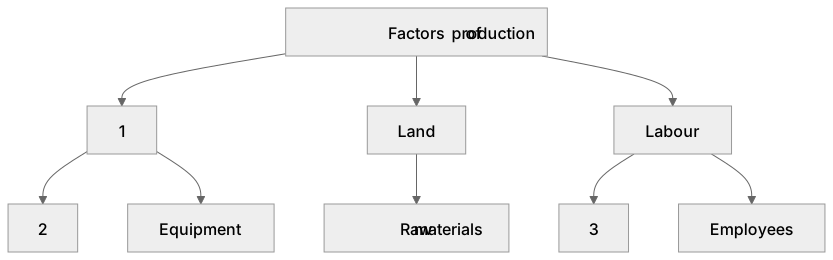
Label the diagram
Some boxes have lost their names. Pick the right name for each number.
1Box 1
2Box 2
3Box 3
There is more to this lesson
The full lesson goes on to check your understanding and help you earn the marks. Create a free account to carry on, with your progress saved.
A week of Premium from your first lesson · Then the free plan continues · No card, no charge
Test your understanding of Factors of production: b) Capital, land and labour: o premises o equipment o raw materials o managers and employees
Active recall beats re-reading. Take an instant quiz now to test what you’ve learned and lock it into long-term memory.
A week of Premium from your first lesson · Then the free plan continues · No card, no charge