Pearson Edexcel · A-Level · Economics B
Course version: 9EB0 · Version from Sept 2015
A) Characteristics of globalisation: o increased investment flows o world…
Full specification wording
Globalisation: a) Characteristics of globalisation: o increased investment flows o world trade rising as a proportion of world Gross Domestic Product (GDP) o increased migration
Globalisation is the increasing integration and interdependence of the world's economies.
Checked against the Pearson Edexcel 9EB0 specification (opens in a new tab) on .
- Point 1 of 2
- 2 key terms
Study notes
From the checked teaching notes for this specification point.
The idea
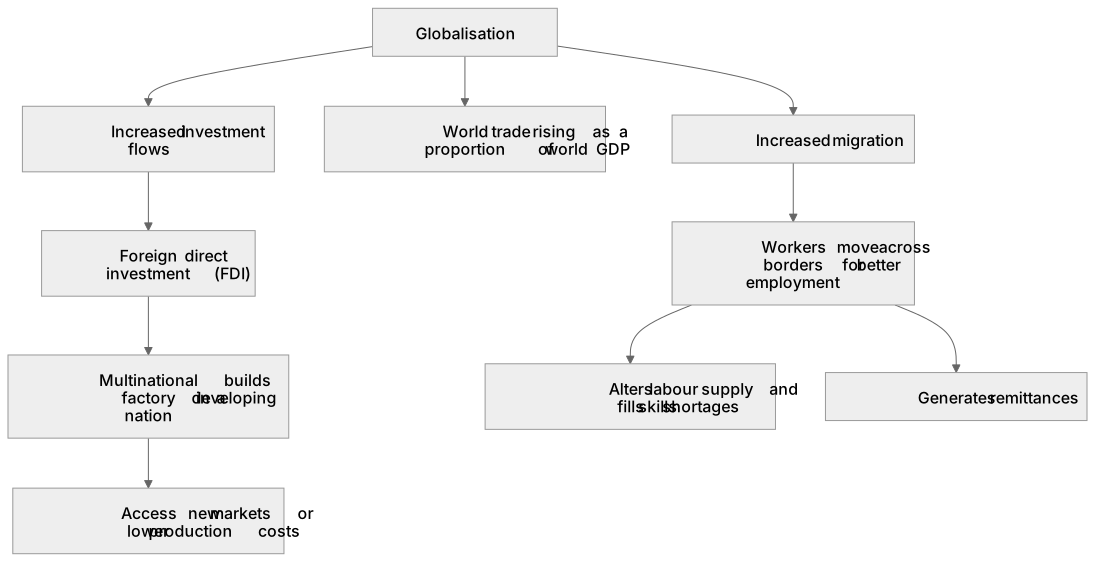
Globalisation is the increasing integration and interdependence of the world's economies. A key characteristic is the rise in world trade as a proportion of world Gross Domestic Product (GDP), meaning countries are exporting and importing a larger share of what they produce. Another feature is increased investment flows, such as foreign direct investment (FDI), where a multinational corporation might build a factory in a developing nation to access new markets or lower production costs. Finally, globalisation is characterised by increased migration, as workers move across borders seeking better employment opportunities, which alters labour supply and can help fill skills shortages in host countries while generating remittances.
What earns the marks
- Defines globalisation as the growing integration of the world's economies.
- Identifies increased investment flows, such as foreign direct investment (FDI), as a core characteristic.
- Explains that world trade has grown faster than world GDP, making trade a larger proportion of global output.
- Recognises increased migration of labour across international borders as a key feature of globalisation.
Common mistakes and how to put them right
Stating that globalisation only involves the trade of physical goods.
Put it right: It also includes services, investment flows, and the movement of labour.
Confusing GDP with trade volume.
Put it right: The characteristic is that trade is rising as a proportion of world GDP, meaning trade is growing faster than overall economic output.
Assuming migration only flows from developing to developed countries.
Put it right: Migration occurs between all types of economies for various reasons, including skilled labour transfers.
Exam tips
- Be prepared to identify the specific characteristics of globalisation from a list in multiple-choice questions.
- Use the concept of a ratio (Value of World Trade / World GDP) to understand how trade is rising as a proportion of GDP.
- Remember to include increased investment flows and migration when defining the scope of globalisation, not just imports and exports.
Try the lesson
The start of the Globalisation: a) Characteristics of globalisation: o increased investment flows o world trade rising as a proportion of world Gross Domestic Product (GDP) o increased migration lesson, made from checked teaching notes for this specification point.
Have a go first
Which of the following is a key characteristic of globalisation?
Listen
Globalisation is the increasing integration and interdependence of the world's economies. A key characteristic is the rise in world trade as a proportion of world Gross Domestic Product (GDP), meaning countries are exporting and importing a larger share of what they produce. Another feature is increased investment flows, such as foreign direct investment (FDI), where a multinational corporation might build a factory in a developing nation to access new markets or lower production costs. Finally, globalisation is characterised by increased migration, as workers move across borders seeking better employment opportunities, which alters labour supply and can help fill skills shortages in host countries while generating remittances. A strong answer earns marks for these points. Defines globalisation as the growing integration of the world's economies. Identifies increased investment flows, such as foreign direct investment (FDI), as a core characteristic. Explains that world trade has grown faster than world GDP, making trade a larger proportion of global output. Recognises increased migration of labour across international borders as a key feature of globalisation. A common slip: Stating that globalisation only involves the trade of physical goods. Instead, it also includes services, investment flows, and the movement of labour. Exam tip: Be prepared to identify the specific characteristics of globalisation from a list in multiple-choice questions.
See it
Key words
Say what each word means before you turn the card.
Globalisation
Try answering aloud or in your head before turning the card.
Foreign direct investment
Try answering aloud or in your head before turning the card.
See every definition
- Globalisation
- The increasing integration and interdependence of the world's economies.
- Foreign direct investment
- Investment flows in which a multinational corporation might build a factory in a developing nation to access new markets or lower production costs.
Label the diagram
Some boxes have lost their names. Pick the right name for each number.

1Box 1
2Box 2
3Box 3
There is more to this lesson
The full lesson goes on to check your understanding and help you earn the marks. Create a free account to carry on, with your progress saved.
A week of Premium from your first lesson · Then the free plan continues · No card, no charge
Test your understanding of Globalisation: a) Characteristics of globalisation: o increased investment flows o world trade rising as a proportion of world Gross Domestic Product (GDP) o increased migration
Active recall beats re-reading. Take an instant quiz now to test what you’ve learned and lock it into long-term memory.
A week of Premium from your first lesson · Then the free plan continues · No card, no charge