Pearson Edexcel · A-Level · Economics B
Course version: 9EB0 · Version from Sept 2015
B) Factors contributing to globalisation in the last 50 years: o trade…
Full specification wording
Globalisation: b) Factors contributing to globalisation in the last 50 years: o trade liberalisation o capital market liberalisation o political change resulting in the opening up of China and the former Soviet Union o reduced cost of transport and communications o increased significance of global (transnational) companies
Globalisation over the last 50 years has been driven by several key factors.
Checked against the Pearson Edexcel 9EB0 specification (opens in a new tab) on .
- Point 2 of 2
- 4 key terms
Study notes
From the checked teaching notes for this specification point.
The idea
Globalisation over the last 50 years has been driven by several key factors. Trade liberalisation, facilitated by the WTO, has reduced tariffs, encouraging international trade. Capital market liberalisation has allowed money to flow freely across borders, boosting foreign direct investment. Political changes, notably the opening of China's economy and the collapse of the Soviet Union, integrated billions of people into the global market. Technological advancements have drastically reduced the cost of transport (e.g., containerisation) and communications (e.g., the internet), making global supply chains viable. Finally, the increased significance of global or transnational companies (TNCs) has accelerated integration, as these firms operate across multiple countries to minimise costs and maximise market reach.
What earns the marks
- Identify trade liberalisation as the removal of trade barriers such as tariffs and quotas.
- Explain how capital market liberalisation enables foreign direct investment and cross-border financial flows.
- Recognise the impact of political changes in China and the former Soviet Union on expanding the global labour force and consumer markets.
- Describe how containerisation and the internet have lowered transport and communication costs, facilitating global supply chains.
- Assess the role of transnational companies in driving globalisation through offshoring and foreign direct investment.
Common mistakes and how to put them right
Confusing trade liberalisation with capital market liberalisation.
Put it right: Trade refers to goods and services, while capital refers to financial flows and investment.
Assuming globalisation is only driven by technology.
Put it right: Political changes and trade agreements are equally crucial structural drivers.
Believing the Soviet Union and China opened up at the same time.
Put it right: China began economic reforms in 1978, whereas the Soviet Union collapsed in 1991.
Exam tips
- When evaluating the causes of globalisation, weigh the relative importance of technological factors against political decisions.
- Use containerisation as a specific example of how reduced transport costs have revolutionised global trade in goods.
- Remember to explicitly link the rise of transnational companies to their ability to exploit economies of scale on a global level.
Try the lesson
The start of the Globalisation: b) Factors contributing to globalisation in the last 50 years: o trade liberalisation o capital market liberalisation o political change resulting in the opening up of China and the former Soviet Union o reduced cost of transport and communications o increased significance of global (transnational) companies lesson, made from checked teaching notes for this specification point.
Have a go first
Which political change has been a significant factor contributing to the rapid acceleration of globalisation in the last 50 years?
Listen
Globalisation over the last 50 years has been driven by several key factors. Trade liberalisation, facilitated by the WTO, has reduced tariffs, encouraging international trade. Capital market liberalisation has allowed money to flow freely across borders, boosting foreign direct investment. Political changes, notably the opening of China's economy and the collapse of the Soviet Union, integrated billions of people into the global market. Technological advancements have drastically reduced the cost of transport (e.g., containerisation) and communications (e.g., the internet), making global supply chains viable. Finally, the increased significance of global or transnational companies (TNCs) has accelerated integration, as these firms operate across multiple countries to minimise costs and maximise market reach. A strong answer earns marks for these points. Identify trade liberalisation as the removal of trade barriers such as tariffs and quotas. Explain how capital market liberalisation enables foreign direct investment and cross-border financial flows. Recognise the impact of political changes in China and the former Soviet Union on expanding the global labour force and consumer markets. Describe how containerisation and the internet have lowered transport and communication costs, facilitating global supply chains. Exam tip: When evaluating the causes of globalisation, weigh the relative importance of technological factors against political decisions.
See it

Key words
Say what each word means before you turn the card.
Globalisation
Try answering aloud or in your head before turning the card.
International trade
Try answering aloud or in your head before turning the card.
Technological change
Try answering aloud or in your head before turning the card.
Transnational corporations
Try answering aloud or in your head before turning the card.
See every definition
- Globalisation
- The integration of economies driven by factors such as trade liberalisation, capital market liberalisation, political change, reduced transport and communication costs and transnational companies.
- International trade
- The exchange of goods and services, encouraged by trade liberalisation, which has reduced tariffs.
- Technological change
- Advancements that have drastically reduced the cost of transport, such as containerisation, and communications, such as the internet.
- Transnational corporations
- Global companies that operate across multiple countries to minimise costs and maximise market reach, accelerating integration.
Label the diagram
Some boxes have lost their names. Pick the right name for each number.
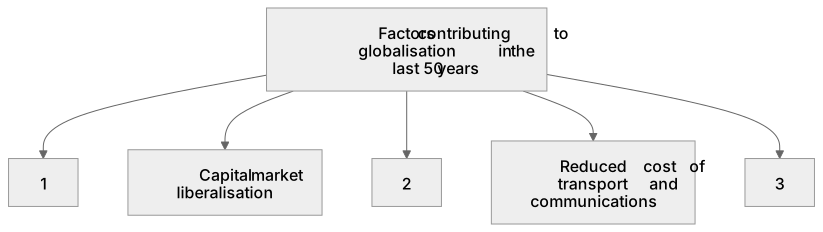
1Box 1
2Box 2
3Box 3
There is more to this lesson
The full lesson goes on to check your understanding and help you earn the marks. Create a free account to carry on, with your progress saved.
A week of Premium from your first lesson · Then the free plan continues · No card, no charge
Test your understanding of Globalisation: b) Factors contributing to globalisation in the last 50 years: o trade liberalisation o capital market liberalisation o political change resulting in the opening up of China and the former Soviet Union o reduced cost of transport and communications o increased significance of global (transnational) companies
Active recall beats re-reading. Take an instant quiz now to test what you’ve learned and lock it into long-term memory.
A week of Premium from your first lesson · Then the free plan continues · No card, no charge