Pearson Edexcel · A-Level · Economics B
Course version: 9EB0 · Version from Sept 2015
B) Methods of government intervention: o regulation o legislation o…
Full specification wording
Government intervention and failure: b) Methods of government intervention: o regulation o legislation o indirect taxation o grants and subsidies o voluntary agreements
Governments use various methods to correct market failures.
Checked against the Pearson Edexcel 9EB0 specification (opens in a new tab) on .
- Point 2 of 3
- 3 key terms
Study notes
From the checked teaching notes for this specification point.
The idea
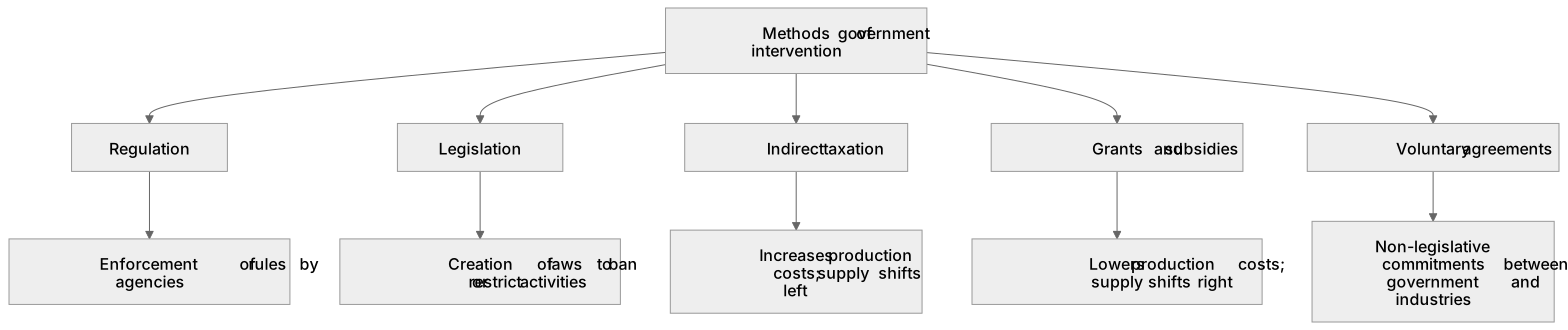
Governments use various methods to correct market failures. Legislation involves passing laws to ban or restrict activities, while regulation enforces these rules through agencies (e.g., the Environment Agency). Indirect taxation increases the cost of production for goods with negative externalities, shifting the supply curve left to internalise the external cost. Conversely, grants and subsidies lower production costs, encouraging the consumption of goods with positive externalities by shifting supply right. Voluntary agreements are non-legislative commitments between the government and industries to achieve specific targets, such as reducing packaging waste, offering a flexible alternative to strict regulation.
What earns the marks
- Define and distinguish between legislation (the creation of laws) and regulation (the enforcement of rules).
- Explain how indirect taxes internalise negative externalities by increasing production costs and reducing supply.
- Illustrate how grants and subsidies encourage the provision of goods with positive externalities by lowering production costs.
- Evaluate the effectiveness of voluntary agreements compared to mandatory legislation in achieving policy objectives.
Common mistakes and how to put them right
Confusing direct and indirect taxation.
Put it right: Indirect taxes, such as excise duties, are levied on goods and services to correct market failure, whereas direct taxes are levied on income or wealth.
Assuming subsidies shift the demand curve.
Put it right: Subsidies lower the cost of production, shifting the supply curve to the right.
Treating legislation and regulation as identical concepts.
Put it right: Legislation is the creation of laws by parliament, while regulation is the monitoring and enforcement of these laws by appointed bodies.
Exam tips
- When evaluating indirect taxes, consider the price elasticity of demand, as inelastic demand will limit the reduction in quantity consumed.
- Use supply and demand diagrams to illustrate the impact of indirect taxes and subsidies on market equilibrium.
- Discuss the opportunity cost of government spending when evaluating the use of grants and subsidies.
Try the lesson
The start of the Government intervention and failure: b) Methods of government intervention: o regulation o legislation o indirect taxation o grants and subsidies o voluntary agreements lesson, made from checked teaching notes for this specification point.
Have a go first
Which of the following is an example of an indirect tax used as a method of government intervention?
Listen
Governments use various methods to correct market failures. Legislation involves passing laws to ban or restrict activities, while regulation enforces these rules through agencies (e.g., the Environment Agency). Indirect taxation increases the cost of production for goods with negative externalities, shifting the supply curve left to internalise the external cost. Conversely, grants and subsidies lower production costs, encouraging the consumption of goods with positive externalities by shifting supply right. Voluntary agreements are non-legislative commitments between the government and industries to achieve specific targets, such as reducing packaging waste, offering a flexible alternative to strict regulation. A strong answer earns marks for these points. Define and distinguish between legislation (the creation of laws) and regulation (the enforcement of rules). Explain how indirect taxes internalise negative externalities by increasing production costs and reducing supply. Illustrate how grants and subsidies encourage the provision of goods with positive externalities by lowering production costs. Evaluate the effectiveness of voluntary agreements compared to mandatory legislation in achieving policy objectives. A common slip: Confusing direct and indirect taxation. Instead, Indirect taxes, such as excise duties, are levied on goods and services to correct market failure, whereas direct taxes are levied on income or wealth. Exam tip: When evaluating indirect taxes, consider the price elasticity of demand, as inelastic demand will limit the reduction in quantity consumed.
See it
Key words
Say what each word means before you turn the card.
Legislation
Try answering aloud or in your head before turning the card.
Regulation
Try answering aloud or in your head before turning the card.
Indirect taxation
Try answering aloud or in your head before turning the card.
See every definition
- Legislation
- The creation of laws by parliament to ban or restrict activities.
- Regulation
- The monitoring and enforcement of rules by appointed bodies such as the Environment Agency.
- Indirect taxation
- A tax levied on goods and services that increases the cost of production for goods with negative externalities, shifting the supply curve left to internalise the external cost.
Label the diagram
Some boxes have lost their names. Pick the right name for each number.
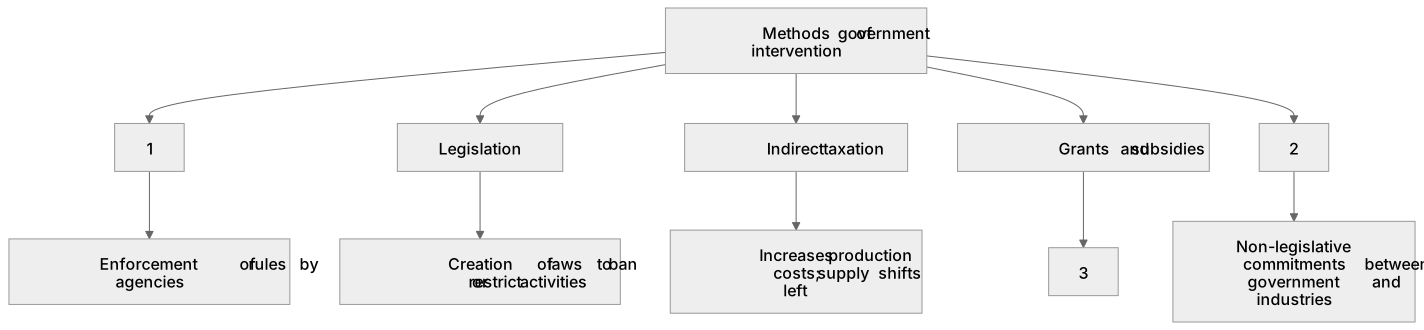
1Box 1
2Box 2
3Box 3
There is more to this lesson
The full lesson goes on to check your understanding and help you earn the marks. Create a free account to carry on, with your progress saved.
A week of Premium from your first lesson · Then the free plan continues · No card, no charge
Test your understanding of Government intervention and failure: b) Methods of government intervention: o regulation o legislation o indirect taxation o grants and subsidies o voluntary agreements
Active recall beats re-reading. Take an instant quiz now to test what you’ve learned and lock it into long-term memory.
A week of Premium from your first lesson · Then the free plan continues · No card, no charge