Pearson Edexcel · A-Level · Economics B
Course version: 9EB0 · Version from Sept 2015
C) Causes of government failure: o distortion of price signals o…
Full specification wording
Government intervention and failure: c) Causes of government failure: o distortion of price signals o unintended consequences o excessive administrative costs o information gaps
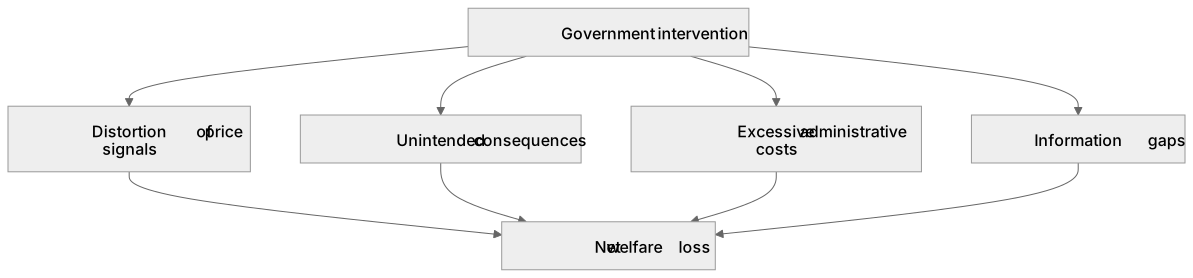
Government failure occurs when intervention leads to a net welfare loss rather than an improvement.
Checked against the Pearson Edexcel 9EB0 specification (opens in a new tab) on .
- Point 3 of 3
- 3 key terms
Study notes
From the checked teaching notes for this specification point.
The idea
Government failure occurs when intervention leads to a net welfare loss rather than an improvement. This can happen through four main causes. Distortion of price signals occurs when policies like minimum wages or rent controls prevent markets from clearing, creating surpluses or shortages. Unintended consequences arise when policies have unforeseen negative effects, such as a tax on waste leading to illegal fly-tipping. Excessive administrative costs mean the expense of implementing and policing a policy outweighs its benefits. Finally, information gaps occur when governments lack the accurate data needed to set optimal taxes or quotas, leading to over- or under-correction of the market failure.
What earns the marks
- Identify government failure as a net welfare loss resulting from intervention.
- Explain how price controls distort price signals and create shortages or surpluses.
- Recognise unintended consequences, such as the emergence of black markets due to high indirect taxes.
- Evaluate whether the excessive administrative costs of enforcing a regulation exceed the social benefits gained.
- Explain how information gaps lead to the government setting taxes or subsidies at the wrong level.
Common mistakes and how to put them right
Confusing government failure with market failure.
Put it right: Market failure is the initial misallocation of resources, whereas government failure is when intervention worsens the allocation or creates a net welfare loss.
Assuming any negative effect of a policy is government failure.
Put it right: Government failure only occurs if the total costs of the intervention, including negative effects, exceed the total benefits.
Stating that administrative costs always cause government failure.
Put it right: Administrative costs only cause government failure if they are excessive and outweigh the welfare gains of the policy.
Exam tips
- Always link the cause of government failure back to the concept of a net welfare loss to secure marks.
- Use specific examples, such as rent controls, to illustrate the distortion of price signals.
- When discussing information gaps, explain exactly what information the government is missing, such as the exact monetary value of a negative externality.
Try the lesson
The start of the Government intervention and failure: c) Causes of government failure: o distortion of price signals o unintended consequences o excessive administrative costs o information gaps lesson, made from checked teaching notes for this specification point.
Have a go first
Which of the following is a recognised cause of government failure when the state intervenes in an economy?
Listen
Government failure occurs when intervention leads to a net welfare loss rather than an improvement. This can happen through four main causes. Distortion of price signals occurs when policies like minimum wages or rent controls prevent markets from clearing, creating surpluses or shortages. Unintended consequences arise when policies have unforeseen negative effects, such as a tax on waste leading to illegal fly-tipping. Excessive administrative costs mean the expense of implementing and policing a policy outweighs its benefits. Finally, information gaps occur when governments lack the accurate data needed to set optimal taxes or quotas, leading to over- or under-correction of the market failure. A strong answer earns marks for these points. Identify government failure as a net welfare loss resulting from intervention. Explain how price controls distort price signals and create shortages or surpluses. Recognise unintended consequences, such as the emergence of black markets due to high indirect taxes. Evaluate whether the excessive administrative costs of enforcing a regulation exceed the social benefits gained. A common slip: Confusing government failure with market failure. Instead, market failure is the initial misallocation of resources, whereas government failure is when intervention worsens the allocation or creates a net welfare loss. Exam tip: Always link the cause of government failure back to the concept of a net welfare loss to secure marks.
See it
Key words
Say what each word means before you turn the card.
Government failure
Try answering aloud or in your head before turning the card.
Unintended consequences
Try answering aloud or in your head before turning the card.
Information gaps
Try answering aloud or in your head before turning the card.
See every definition
- Government failure
- A net welfare loss resulting from intervention rather than an improvement.
- Unintended consequences
- Unforeseen negative effects of policies, such as a tax on waste leading to illegal fly-tipping.
- Information gaps
- When governments lack the accurate data needed to set optimal taxes or quotas, leading to over- or under-correction of the market failure.
Label the diagram
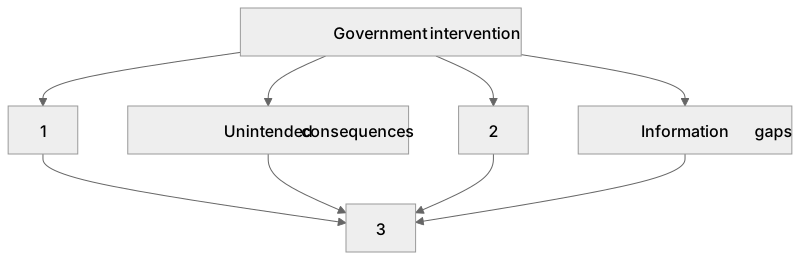
Some boxes have lost their names. Pick the right name for each number.
1Box 1
2Box 2
3Box 3
There is more to this lesson
The full lesson goes on to check your understanding and help you earn the marks. Create a free account to carry on, with your progress saved.
A week of Premium from your first lesson · Then the free plan continues · No card, no charge
Test your understanding of Government intervention and failure: c) Causes of government failure: o distortion of price signals o unintended consequences o excessive administrative costs o information gaps
Active recall beats re-reading. Take an instant quiz now to test what you’ve learned and lock it into long-term memory.
A week of Premium from your first lesson · Then the free plan continues · No card, no charge