Pearson Edexcel · A-Level · Economics B
Course version: 9EB0 · Version from Sept 2015
B) Implications of economic growth for individuals and firms: o trade and…
Full specification wording
Growing economies: b) Implications of economic growth for individuals and firms: o trade and rationalisation opportunities for firms o shifting employment patterns
Economic growth in emerging markets creates significant implications for both individuals and firms.
Checked against the Pearson Edexcel 9EB0 specification (opens in a new tab) on .
- Point 2 of 5
- 4 key terms
Study notes
From the checked teaching notes for this specification point.
The idea
Economic growth in emerging markets creates significant implications for both individuals and firms. For businesses, rising global incomes present lucrative new trade opportunities and expanding consumer markets for exports. Firms may also pursue rationalisation, reorganising operations to improve efficiency, such as offshoring manufacturing to countries with lower labour costs while retaining high-value functions domestically. For individuals, this growth drives shifting employment patterns. As economies develop, workers typically transition from primary agriculture into secondary manufacturing, and eventually into tertiary services. This structural change alters wage levels and demands new skills from the workforce.
What earns the marks
- Define rationalisation as the reorganisation of a firm's operations to increase efficiency and reduce costs.
- Explain how economic growth in emerging markets provides firms with new export markets and trade opportunities.
- Describe the shift in employment patterns from primary to secondary and tertiary sectors as an economy grows.
- Identify the impact of structural economic changes on the skills required by individuals in the labour market.
Common mistakes and how to put them right
Confusing rationalisation with simply expanding a business.
Put it right: Rationalisation specifically refers to reorganising a business to make it more efficient, which may involve downsizing, relocating, or closing unprofitable divisions.
Assuming economic growth always leads to increased manufacturing jobs in developed countries.
Put it right: Growth in emerging markets often leads to a shift away from manufacturing towards services in developed economies due to offshoring.
Believing that shifting employment patterns only affect low-skilled workers.
Put it right: Structural changes impact all levels of the workforce, requiring continuous retraining and adaptation to new industries.
Exam tips
- Link rationalisation directly to cost-saving strategies, such as economies of scale or offshoring production to emerging markets.
- Use the concept of structural change to explain how employment shifts from agriculture to manufacturing and services during economic development.
- When evaluating trade opportunities, consider both the benefits of new markets and the threats of increased global competition for domestic firms.
Try the lesson
The start of the Growing economies: b) Implications of economic growth for individuals and firms: o trade and rationalisation opportunities for firms o shifting employment patterns lesson, made from checked teaching notes for this specification point.
Have a go first
Which of the following is a likely implication of rapid economic growth for employment patterns within a developing economy?
Listen
Economic growth in emerging markets creates significant implications for both individuals and firms. For businesses, rising global incomes present lucrative new trade opportunities and expanding consumer markets for exports. Firms may also pursue rationalisation, reorganising operations to improve efficiency, such as offshoring manufacturing to countries with lower labour costs while retaining high-value functions domestically. For individuals, this growth drives shifting employment patterns. As economies develop, workers typically transition from primary agriculture into secondary manufacturing, and eventually into tertiary services. This structural change alters wage levels and demands new skills from the workforce. A strong answer earns marks for these points. Define rationalisation as the reorganisation of a firm's operations to increase efficiency and reduce costs. Explain how economic growth in emerging markets provides firms with new export markets and trade opportunities. Describe the shift in employment patterns from primary to secondary and tertiary sectors as an economy grows. Identify the impact of structural economic changes on the skills required by individuals in the labour market. A common slip: Confusing rationalisation with simply expanding a business. Instead, Rationalisation specifically refers to reorganising a business to make it more efficient, which may involve downsizing, relocating, or closing unprofitable divisions. Exam tip: Link rationalisation directly to cost-saving strategies, such as economies of scale or offshoring production to emerging markets.
See it
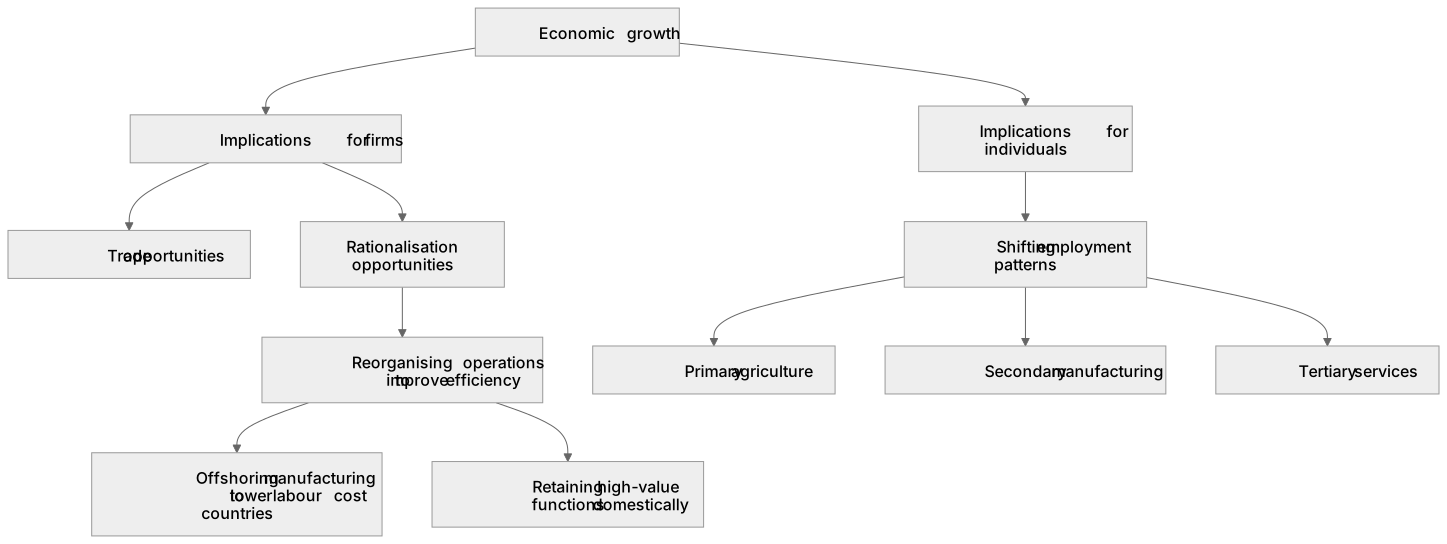
Key words
Say what each word means before you turn the card.
Rationalisation
Try answering aloud or in your head before turning the card.
Offshoring
Try answering aloud or in your head before turning the card.
Structural change
Try answering aloud or in your head before turning the card.
Shifting employment patterns
Try answering aloud or in your head before turning the card.
See every definition
- Rationalisation
- The reorganisation of a firm's operations to increase efficiency and reduce costs, which may involve downsizing, relocating, or closing unprofitable divisions.
- Offshoring
- Moving manufacturing to countries with lower labour costs while retaining high-value functions domestically.
- Structural change
- The shift in employment from primary agriculture into secondary manufacturing, and eventually into tertiary services, as economies develop.
- Shifting employment patterns
- The transition of workers between sectors as an economy grows, which alters wage levels and demands new skills from the workforce.
Label the diagram
Some boxes have lost their names. Pick the right name for each number.
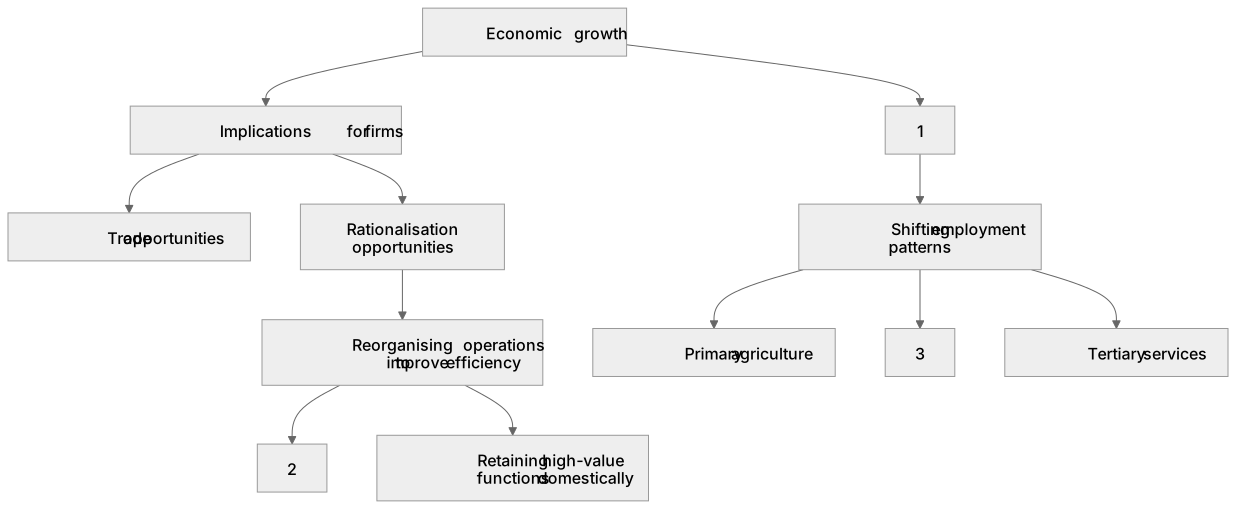
1Box 1
2Box 2
3Box 3
There is more to this lesson
The full lesson goes on to check your understanding and help you earn the marks. Create a free account to carry on, with your progress saved.
A week of Premium from your first lesson · Then the free plan continues · No card, no charge
Test your understanding of Growing economies: b) Implications of economic growth for individuals and firms: o trade and rationalisation opportunities for firms o shifting employment patterns
Active recall beats re-reading. Take an instant quiz now to test what you’ve learned and lock it into long-term memory.
A week of Premium from your first lesson · Then the free plan continues · No card, no charge