Pearson Edexcel · A-Level · Economics B
Course version: 9EB0 · Version from Sept 2015
Growing economies: c) Rising incomes
Rising incomes are a primary indicator of a growing economy.
Checked against the Pearson Edexcel 9EB0 specification (opens in a new tab) on .
- Point 3 of 5
- 4 key terms
Study notes
From the checked teaching notes for this specification point.
The idea
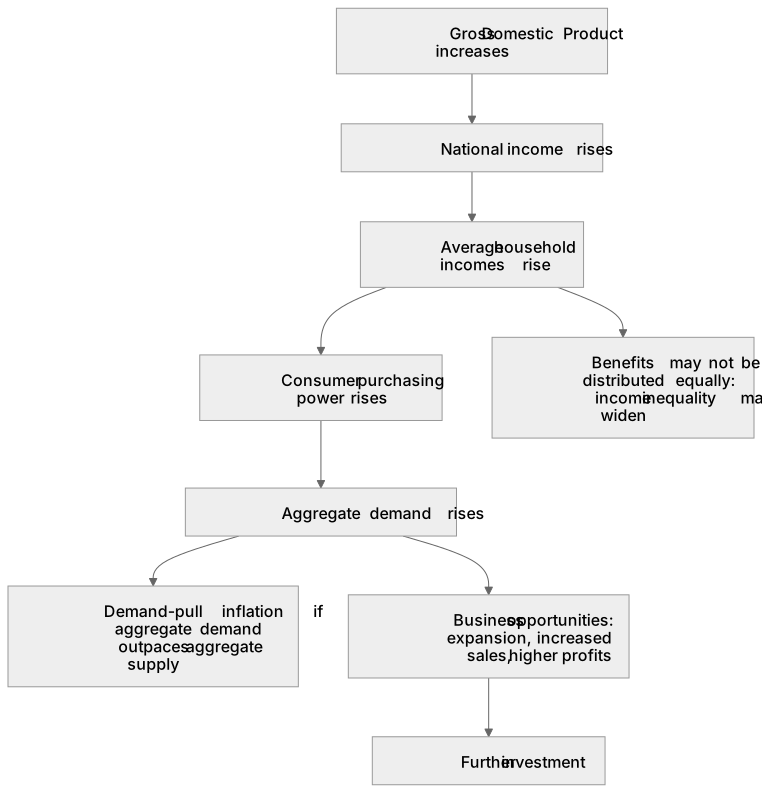
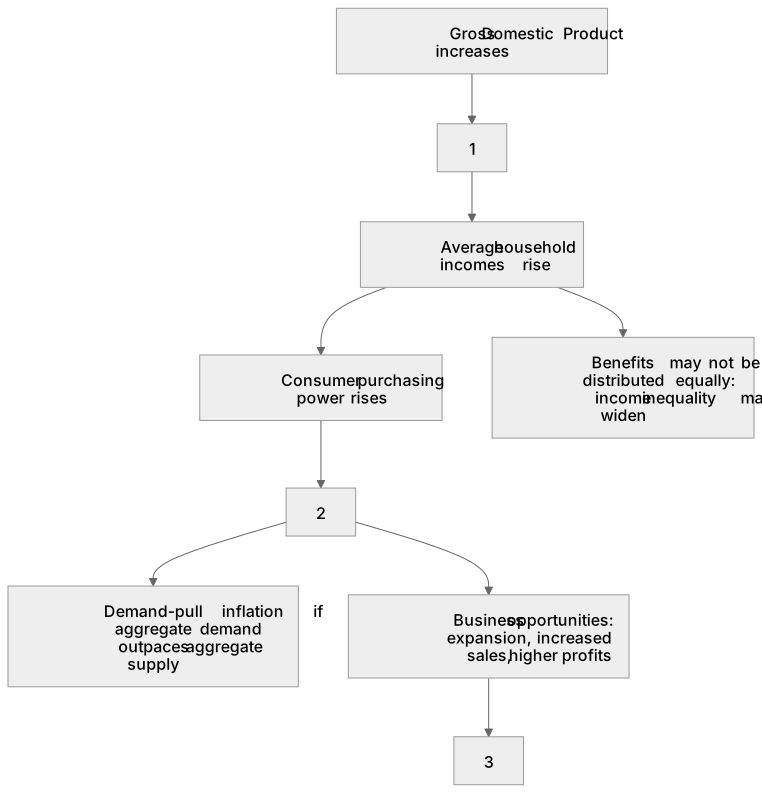
Rising incomes are a primary indicator of a growing economy. As Gross Domestic Product increases, national income rises, leading to higher average household incomes. This boosts consumer purchasing power, driving up aggregate demand for goods, especially normal and luxury items. For businesses, rising incomes create opportunities for expansion, increased sales, and higher profits, which stimulates further investment. However, rising incomes can trigger demand-pull inflation if aggregate demand outpaces aggregate supply. Additionally, the benefits might not be distributed equally, potentially widening income inequality. Understanding both the microeconomic impacts on businesses and the macroeconomic implications for inflation is essential.
What earns the marks
- Identify that rising incomes lead to an outward shift in aggregate demand.
- Explain the impact of rising incomes on the demand for normal and luxury goods using the concept of positive income elasticity of demand.
- Analyse how rising incomes can lead to demand-pull inflation if the economy is operating near full capacity.
- Evaluate the impact of rising incomes on business confidence, profitability, and capital investment.
- Discuss the potential for rising incomes to exacerbate income inequality if economic growth is not inclusive.
Common mistakes and how to put them right
Assuming rising incomes always lead to increased demand for all goods.
Put it right: Demand for inferior goods will fall as consumer incomes rise.
Confusing nominal income growth with real income growth.
Put it right: Real income growth accounts for inflation, whereas nominal income growth does not.
Believing rising incomes automatically reduce poverty.
Put it right: If income inequality worsens, relative poverty might increase despite rising average incomes.
Exam tips
- Always distinguish between nominal and real income when discussing the purchasing power of consumers.
- Use the concept of income elasticity of demand to explain how different types of businesses are affected by rising incomes.
- Consider the macroeconomic trade-offs, such as the potential conflict between economic growth and price stability.
Try the lesson
The start of the Growing economies: c) Rising incomes lesson, made from checked teaching notes for this specification point.
Have a go first
Which of the following is the most likely direct consequence of rising average incomes in a growing economy?
Listen
Rising incomes are a primary indicator of a growing economy. As Gross Domestic Product increases, national income rises, leading to higher average household incomes. This boosts consumer purchasing power, driving up aggregate demand for goods, especially normal and luxury items. For businesses, rising incomes create opportunities for expansion, increased sales, and higher profits, which stimulates further investment. However, rising incomes can trigger demand-pull inflation if aggregate demand outpaces aggregate supply. Additionally, the benefits might not be distributed equally, potentially widening income inequality. Understanding both the microeconomic impacts on businesses and the macroeconomic implications for inflation is essential. A strong answer earns marks for these points. Identify that rising incomes lead to an outward shift in aggregate demand. Explain the impact of rising incomes on the demand for normal and luxury goods using the concept of positive income elasticity of demand. Analyse how rising incomes can lead to demand-pull inflation if the economy is operating near full capacity. Evaluate the impact of rising incomes on business confidence, profitability, and capital investment. A common slip: Assuming rising incomes always lead to increased demand for all goods. Instead, demand for inferior goods will fall as consumer incomes rise. Exam tip: Always distinguish between nominal and real income when discussing the purchasing power of consumers.
See it
Key words
Say what each word means before you turn the card.
Aggregate demand
Try answering aloud or in your head before turning the card.
Demand-pull inflation
Try answering aloud or in your head before turning the card.
Income inequality
Try answering aloud or in your head before turning the card.
Real income growth
Try answering aloud or in your head before turning the card.
See every definition
- Aggregate demand
- The total demand for goods in an economy, which rising incomes drive up, especially for normal and luxury items.
- Demand-pull inflation
- Inflation that can be triggered when aggregate demand outpaces aggregate supply as incomes rise.
- Income inequality
- An unequal distribution of the benefits of growth, which rising incomes may widen if growth is not inclusive.
- Real income growth
- Growth in income that accounts for inflation, unlike nominal income growth.
Label the diagram
Some boxes have lost their names. Pick the right name for each number.
1Box 1
2Box 2
3Box 3
There is more to this lesson
The full lesson goes on to check your understanding and help you earn the marks. Create a free account to carry on, with your progress saved.
A week of Premium from your first lesson · Then the free plan continues · No card, no charge
Test your understanding of Growing economies: c) Rising incomes
Active recall beats re-reading. Take an instant quiz now to test what you’ve learned and lock it into long-term memory.
A week of Premium from your first lesson · Then the free plan continues · No card, no charge