Pearson Edexcel · A-Level · Economics B
Course version: 9EB0 · Version from Sept 2015
A) Objectives of growth: o to achieve economies of scale (internal and…
Full specification wording
Growth: a) Objectives of growth: o to achieve economies of scale (internal and external) o increased market power over consumers and suppliers o increased market share and brand recognition o increased profitability
Businesses pursue growth to achieve several strategic objectives.
Checked against the Pearson Edexcel 9EB0 specification (opens in a new tab) on .
- Point 1 of 3
- 4 key terms
Study notes
From the checked teaching notes for this specification point.
The idea
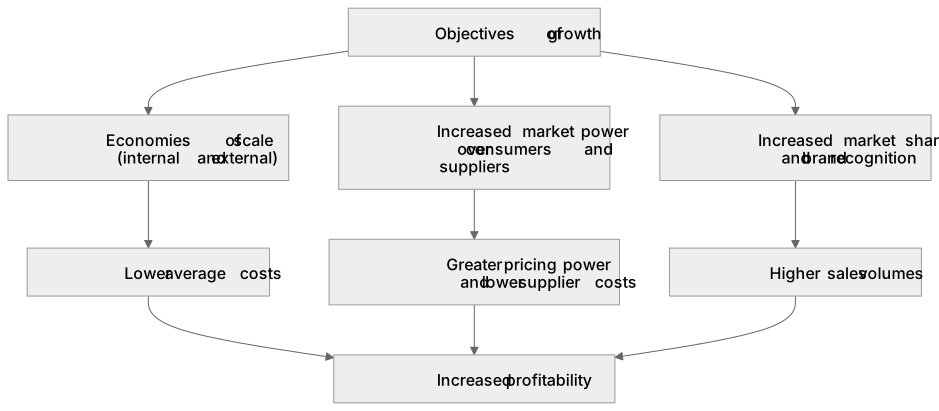
Businesses pursue growth to achieve several strategic objectives. A primary goal is to exploit internal economies of scale, such as purchasing economies from bulk buying, which reduce average costs. Growth can also lead to external economies of scale, like a better local infrastructure as an industry expands. Furthermore, larger firms gain increased market power, allowing them to dictate higher prices to consumers and negotiate lower costs from suppliers. Growth also drives increased market share and brand recognition, making it easier to attract and retain customers. Ultimately, these factors—lower average costs, greater pricing power, and higher sales volumes—combine to achieve the overarching objective of increased profitability.
What earns the marks
- Identifies internal economies of scale as reductions in long-run average costs resulting from the growth of the individual firm.
- Explains external economies of scale as cost reductions resulting from the growth of the industry as a whole.
- Describes how increased market power allows a firm to act as a price maker for consumers and a monopsonist for suppliers.
- Links increased market share and brand recognition to higher sales volumes and customer loyalty.
- Concludes that the combination of lower average costs and higher revenues leads to increased profitability.
Common mistakes and how to put them right
Confusing internal and external economies of scale.
Put it right: Internal economies relate to the firm's own growth (e.g. managerial economies), while external economies relate to the industry's growth (e.g. a pool of skilled labour).
Assuming growth always leads to increased profitability.
Put it right: Growth can lead to diseconomies of scale, where average costs rise due to communication or coordination issues, reducing profitability.
Equating market share with profitability.
Put it right: A firm can have a large market share but low profitability if it achieved that share through aggressive price cutting.
Exam tips
- When evaluating growth objectives, always consider the potential drawbacks, such as diseconomies of scale or regulatory intervention by the Competition and Markets Authority.
- Use specific examples of internal economies of scale, such as purchasing or technical economies, to strengthen your analysis.
- Clearly distinguish between market power over consumers (monopoly power) and market power over suppliers (monopsony power).
Try the lesson
The start of the Growth: a) Objectives of growth: o to achieve economies of scale (internal and external) o increased market power over consumers and suppliers o increased market share and brand recognition o increased profitability lesson, made from checked teaching notes for this specification point.
Have a go first
Which of the following is a primary objective for a business seeking to grow in order to achieve internal economies of scale?
Listen
Businesses pursue growth to achieve several strategic objectives. A primary goal is to exploit internal economies of scale, such as purchasing economies from bulk buying, which reduce average costs. Growth can also lead to external economies of scale, like a better local infrastructure as an industry expands. Furthermore, larger firms gain increased market power, allowing them to dictate higher prices to consumers and negotiate lower costs from suppliers. Growth also drives increased market share and brand recognition, making it easier to attract and retain customers. Ultimately, these factors—lower average costs, greater pricing power, and higher sales volumes—combine to achieve the overarching objective of increased profitability. A strong answer earns marks for these points. Identifies internal economies of scale as reductions in long-run average costs resulting from the growth of the individual firm. Explains external economies of scale as cost reductions resulting from the growth of the industry as a whole. Describes how increased market power allows a firm to act as a price maker for consumers and a monopsonist for suppliers. Links increased market share and brand recognition to higher sales volumes and customer loyalty. A common slip: Confusing internal and external economies of scale. Instead, internal economies relate to the firm's own growth (e.g. managerial economies), while external economies relate to the industry's growth (e.g. a pool of skilled labour). Exam tip: When evaluating growth objectives, always consider the potential drawbacks, such as diseconomies of scale or regulatory intervention by the Competition and Markets Authority.
See it
Key words
Say what each word means before you turn the card.
Economies of scale
Try answering aloud or in your head before turning the card.
Market power
Try answering aloud or in your head before turning the card.
Market share
Try answering aloud or in your head before turning the card.
Profitability
Try answering aloud or in your head before turning the card.
See every definition
- Economies of scale
- Reductions in average costs that a business can achieve through growth, either internal to the firm or external as the industry expands.
- Market power
- The ability of a larger firm to dictate higher prices to consumers and negotiate lower costs from suppliers.
- Market share
- The portion of a market held by a firm, which growth can increase alongside brand recognition.
- Profitability
- The overarching objective achieved when lower average costs, greater pricing power and higher sales volumes combine.
Label the diagram
Some boxes have lost their names. Pick the right name for each number.
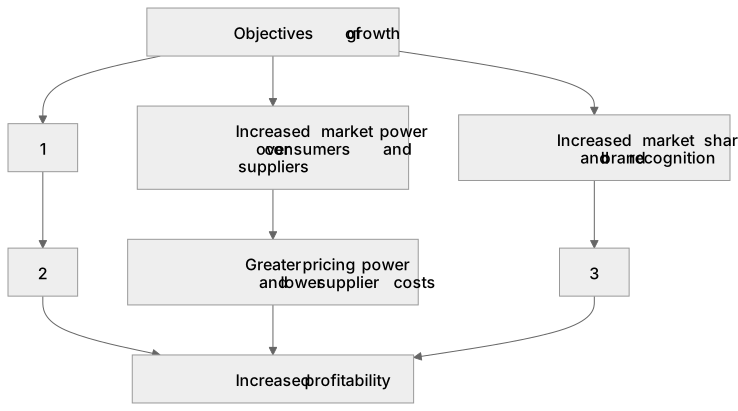
1Box 1
2Box 2
3Box 3
There is more to this lesson
The full lesson goes on to check your understanding and help you earn the marks. Create a free account to carry on, with your progress saved.
A week of Premium from your first lesson · Then the free plan continues · No card, no charge
Test your understanding of Growth: a) Objectives of growth: o to achieve economies of scale (internal and external) o increased market power over consumers and suppliers o increased market share and brand recognition o increased profitability
Active recall beats re-reading. Take an instant quiz now to test what you’ve learned and lock it into long-term memory.
A week of Premium from your first lesson · Then the free plan continues · No card, no charge