Pearson Edexcel · A-Level · Economics B
Course version: 9EB0 · Version from Sept 2015
B) Problems arising from growth: o diseconomies of scale o internal…
Full specification wording
Growth: b) Problems arising from growth: o diseconomies of scale o internal communication o potential skills shortages
As businesses grow, they may encounter problems that hinder efficiency.
Checked against the Pearson Edexcel 9EB0 specification (opens in a new tab) on .
- Point 2 of 3
- 3 key terms
Study notes
From the checked teaching notes for this specification point.
The idea
As businesses grow, they may encounter problems that hinder efficiency. Diseconomies of scale occur when a firm expands beyond its optimum size, causing long-run average costs to rise. This often stems from internal communication breakdowns; as organisational structures gain more layers, messages can become distorted or delayed, reducing agility. Furthermore, rapid expansion can lead to potential skills shortages. A growing firm might struggle to recruit enough qualified staff to meet increased demand, forcing it to pay higher wages or accept lower productivity.
For example: A scaling tech firm might find its informal communication failing while facing a shortage of engineers, driving up average costs and reducing its overall competitiveness.
What earns the marks
- Identification of diseconomies of scale as rising long-run average costs due to excessive expansion.
- Explanation of how increased hierarchical layers lead to poor internal communication and slower decision-making.
- Analysis of how potential skills shortages constrain growth by limiting output or increasing labour costs.
- Application of these growth problems to a specific business context, showing the impact on profitability.
Common mistakes and how to put them right
Confusing diseconomies of scale with diminishing returns.
Put it right: Diminishing returns occur in the short run, whereas diseconomies of scale are a long-run phenomenon.
Assuming all growth leads to economies of scale.
Put it right: Growth beyond the minimum efficient scale can actually increase average costs.
Overlooking the impact of skills shortages; students often focus only on capital or structural issues, forgetting that a lack of qualified labour directly increases costs and limits expansion.
Exam tips
- Always link internal communication issues to the concept of diseconomies of scale by explaining how delays increase average costs.
- Use a diagram showing the long-run average cost curve turning upwards to illustrate diseconomies of scale effectively.
- When evaluating growth strategies, weigh the benefits of expansion against the risks of skills shortages and communication breakdowns.
Try the lesson
The start of the Growth: b) Problems arising from growth: o diseconomies of scale o internal communication o potential skills shortages lesson, made from checked teaching notes for this specification point.
Have a go first
As a business grows significantly in size, which of the following is a common problem associated with internal communication?
Listen
As businesses grow, they may encounter problems that hinder efficiency. Diseconomies of scale occur when a firm expands beyond its optimum size, causing long-run average costs to rise. This often stems from internal communication breakdowns; as organisational structures gain more layers, messages can become distorted or delayed, reducing agility. Furthermore, rapid expansion can lead to potential skills shortages. A growing firm might struggle to recruit enough qualified staff to meet increased demand, forcing it to pay higher wages or accept lower productivity. For example, a scaling tech firm might find its informal communication failing while facing a shortage of engineers, driving up average costs and reducing its overall competitiveness. A strong answer earns marks for these points. Identification of diseconomies of scale as rising long-run average costs due to excessive expansion. Explanation of how increased hierarchical layers lead to poor internal communication and slower decision-making. Analysis of how potential skills shortages constrain growth by limiting output or increasing labour costs. Application of these growth problems to a specific business context, showing the impact on profitability. Exam tip: Always link internal communication issues to the concept of diseconomies of scale by explaining how delays increase average costs.
See it
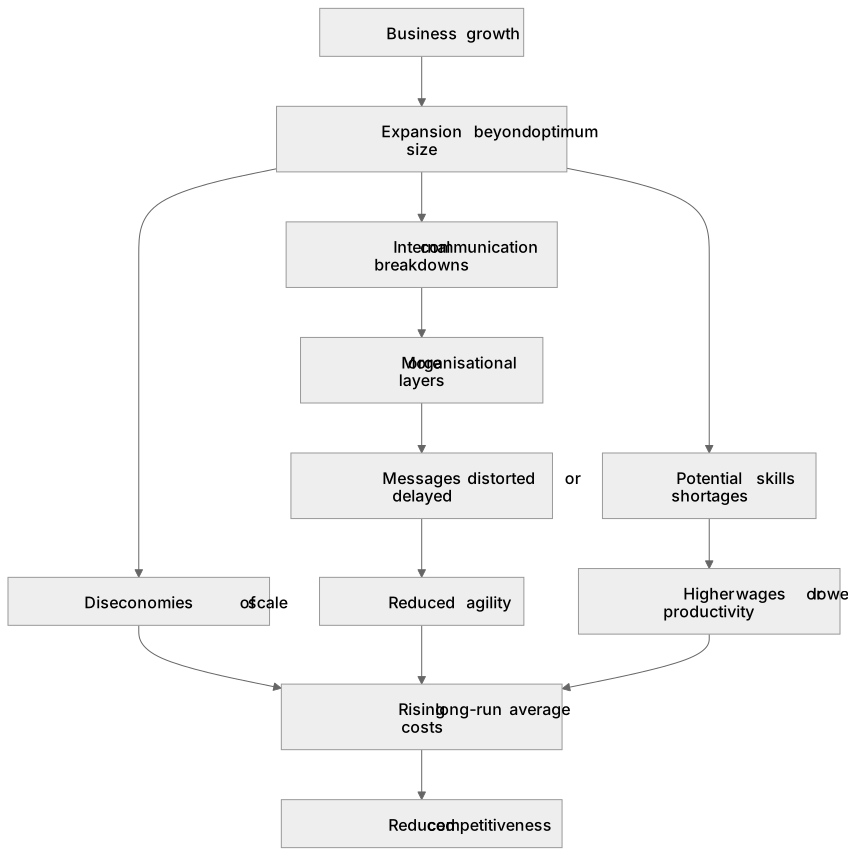
Key words
Say what each word means before you turn the card.
Diseconomies of scale
Try answering aloud or in your head before turning the card.
Internal communication
Try answering aloud or in your head before turning the card.
Potential skills shortages
Try answering aloud or in your head before turning the card.
See every definition
- Diseconomies of scale
- Occur when a firm expands beyond its optimum size, causing long-run average costs to rise.
- Internal communication
- Breakdowns in this can occur as organisational structures gain more layers, so messages become distorted or delayed, reducing agility.
- Potential skills shortages
- Rapid expansion can leave a growing firm struggling to recruit enough qualified staff to meet increased demand, forcing it to pay higher wages or accept lower productivity.
Label the diagram
Some boxes have lost their names. Pick the right name for each number.
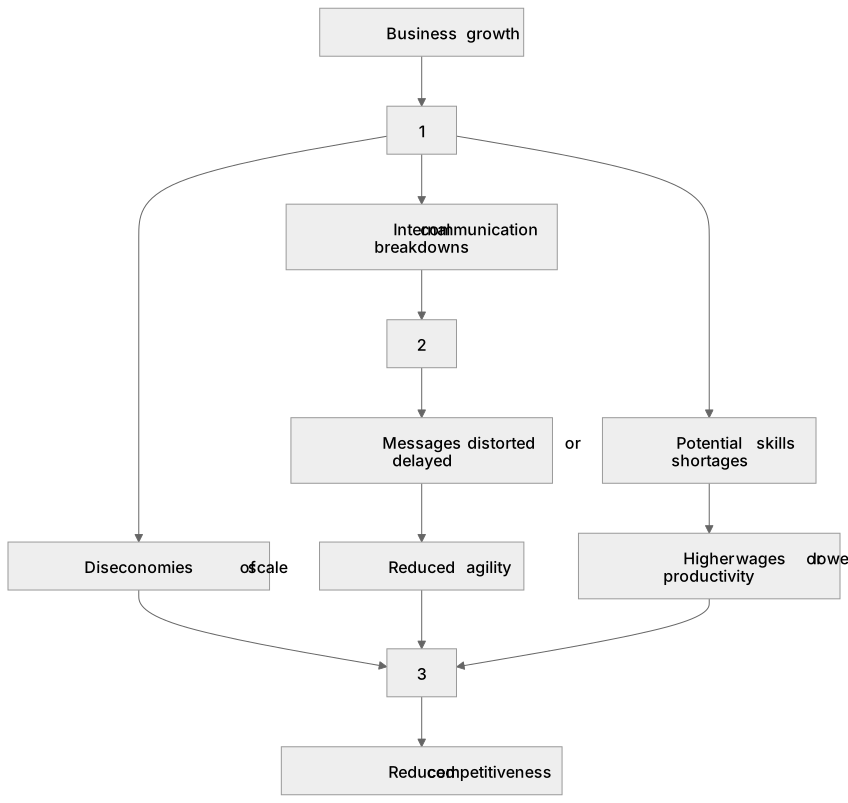
1Box 1
2Box 2
3Box 3
There is more to this lesson
The full lesson goes on to check your understanding and help you earn the marks. Create a free account to carry on, with your progress saved.
A week of Premium from your first lesson · Then the free plan continues · No card, no charge
Test your understanding of Growth: b) Problems arising from growth: o diseconomies of scale o internal communication o potential skills shortages
Active recall beats re-reading. Take an instant quiz now to test what you’ve learned and lock it into long-term memory.
A week of Premium from your first lesson · Then the free plan continues · No card, no charge