Pearson Edexcel · A-Level · Economics B
Course version: 9EB0 · Version from Sept 2015
Growth: c) The role of corporate culture
Corporate culture refers to the shared values, beliefs, and norms influencing how employees behave within a business.
Checked against the Pearson Edexcel 9EB0 specification (opens in a new tab) on .
- Point 3 of 3
- 4 key terms
Study notes
From the checked teaching notes for this specification point.
The idea
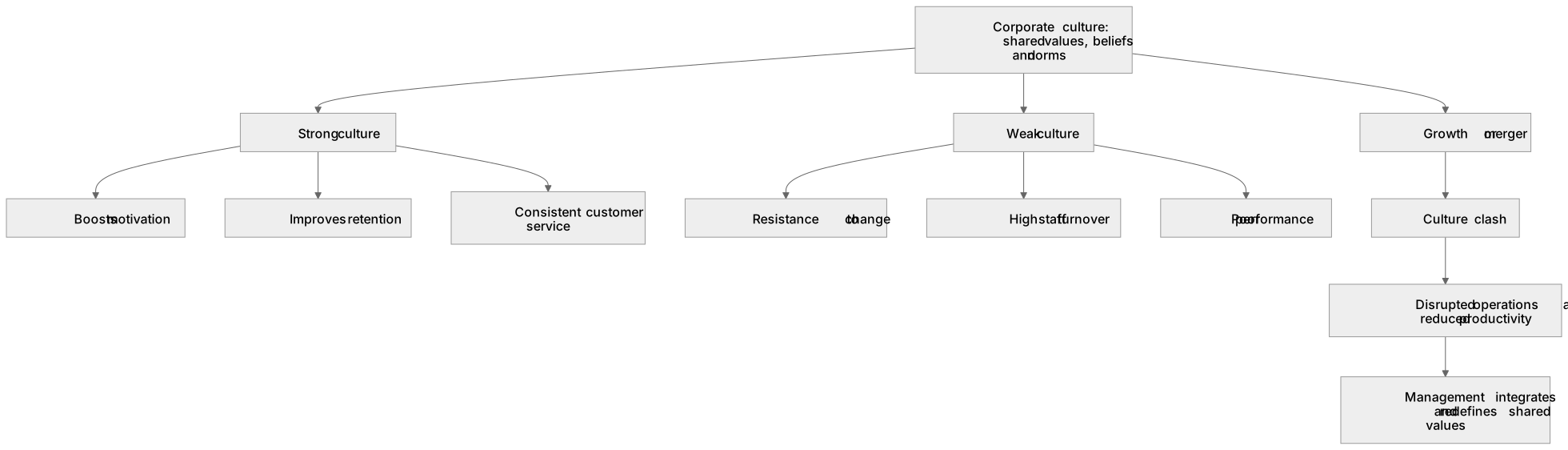
Corporate culture refers to the shared values, beliefs, and norms influencing how employees behave within a business. As a firm grows, maintaining a cohesive culture becomes challenging but vital. A strong culture can boost motivation, improve retention, and ensure consistent customer service, acting as a unifying force during expansion. Conversely, a weak culture can lead to resistance to change, high staff turnover, and poor performance. For example, if a small business with a collaborative culture merges with a bureaucratic corporation, a culture clash may occur. This misalignment disrupts operations and reduces productivity unless management actively integrates and redefines the shared values to align with new strategic objectives.
What earns the marks
- Definition of corporate culture as the shared values, beliefs, and attitudes within an organisation.
- Explanation of how a strong corporate culture improves employee motivation and productivity.
- Analysis of the difficulties in maintaining or changing corporate culture during business growth or mergers.
- Evaluation of the impact of culture clashes on operational efficiency and staff retention.
Common mistakes and how to put them right
Treating corporate culture as a tangible asset.
Put it right: Culture is intangible and must be inferred from behaviours and norms, not just mission statements.
Assuming corporate culture is uniform across a large organisation.
Put it right: Subcultures often exist in different departments or branches, which must be acknowledged.
Ignoring the role of leadership; students sometimes forget that corporate culture is heavily influenced and driven by the actions and attitudes of senior management.
Exam tips
- Use real-world examples of companies known for their strong corporate culture to illustrate how it provides a competitive advantage.
- When discussing mergers and acquisitions, always consider the potential for a culture clash as a major reason for integration failure.
- Link corporate culture to human resources metrics, such as labour turnover and absenteeism, to provide quantitative impacts of qualitative issues.
Try the lesson
The start of the Growth: c) The role of corporate culture lesson, made from checked teaching notes for this specification point.
Have a go first
Which of the following best describes the concept of corporate culture within a business organisation?
Listen
Corporate culture refers to the shared values, beliefs, and norms influencing how employees behave within a business. As a firm grows, maintaining a cohesive culture becomes challenging but vital. A strong culture can boost motivation, improve retention, and ensure consistent customer service, acting as a unifying force during expansion. Conversely, a weak culture can lead to resistance to change, high staff turnover, and poor performance. For example, if a small business with a collaborative culture merges with a bureaucratic corporation, a culture clash may occur. This misalignment disrupts operations and reduces productivity unless management actively integrates and redefines the shared values to align with new strategic objectives. A strong answer earns marks for these points. Definition of corporate culture as the shared values, beliefs, and attitudes within an organisation. Explanation of how a strong corporate culture improves employee motivation and productivity. Analysis of the difficulties in maintaining or changing corporate culture during business growth or mergers. Evaluation of the impact of culture clashes on operational efficiency and staff retention. Exam tip: Use real-world examples of companies known for their strong corporate culture to illustrate how it provides a competitive advantage.
See it
Key words
Say what each word means before you turn the card.
Corporate culture
Try answering aloud or in your head before turning the card.
Culture clash
Try answering aloud or in your head before turning the card.
Mergers and acquisitions
Try answering aloud or in your head before turning the card.
Employee motivation
Try answering aloud or in your head before turning the card.
See every definition
- Corporate culture
- The shared values, beliefs, and norms influencing how employees behave within a business.
- Culture clash
- A misalignment that may occur when a small business with a collaborative culture merges with a bureaucratic corporation, disrupting operations and reducing productivity.
- Mergers and acquisitions
- External growth in which a culture clash may occur and is a major reason for integration failure.
- Employee motivation
- Something a strong corporate culture can boost, alongside improving retention and ensuring consistent customer service.
Label the diagram
Some boxes have lost their names. Pick the right name for each number.
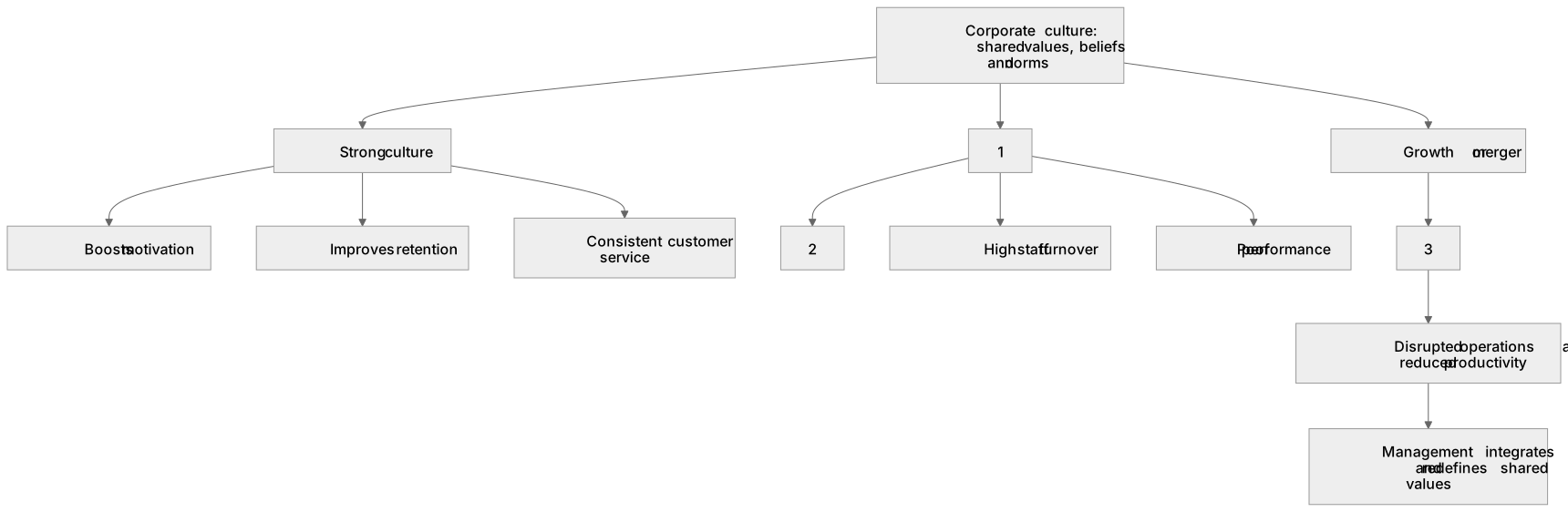
1Box 1
2Box 2
3Box 3
There is more to this lesson
The full lesson goes on to check your understanding and help you earn the marks. Create a free account to carry on, with your progress saved.
A week of Premium from your first lesson · Then the free plan continues · No card, no charge
Test your understanding of Growth: c) The role of corporate culture
Active recall beats re-reading. Take an instant quiz now to test what you’ve learned and lock it into long-term memory.
A week of Premium from your first lesson · Then the free plan continues · No card, no charge