Pearson Edexcel · A-Level · Economics B
Course version: 9EB0 · Version from Sept 2015
E) The impact of inflation on firms: o uncertainty o loss of international…
Full specification wording
Inflation: e) The impact of inflation on firms: o uncertainty o loss of international competitiveness
Inflation impacts firms through increased uncertainty and a loss of international competitiveness.
Checked against the Pearson Edexcel 9EB0 specification (opens in a new tab) on .
- Point 5 of 6
- 2 key terms
Study notes
From the checked teaching notes for this specification point.
The idea
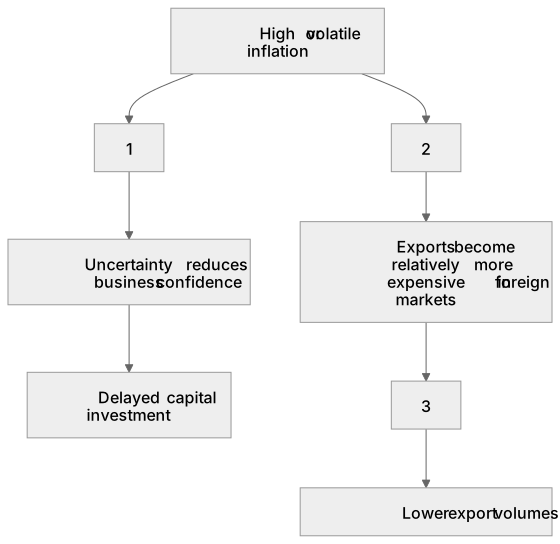
Inflation impacts firms through increased uncertainty and a loss of international competitiveness. When inflation is high or volatile, firms struggle to forecast future costs and revenues accurately. This uncertainty often leads to delayed capital investment, as the expected return on investment becomes harder to calculate. Furthermore, if domestic inflation exceeds that of trading partners, a firm's exports become relatively more expensive in foreign markets. For example, a UK manufacturer facing 8% inflation while European competitors face 2% will see its prices rise faster. Assuming exchange rates remain constant, this leads to a loss of international competitiveness and lower export volumes.
What earns the marks
- Identifies that high or volatile inflation creates uncertainty for firms regarding future costs and revenues.
- Explains that uncertainty reduces business confidence, leading to lower levels of capital investment.
- Recognises that domestic inflation higher than trading partners increases the relative price of exports.
- Explains that higher export prices lead to a loss of international competitiveness and reduced export demand.
Common mistakes and how to put them right
Assuming inflation always benefits firms by allowing them to charge higher prices.
Put it right: Firms also face higher input costs, and if prices rise too fast, demand may fall, especially in competitive markets.
Stating that inflation pushes up export prices regardless of exchange rate movements.
Put it right: A depreciation in the domestic currency's exchange rate can offset the impact of domestic inflation, meaning foreign-currency export prices may not actually rise.
Stating that uncertainty only affects consumers.
Put it right: Uncertainty heavily impacts firms, particularly by delaying long-term investment decisions due to unpredictable future profitability.
Exam tips
- When evaluating the impact of inflation on competitiveness, always compare the domestic inflation rate to that of key trading partners.
- Use the concept of menu costs to explain the practical difficulties firms face when constantly updating prices during periods of high inflation.
- Link the uncertainty caused by inflation directly to a reduction in foreign direct investment as well as domestic investment.
Try the lesson
The start of the Inflation: e) The impact of inflation on firms: o uncertainty o loss of international competitiveness lesson, made from checked teaching notes for this specification point.
Have a go first
Which of the following best explains why a high rate of domestic inflation can lead to a loss of international competitiveness for a firm?
Listen
Inflation impacts firms through increased uncertainty and a loss of international competitiveness. When inflation is high or volatile, firms struggle to forecast future costs and revenues accurately. This uncertainty often leads to delayed capital investment, as the expected return on investment becomes harder to calculate. Furthermore, if domestic inflation exceeds that of trading partners, a firm's exports become relatively more expensive in foreign markets. For example, a UK manufacturer facing 8% inflation while European competitors face 2% will see its prices rise faster. Assuming exchange rates remain constant, this leads to a loss of international competitiveness and lower export volumes. A strong answer earns marks for these points. Identifies that high or volatile inflation creates uncertainty for firms regarding future costs and revenues. Explains that uncertainty reduces business confidence, leading to lower levels of capital investment. Recognises that domestic inflation higher than trading partners increases the relative price of exports. Explains that higher export prices lead to a loss of international competitiveness and reduced export demand. A common slip: Assuming inflation always benefits firms by allowing them to charge higher prices. Instead, Firms also face higher input costs, and if prices rise too fast, demand may fall, especially in competitive markets. Exam tip: When evaluating the impact of inflation on competitiveness, always compare the domestic inflation rate to that of key trading partners.
See it

Key words
Say what each word means before you turn the card.
Business uncertainty
Try answering aloud or in your head before turning the card.
Investment
Try answering aloud or in your head before turning the card.
See every definition
- Business uncertainty
- Arises when high or volatile inflation makes future costs and revenues difficult to forecast, reducing business confidence.
- Investment
- Capital spending that is often delayed when uncertainty makes the expected return harder to calculate.
Label the diagram
Some boxes have lost their names. Pick the right name for each number.
1Box 1
2Box 2
3Box 3
There is more to this lesson
The full lesson goes on to check your understanding and help you earn the marks. Create a free account to carry on, with your progress saved.
A week of Premium from your first lesson · Then the free plan continues · No card, no charge
Test your understanding of Inflation: e) The impact of inflation on firms: o uncertainty o loss of international competitiveness
Active recall beats re-reading. Take an instant quiz now to test what you’ve learned and lock it into long-term memory.
A week of Premium from your first lesson · Then the free plan continues · No card, no charge