Pearson Edexcel · A-Level · Economics B
Course version: 9EB0 · Version from Sept 2015
F) The impact of inflation on individuals: o loss of real income o savers…
Full specification wording
Inflation: f) The impact of inflation on individuals: o loss of real income o savers and borrowers
Inflation affects individuals primarily through a loss of real income and by altering the real value of savings and debt.
Checked against the Pearson Edexcel 9EB0 specification (opens in a new tab) on .
- Point 6 of 6
- 4 key terms
Study notes
From the checked teaching notes for this specification point.
The idea
Inflation affects individuals primarily through a loss of real income and by altering the real value of savings and debt. Real income falls when the rate of inflation exceeds the rate of nominal wage growth, meaning individuals can purchase fewer goods and services with their earnings, reducing their standard of living. For example, if nominal wages rise by 3% but inflation is 5%, real income falls by 2%. Furthermore, inflation redistributes wealth between savers and borrowers. Savers lose out because the real purchasing power of their savings diminishes if the interest rate is lower than inflation. Conversely, borrowers benefit as the real value of their debt decreases, making it easier to repay over time.
What earns the marks
- Defines real income as nominal income adjusted for the rate of inflation.
- Explains that individuals experience a fall in living standards when inflation outstrips nominal wage increases.
- Identifies that inflation erodes the real value of money, negatively impacting savers if interest rates do not keep pace.
- Explains that borrowers benefit from inflation because the real value of their outstanding debt falls.
Common mistakes and how to put them right
Stating that inflation always makes everyone poorer.
Put it right: Borrowers can actually benefit from inflation because the real value of their debt decreases.
Confusing nominal income with real income.
Put it right: Nominal income is the monetary amount earned, whereas real income measures the purchasing power of that money after accounting for inflation.
Assuming savers always lose during inflation.
Put it right: Savers only lose if the rate of inflation is higher than the nominal interest rate they receive on their savings, resulting in a negative real interest rate.
Exam tips
- Always distinguish between nominal and real values when discussing the impact of inflation on wages and savings.
- Use a numerical example to demonstrate how a negative real interest rate erodes the purchasing power of savings over time.
- Consider the distributional effects of inflation, noting that those on fixed incomes suffer more than those whose wages are index-linked.
Try the lesson
The start of the Inflation: f) The impact of inflation on individuals: o loss of real income o savers and borrowers lesson, made from checked teaching notes for this specification point.
Have a go first
How does a period of unexpectedly high inflation typically affect individuals who are borrowers and savers?
Listen
Inflation affects individuals primarily through a loss of real income and by altering the real value of savings and debt. Real income falls when the rate of inflation exceeds the rate of nominal wage growth, meaning individuals can purchase fewer goods and services with their earnings, reducing their standard of living. For example, if nominal wages rise by 3% but inflation is 5%, real income falls by 2%. Furthermore, inflation redistributes wealth between savers and borrowers. Savers lose out because the real purchasing power of their savings diminishes if the interest rate is lower than inflation. Conversely, borrowers benefit as the real value of their debt decreases, making it easier to repay over time. A strong answer earns marks for these points. Defines real income as nominal income adjusted for the rate of inflation. Explains that individuals experience a fall in living standards when inflation outstrips nominal wage increases. Identifies that inflation erodes the real value of money, negatively impacting savers if interest rates do not keep pace. Explains that borrowers benefit from inflation because the real value of their outstanding debt falls. A common slip: Stating that inflation always makes everyone poorer. Instead, Borrowers can actually benefit from inflation because the real value of their debt decreases. Exam tip: Always distinguish between nominal and real values when discussing the impact of inflation on wages and savings.
See it
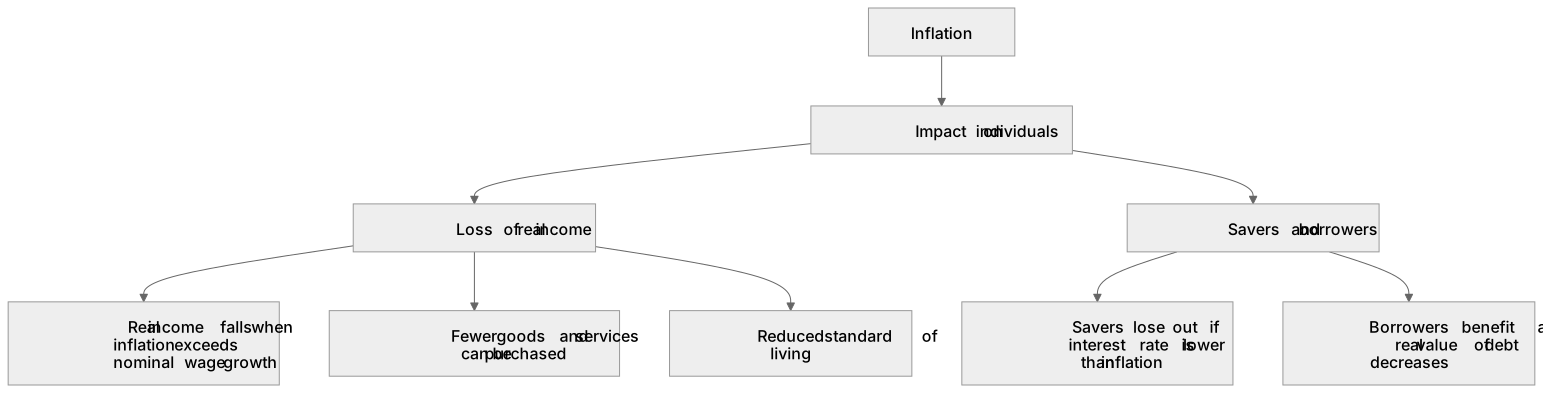
Key words
Say what each word means before you turn the card.
Real income
Try answering aloud or in your head before turning the card.
Purchasing power
Try answering aloud or in your head before turning the card.
Savings and borrowing
Try answering aloud or in your head before turning the card.
Standard of living
Try answering aloud or in your head before turning the card.
See every definition
- Real income
- Nominal income adjusted for the rate of inflation, so it measures the purchasing power of earnings.
- Purchasing power
- The amount of goods and services money can buy, which diminishes for savings if the interest rate is lower than inflation.
- Savings and borrowing
- Inflation redistributes wealth between savers and borrowers, as savers lose out while borrowers benefit from the falling real value of their debt.
- Standard of living
- Reduced when inflation outstrips nominal wage increases, as individuals can purchase fewer goods and services with their earnings.
Label the diagram
Some boxes have lost their names. Pick the right name for each number.
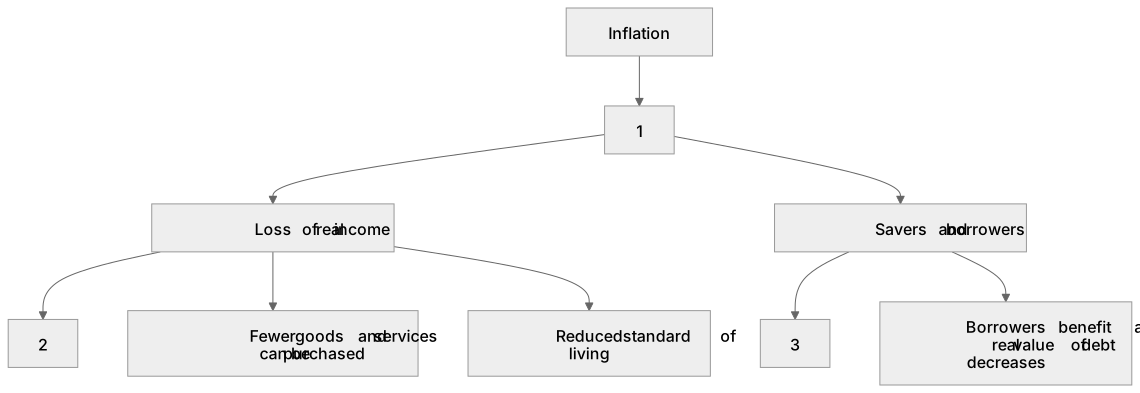
1Box 1
2Box 2
3Box 3
There is more to this lesson
The full lesson goes on to check your understanding and help you earn the marks. Create a free account to carry on, with your progress saved.
A week of Premium from your first lesson · Then the free plan continues · No card, no charge
Test your understanding of Inflation: f) The impact of inflation on individuals: o loss of real income o savers and borrowers
Active recall beats re-reading. Take an instant quiz now to test what you’ve learned and lock it into long-term memory.
A week of Premium from your first lesson · Then the free plan continues · No card, no charge