Pearson Edexcel · A-Level · Economics B
Course version: 9EB0 · Version from Sept 2015
International trade: a) Specialisation and international trade
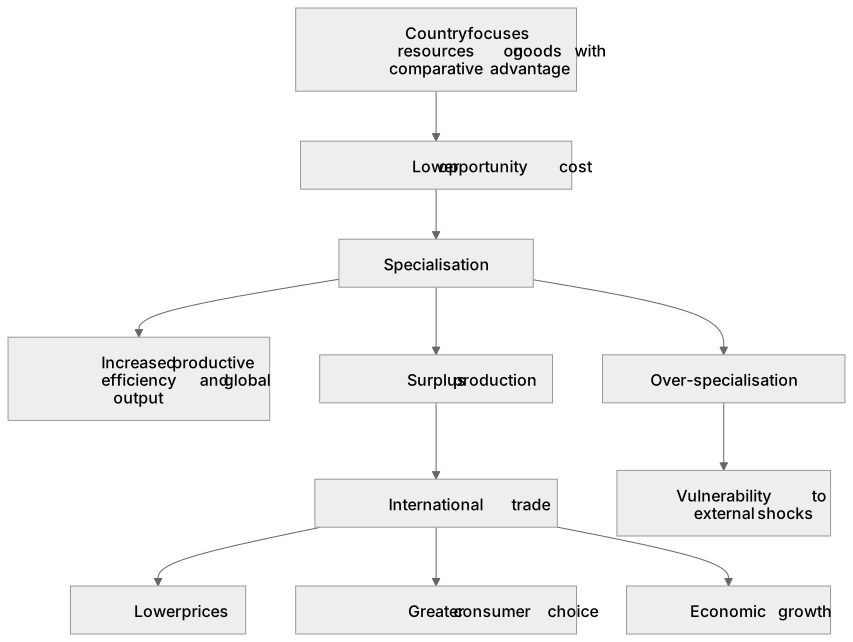
Specialisation occurs when a country focuses resources on producing goods where it holds a comparative advantage, meaning it produces them at a lower opportunity cost.
Checked against the Pearson Edexcel 9EB0 specification (opens in a new tab) on .
- Point 1 of 3
- 4 key terms
Study notes
From the checked teaching notes for this specification point.
The idea
Specialisation occurs when a country focuses resources on producing goods where it holds a comparative advantage, meaning it produces them at a lower opportunity cost. By specialising, countries increase productive efficiency and global output. International trade allows nations to exchange surplus production for goods they cannot produce efficiently. For example, an emerging economy might specialise in textiles, while a developed economy focuses on financial services. This exchange leads to lower prices, greater consumer choice, and economic growth. However, over-specialisation leaves economies vulnerable to external shocks, such as sudden changes in global commodity prices, highlighting the risks of relying heavily on international trade.
What earns the marks
- Defines specialisation at a national level as focusing on specific goods or services.
- Explains comparative advantage and lower opportunity cost as the basis for trade.
- Identifies benefits of trade, such as increased global output, lower prices, and greater choice.
- Recognises the risks of over-specialisation, including vulnerability to external economic shocks.
Common mistakes and how to put them right
Confusing absolute and comparative advantage.
Put it right: Understanding specialisation is based on lowest opportunity cost.
Ignoring the risks of specialisation.
Put it right: Evaluating the risks, such as structural unemployment if global demand shifts.
Misunderstanding opportunity cost: The error is defining it as financial cost; the correction is defining it as the value of the next best alternative foregone.
Exam tips
- Always link specialisation to opportunity cost when explaining why countries choose to trade specific goods.
- Use real-world examples of countries specialising in primary, secondary, or tertiary sectors to strengthen your analysis.
- When evaluating international trade, contrast the benefits of lower consumer prices with the risks of domestic structural unemployment.
Try the lesson
The start of the International trade: a) Specialisation and international trade lesson, made from checked teaching notes for this specification point.
Have a go first
What is the primary economic rationale for a country to specialise in the production of a specific good for international trade?
Listen
Specialisation occurs when a country focuses resources on producing goods where it holds a comparative advantage, meaning it produces them at a lower opportunity cost. By specialising, countries increase productive efficiency and global output. International trade allows nations to exchange surplus production for goods they cannot produce efficiently. For example, an emerging economy might specialise in textiles, while a developed economy focuses on financial services. This exchange leads to lower prices, greater consumer choice, and economic growth. However, over-specialisation leaves economies vulnerable to external shocks, such as sudden changes in global commodity prices, highlighting the risks of relying heavily on international trade. A strong answer earns marks for these points. Defines specialisation at a national level as focusing on specific goods or services. Explains comparative advantage and lower opportunity cost as the basis for trade. Identifies benefits of trade, such as increased global output, lower prices, and greater choice. Recognises the risks of over-specialisation, including vulnerability to external economic shocks. A common slip: Confusing absolute and comparative advantage: The error is thinking a country must be the best at producing something to specialise. Instead, understanding specialisation is based on lowest opportunity cost. Exam tip: Always link specialisation to opportunity cost when explaining why countries choose to trade specific goods.
See it
Key words
Say what each word means before you turn the card.
Specialisation
Try answering aloud or in your head before turning the card.
Comparative advantage
Try answering aloud or in your head before turning the card.
Opportunity cost
Try answering aloud or in your head before turning the card.
Over-specialisation
Try answering aloud or in your head before turning the card.
See every definition
- Specialisation
- When a country focuses resources on producing goods where it holds a comparative advantage, meaning it produces them at a lower opportunity cost.
- Comparative advantage
- Producing goods at a lower opportunity cost, which is the basis for specialisation and trade.
- Opportunity cost
- The value of the next best alternative foregone.
- Over-specialisation
- Relying heavily on a narrow range of exports, which leaves economies vulnerable to external shocks such as sudden changes in global commodity prices.
Label the diagram
Some boxes have lost their names. Pick the right name for each number.
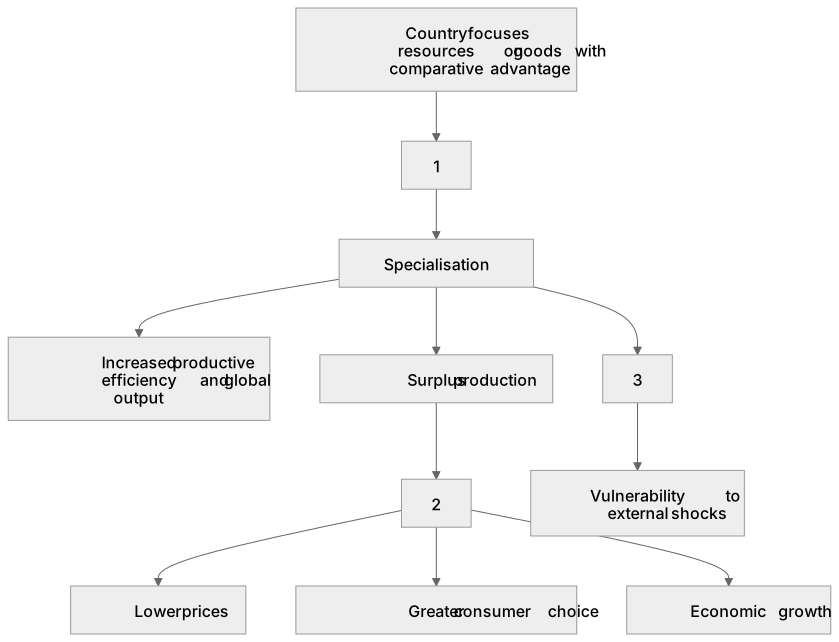
1Box 1
2Box 2
3Box 3
There is more to this lesson
The full lesson goes on to check your understanding and help you earn the marks. Create a free account to carry on, with your progress saved.
A week of Premium from your first lesson · Then the free plan continues · No card, no charge
Test your understanding of International trade: a) Specialisation and international trade
Active recall beats re-reading. Take an instant quiz now to test what you’ve learned and lock it into long-term memory.
A week of Premium from your first lesson · Then the free plan continues · No card, no charge