Pearson Edexcel · A-Level · Economics B
Course version: 9EB0 · Version from Sept 2015
International trade: b) Trading blocs
Trading blocs are intergovernmental agreements where regional trade barriers, such as tariffs, are reduced or eliminated.
Checked against the Pearson Edexcel 9EB0 specification (opens in a new tab) on .
- Point 2 of 3
- 4 key terms
Study notes
From the checked teaching notes for this specification point.
The idea
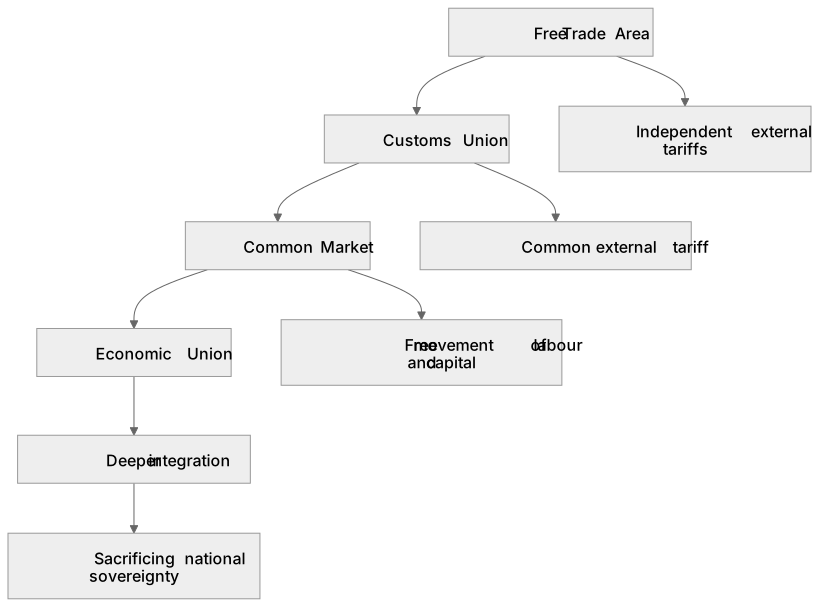
Trading blocs are intergovernmental agreements where regional trade barriers, such as tariffs, are reduced or eliminated. They range from Free Trade Areas (like USMCA, with independent external tariffs) to Customs Unions (adding a common external tariff), Common Markets (allowing free movement of labour and capital), and Economic Unions (like the EU). Trading blocs encourage trade creation by shifting production to more efficient member states, generating economies of scale and attracting foreign direct investment. However, they can cause trade diversion if members must buy from less efficient bloc members due to external tariffs, and deeper integration requires sacrificing national sovereignty.
What earns the marks
- Identify the type of trading bloc based on its characteristics, such as recognising that a common external tariff indicates a customs union.
- Explain trade creation as the replacement of expensive domestic production with cheaper imports from a member state.
- Explain trade diversion as the replacement of cheaper imports from the rest of the world with more expensive imports from a member state.
- Analyse the impact of trading blocs on business costs, such as reduced administrative burdens and tariff-free access to larger markets.
- Evaluate the loss of independent trade policy when joining a customs union or deeper integration bloc.
Common mistakes and how to put them right
Mistaking a free trade area for a customs union.
Put it right by remembering that only customs unions and deeper blocs have a common external tariff.
Assuming trading blocs always increase global free trade.
Put it right by recognising that while they liberalise internal trade, they can raise protectionist barriers against non-members.
Confusing trade creation with trade diversion.
Put it right by defining trade creation as shifting to a more efficient producer, whereas trade diversion shifts trade to a less efficient producer inside the bloc.
Exam tips
- Use specific real-world examples of trading blocs, such as the EU or ASEAN, to contextualise your analysis of their economic impacts.
- When evaluating the benefits of a trading bloc, contrast the gains from economies of scale against the potential loss of domestic industries unable to compete.
- Read multiple-choice options carefully to distinguish between the defining features of common markets versus economic unions.
Try the lesson
The start of the International trade: b) Trading blocs lesson, made from checked teaching notes for this specification point.
Have a go first
Which of the following best describes a customs union, a specific type of trading bloc?
Listen
Trading blocs are intergovernmental agreements where regional trade barriers, such as tariffs, are reduced or eliminated. They range from Free Trade Areas (like USMCA, with independent external tariffs) to Customs Unions (adding a common external tariff), Common Markets (allowing free movement of labour and capital), and Economic Unions (like the EU). Trading blocs encourage trade creation by shifting production to more efficient member states, generating economies of scale and attracting foreign direct investment. However, they can cause trade diversion if members must buy from less efficient bloc members due to external tariffs, and deeper integration requires sacrificing national sovereignty. A strong answer earns marks for these points. Identify the type of trading bloc based on its characteristics, such as recognising that a common external tariff indicates a customs union. Explain trade creation as the replacement of expensive domestic production with cheaper imports from a member state. Explain trade diversion as the replacement of cheaper imports from the rest of the world with more expensive imports from a member state. Analyse the impact of trading blocs on business costs, such as reduced administrative burdens and tariff-free access to larger markets. A common slip: Mistaking a free trade area for a customs union. Instead, remembering that only customs unions and deeper blocs have a common external tariff. Exam tip: Use specific real-world examples of trading blocs, such as the EU or ASEAN, to contextualise your analysis of their economic impacts.
See it
Key words
Say what each word means before you turn the card.
Trading blocs
Try answering aloud or in your head before turning the card.
Trade creation
Try answering aloud or in your head before turning the card.
Trade diversion
Try answering aloud or in your head before turning the card.
Customs union
Try answering aloud or in your head before turning the card.
See every definition
- Trading blocs
- Intergovernmental agreements where regional trade barriers, such as tariffs, are reduced or eliminated.
- Trade creation
- The replacement of expensive domestic production with cheaper imports from a member state, shifting production to more efficient member states.
- Trade diversion
- The replacement of cheaper imports from the rest of the world with more expensive imports from a member state, as members must buy from less efficient bloc members due to external tariffs.
- Customs union
- A trading bloc that adds a common external tariff to a free trade area.
Label the diagram
Some boxes have lost their names. Pick the right name for each number.
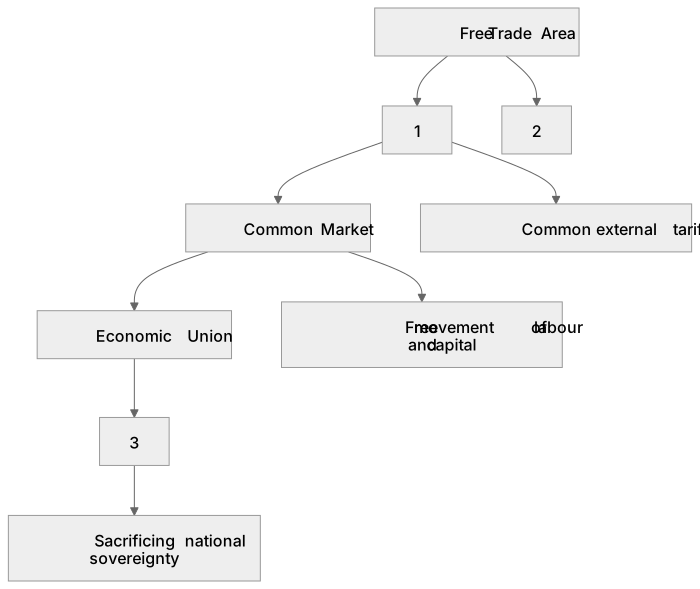
1Box 1
2Box 2
3Box 3
There is more to this lesson
The full lesson goes on to check your understanding and help you earn the marks. Create a free account to carry on, with your progress saved.
A week of Premium from your first lesson · Then the free plan continues · No card, no charge
Test your understanding of International trade: b) Trading blocs
Active recall beats re-reading. Take an instant quiz now to test what you’ve learned and lock it into long-term memory.
A week of Premium from your first lesson · Then the free plan continues · No card, no charge