Pearson Edexcel · A-Level · Economics B
Course version: 9EB0 · Version from Sept 2015
International trade: d) Imports and exports: visibles and invisibles
Imports are goods and services purchased from other countries, leading to an outflow of money.
Checked against the Pearson Edexcel 9EB0 specification (opens in a new tab) on .
- Point 3 of 3
- 4 key terms
Study notes
From the checked teaching notes for this specification point.
The idea
Imports are goods and services purchased from other countries, leading to an outflow of money. Exports are goods and services sold to other countries, resulting in an inflow of money. Visibles refer to tangible physical goods, such as cars, machinery, or agricultural products. Invisibles refer to intangible services, such as banking, insurance, tourism, and education. For example, a UK firm selling financial consulting to a French company is an invisible export, whereas a UK consumer buying a German car is a visible import. Understanding the distinction between visible and invisible trade is crucial for analysing a country's balance of trade and its current account on the balance of payments.
What earns the marks
- Define imports as goods or services bought from abroad, causing a financial outflow.
- Define exports as goods or services sold abroad, causing a financial inflow.
- Distinguish visible trade as the exchange of tangible physical goods.
- Distinguish invisible trade as the exchange of intangible services.
Common mistakes and how to put them right
Mistaking tourism as a visible trade because tourists are physical people.
Put it right: Tourism is an invisible export or import because it is a service provided to foreign nationals.
Confusing the direction of money flow with the movement of goods.
Put it right: Exports involve goods leaving the country but money entering, while imports involve goods entering but money leaving.
Assuming invisible trade only includes digital products.
Put it right: Invisible trade encompasses all services, including education, insurance, and transport, not just digital downloads.
Exam tips
- Always check whether a multiple-choice question is asking about the flow of goods and services or the flow of money.
- Use the terms 'tangible' for visibles and 'intangible' for invisibles to help categorise examples given in stimulus material.
- Remember that a foreign student studying at a UK university represents an invisible export for the UK.
Try the lesson
The start of the International trade: d) Imports and exports: visibles and invisibles lesson, made from checked teaching notes for this specification point.
Have a go first
Which of the following transactions represents an invisible export for the United Kingdom?
Listen
Imports are goods and services purchased from other countries, leading to an outflow of money. Exports are goods and services sold to other countries, resulting in an inflow of money. Visibles refer to tangible physical goods, such as cars, machinery, or agricultural products. Invisibles refer to intangible services, such as banking, insurance, tourism, and education. For example, a UK firm selling financial consulting to a French company is an invisible export, whereas a UK consumer buying a German car is a visible import. Understanding the distinction between visible and invisible trade is crucial for analysing a country's balance of trade and its current account on the balance of payments. A strong answer earns marks for these points. Define imports as goods or services bought from abroad, causing a financial outflow. Define exports as goods or services sold abroad, causing a financial inflow. Distinguish visible trade as the exchange of tangible physical goods. Distinguish invisible trade as the exchange of intangible services. A common slip: Mistaking tourism as a visible trade because tourists are physical people. Instead, tourism is an invisible export or import because it is a service provided to foreign nationals. Exam tip: Always check whether a multiple-choice question is asking about the flow of goods and services or the flow of money.
See it
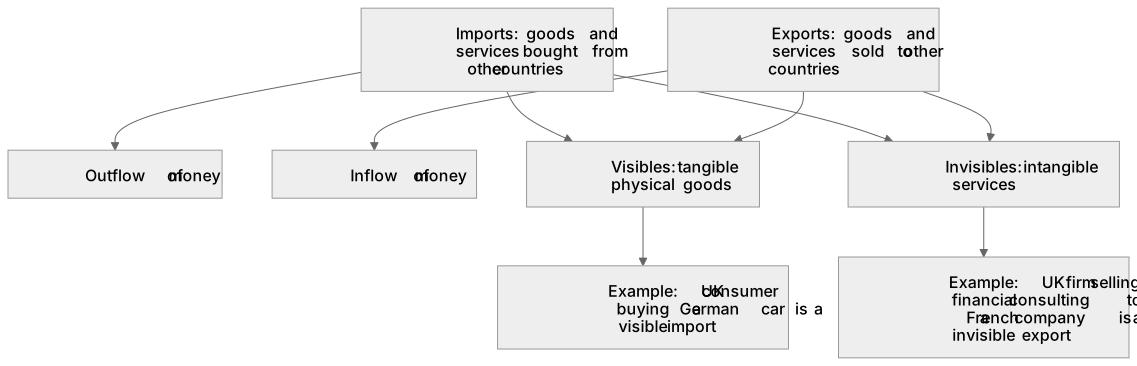
Key words
Say what each word means before you turn the card.
Imports
Try answering aloud or in your head before turning the card.
Exports
Try answering aloud or in your head before turning the card.
Visibles
Try answering aloud or in your head before turning the card.
Invisibles
Try answering aloud or in your head before turning the card.
See every definition
- Imports
- Goods and services purchased from other countries, leading to an outflow of money.
- Exports
- Goods and services sold to other countries, resulting in an inflow of money.
- Visibles
- Tangible physical goods, such as cars, machinery, or agricultural products.
- Invisibles
- Intangible services, such as banking, insurance, tourism, and education.
Label the diagram
Some boxes have lost their names. Pick the right name for each number.
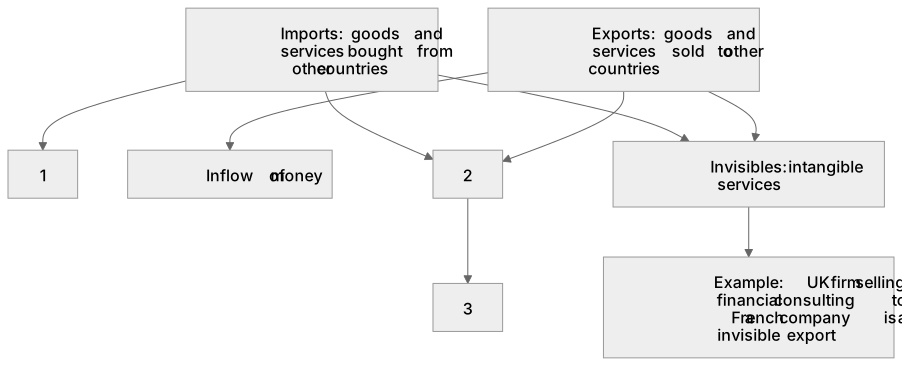
1Box 1
2Box 2
3Box 3
There is more to this lesson
The full lesson goes on to check your understanding and help you earn the marks. Create a free account to carry on, with your progress saved.
A week of Premium from your first lesson · Then the free plan continues · No card, no charge
Test your understanding of International trade: d) Imports and exports: visibles and invisibles
Active recall beats re-reading. Take an instant quiz now to test what you’ve learned and lock it into long-term memory.
A week of Premium from your first lesson · Then the free plan continues · No card, no charge