Pearson Edexcel · A-Level · Economics B
Course version: 9EB0 · Version from Sept 2015
Market failure in society: c) Over-consumption of demerit goods
Full specification wording
Market failure in society: c) Over-consumption of demerit goods
Demerit goods are products that are considered harmful to the individual consumer and generate negative externalities in consumption, meaning they impose costs on third parties.
Checked against the Pearson Edexcel 9EB0 specification (opens in a new tab) on .
- Point 3 of 6
- 4 key terms
Study notes
From the checked teaching notes for this specification point.
The idea
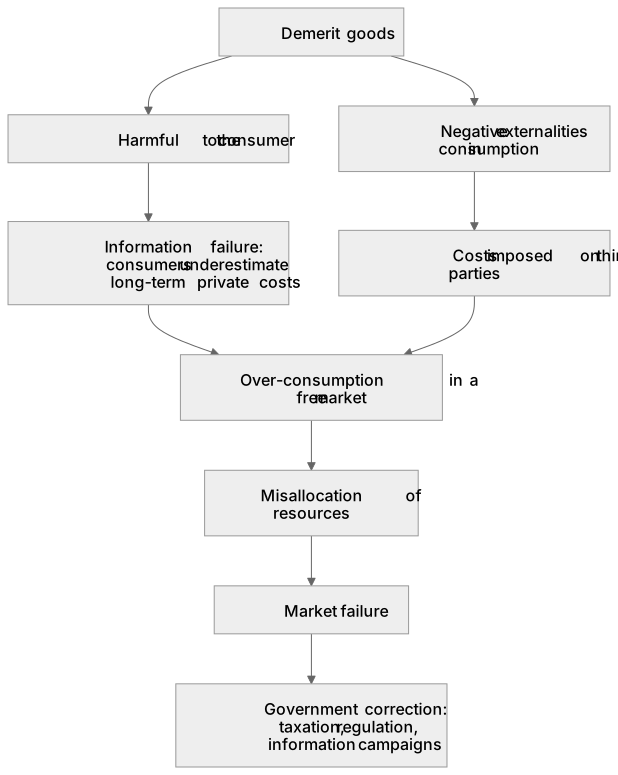
Demerit goods are products that are considered harmful to the individual consumer and generate negative externalities in consumption, meaning they impose costs on third parties. Examples include tobacco, alcohol, and gambling. Because consumers often suffer from information failure, underestimating the long-term private costs to their own health or well-being, and ignore the external costs imposed on society, demerit goods are over-consumed in a free market. This over-consumption results in a misallocation of resources, representing a market failure that governments often attempt to correct through taxation, regulation, or information campaigns.
What earns the marks
- Define demerit goods as goods that are harmful to the consumer and generate negative externalities in consumption.
- Explain that information failure causes consumers to underestimate the long-term private costs of consuming demerit goods.
- Identify that the combination of negative externalities and information failure leads to the over-consumption of demerit goods in a free market.
- Recognise that the over-consumption of demerit goods represents a market failure due to the misallocation of resources.
- Provide examples of demerit goods, such as alcohol, tobacco, or high-sugar foods.
Common mistakes and how to put them right
Confusing demerit goods with negative externalities in production.
Put it right: Demerit goods specifically relate to negative externalities in consumption and harm to the consumer.
Stating that demerit goods are simply goods that are illegal.
Put it right: Many demerit goods, like alcohol and tobacco, are legal but over-consumed.
Forgetting to mention information failure.
Put it right: A key characteristic of demerit goods is that consumers do not fully realise the harm they cause to themselves.
Exam tips
- Clearly distinguish between the harm caused to the consumer through information failure and the harm caused to third parties through negative externalities.
- Use specific examples like passive smoking or alcohol-related anti-social behaviour to illustrate the external costs of demerit goods.
- Link the over-consumption of demerit goods directly to the concept of market failure and resource misallocation.
Try the lesson
The start of the Market failure in society: c) Over-consumption of demerit goods lesson, made from checked teaching notes for this specification point.
Have a go first
Which of the following best explains why demerit goods are typically over-consumed in a free market?
Listen
Demerit goods are products that are considered harmful to the individual consumer and generate negative externalities in consumption, meaning they impose costs on third parties. Examples include tobacco, alcohol, and gambling. Because consumers often suffer from information failure, underestimating the long-term private costs to their own health or well-being, and ignore the external costs imposed on society, demerit goods are over-consumed in a free market. This over-consumption results in a misallocation of resources, representing a market failure that governments often attempt to correct through taxation, regulation, or information campaigns. A strong answer earns marks for these points. Define demerit goods as goods that are harmful to the consumer and generate negative externalities in consumption. Explain that information failure causes consumers to underestimate the long-term private costs of consuming demerit goods. Identify that the combination of negative externalities and information failure leads to the over-consumption of demerit goods in a free market. Recognise that the over-consumption of demerit goods represents a market failure due to the misallocation of resources. Exam tip: Clearly distinguish between the harm caused to the consumer through information failure and the harm caused to third parties through negative externalities.
See it
Key words
Say what each word means before you turn the card.
Demerit goods
Try answering aloud or in your head before turning the card.
Information failure
Try answering aloud or in your head before turning the card.
Negative externalities in consumption
Try answering aloud or in your head before turning the card.
Market failure
Try answering aloud or in your head before turning the card.
See every definition
- Demerit goods
- Products that are considered harmful to the individual consumer and generate negative externalities in consumption, meaning they impose costs on third parties.
- Information failure
- A situation where consumers underestimate the long-term private costs of consuming demerit goods to their own health or well-being.
- Negative externalities in consumption
- Costs that demerit goods impose on third parties when they are consumed.
- Market failure
- A misallocation of resources resulting from the over-consumption of demerit goods in a free market.
Label the diagram
Some boxes have lost their names. Pick the right name for each number.
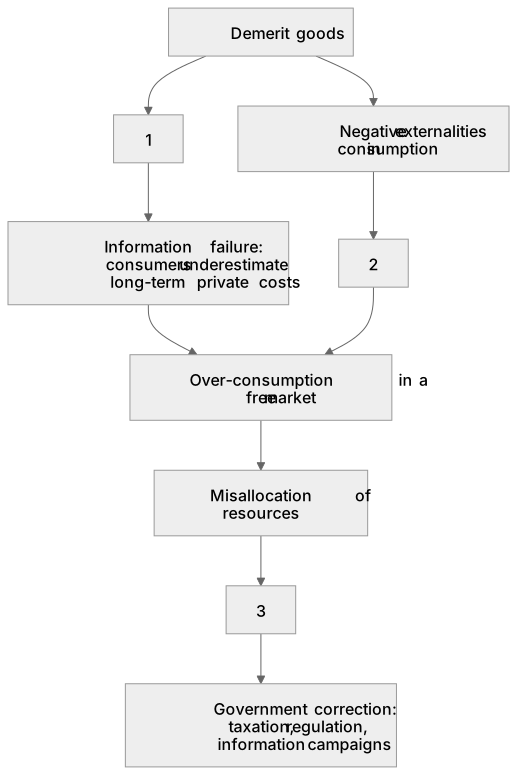
1Box 1
2Box 2
3Box 3
There is more to this lesson
The full lesson goes on to check your understanding and help you earn the marks. Create a free account to carry on, with your progress saved.
A week of Premium from your first lesson · Then the free plan continues · No card, no charge
Test your understanding of Market failure in society: c) Over-consumption of demerit goods
Active recall beats re-reading. Take an instant quiz now to test what you’ve learned and lock it into long-term memory.
A week of Premium from your first lesson · Then the free plan continues · No card, no charge