Pearson Edexcel · A-Level · Economics B
Course version: 9EB0 · Version from Sept 2015
D) Factor immobility (occupational and geographical)
Full specification wording
Market failure in society: d) Factor immobility (occupational and geographical)
Factor immobility occurs when factors of production, particularly labour, cannot easily move between different uses or locations, leading to market failure through the inefficient allocation of…
Checked against the Pearson Edexcel 9EB0 specification (opens in a new tab) on .
- Point 4 of 6
- 2 key terms
Study notes
From the checked teaching notes for this specification point.
The idea
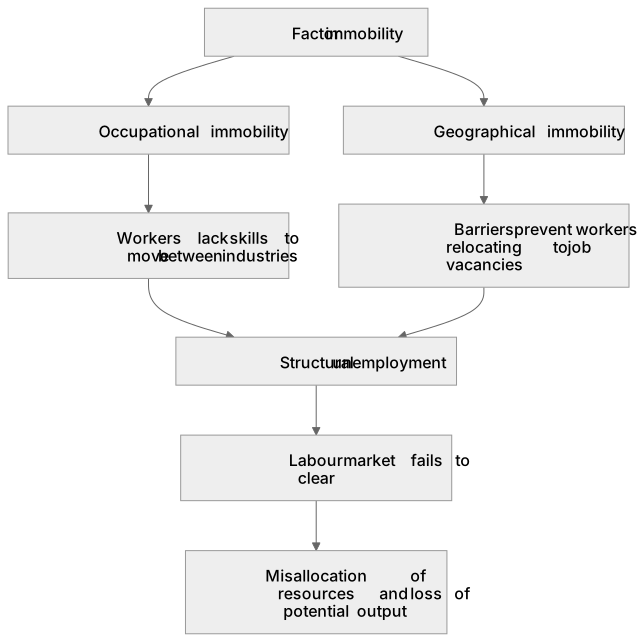
Factor immobility occurs when factors of production, particularly labour, cannot easily move between different uses or locations, leading to market failure through the inefficient allocation of resources. Occupational immobility happens when workers lack the skills to transition between industries, such as a former coal miner unable to secure work as a software developer without retraining. Geographical immobility occurs when workers cannot relocate to areas with job vacancies due to barriers like high housing costs, family ties, or regional cost-of-living disparities. Both forms of immobility result in structural unemployment and prevent the labour market from clearing, causing a misallocation of resources and a loss of potential output.
What earns the marks
- Define factor immobility as the inability of resources to move easily between alternative uses or locations.
- Explain occupational immobility as a mismatch of skills preventing workers from changing industries.
- Explain geographical immobility as physical or financial barriers preventing workers from moving to where jobs are available.
- Link factor immobility to market failure via structural unemployment and the resulting inefficient allocation of resources.
Common mistakes and how to put them right
Confusing occupational and geographical immobility.
Put it right: Occupational relates to skills and training, while geographical relates to location and physical movement.
Assuming factor immobility only applies to labour.
Put it right: While most commonly applied to labour, capital and land can also experience immobility (e.g., a factory cannot easily be converted into a hospital).
Failing to link immobility to market failure.
Put it right: Explicitly state that immobility prevents markets from clearing, leading to an inefficient allocation of resources and lost output.
Exam tips
- Use specific examples, such as regional housing price disparities, to illustrate geographical immobility.
- When discussing government intervention, evaluate policies like subsidised retraining for occupational immobility or relocation grants for geographical immobility.
- Always connect the concept of factor immobility back to the core economic problem of resource misallocation and market failure.
Try the lesson
The start of the Market failure in society: d) Factor immobility (occupational and geographical) lesson, made from checked teaching notes for this specification point.
Have a go first
Which of the following situations is an example of occupational immobility of labour?
Listen
Factor immobility occurs when factors of production, particularly labour, cannot easily move between different uses or locations, leading to market failure through the inefficient allocation of resources. Occupational immobility happens when workers lack the skills to transition between industries, such as a former coal miner unable to secure work as a software developer without retraining. Geographical immobility occurs when workers cannot relocate to areas with job vacancies due to barriers like high housing costs, family ties, or regional cost-of-living disparities. Both forms of immobility result in structural unemployment and prevent the labour market from clearing, causing a misallocation of resources and a loss of potential output. A strong answer earns marks for these points. Define factor immobility as the inability of resources to move easily between alternative uses or locations. Explain occupational immobility as a mismatch of skills preventing workers from changing industries. Explain geographical immobility as physical or financial barriers preventing workers from moving to where jobs are available. Link factor immobility to market failure via structural unemployment and the resulting inefficient allocation of resources. A common slip: Confusing occupational and geographical immobility. Instead, occupational relates to skills and training, while geographical relates to location and physical movement. Exam tip: Use specific examples, such as regional housing price disparities, to illustrate geographical immobility.
See it
Key words
Say what each word means before you turn the card.
Resource allocation
Try answering aloud or in your head before turning the card.
Structural unemployment
Try answering aloud or in your head before turning the card.
See every definition
- Resource allocation
- The distribution of resources, which becomes inefficient when factors of production cannot move easily between alternative uses or locations.
- Structural unemployment
- A form of unemployment resulting from both occupational and geographical immobility, which prevents the labour market from clearing.
Label the diagram
Some boxes have lost their names. Pick the right name for each number.
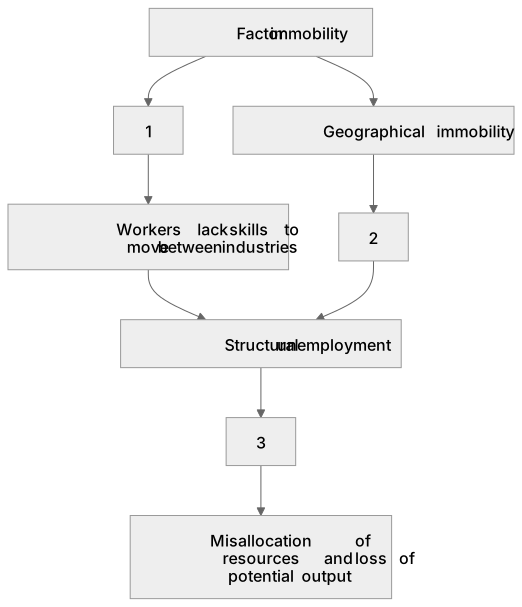
1Box 1
2Box 2
3Box 3
There is more to this lesson
The full lesson goes on to check your understanding and help you earn the marks. Create a free account to carry on, with your progress saved.
A week of Premium from your first lesson · Then the free plan continues · No card, no charge
Test your understanding of Market failure in society: d) Factor immobility (occupational and geographical)
Active recall beats re-reading. Take an instant quiz now to test what you’ve learned and lock it into long-term memory.
A week of Premium from your first lesson · Then the free plan continues · No card, no charge