Pearson Edexcel · A-Level · Economics B
Course version: 9EB0 · Version from Sept 2015
Methods of growth: a) Organic and inorganic growth
Organic growth, or internal growth, occurs when a business expands its own operations rather than relying on takeovers.
Checked against the Pearson Edexcel 9EB0 specification (opens in a new tab) on .
- Point 1 of 2
- 3 key terms
Study notes
From the checked teaching notes for this specification point.
The idea
Organic growth, or internal growth, occurs when a business expands its own operations rather than relying on takeovers. This is achieved by launching new products, opening new branches, or entering new markets. For example, a retailer opening five new stores is growing organically. Inorganic growth, or external growth, happens when a business expands by joining with or buying another business through mergers or acquisitions. An example is a supermarket purchasing a rival. Organic growth is typically slower but carries less risk and avoids integration clashes. In contrast, inorganic growth offers rapid expansion and immediate market share but involves high costs and potential cultural conflicts between the merging firms.
What earns the marks
- Define organic growth as expansion from within the business using its own resources.
- Define inorganic growth as expansion through external mergers and acquisitions.
- Identify advantages of organic growth, such as lower risk and retained management control.
- Identify advantages of inorganic growth, such as rapid market entry and acquiring established brands.
- Contrast the speed and risk levels associated with both methods of business growth.
Common mistakes and how to put them right
Confusing organic and inorganic growth.
Put it right: Organic is internal expansion and inorganic is external expansion through buying another firm.
Assuming inorganic growth is always successful.
Put it right: Recognise that mergers often fail due to cultural clashes or diseconomies of scale.
Believing organic growth requires no capital.
Put it right: Organic growth still requires significant investment, such as funding new stores or research and development.
Exam tips
- Use clear examples of real-world mergers to illustrate inorganic growth in your answers.
- When evaluating growth methods, contrast the slow, lower-risk nature of organic growth with the fast, higher-risk nature of inorganic growth.
- Read case study data carefully to identify whether a firm's expansion strategy relies on internal investment or external acquisitions.
Try the lesson
The start of the Methods of growth: a) Organic and inorganic growth lesson, made from checked teaching notes for this specification point.
Have a go first
Which of the following best describes a firm achieving organic growth?
Listen
Organic growth, or internal growth, occurs when a business expands its own operations rather than relying on takeovers. This is achieved by launching new products, opening new branches, or entering new markets. For example, a retailer opening five new stores is growing organically. Inorganic growth, or external growth, happens when a business expands by joining with or buying another business through mergers or acquisitions. An example is a supermarket purchasing a rival. Organic growth is typically slower but carries less risk and avoids integration clashes. In contrast, inorganic growth offers rapid expansion and immediate market share but involves high costs and potential cultural conflicts between the merging firms. A strong answer earns marks for these points. Define organic growth as expansion from within the business using its own resources. Define inorganic growth as expansion through external mergers and acquisitions. Identify advantages of organic growth, such as lower risk and retained management control. Identify advantages of inorganic growth, such as rapid market entry and acquiring established brands. A common slip: Confusing organic and inorganic growth. Instead, organic is internal expansion and inorganic is external expansion through buying another firm. Exam tip: Use clear examples of real-world mergers to illustrate inorganic growth in your answers.
See it

Key words
Say what each word means before you turn the card.
Organic growth
Try answering aloud or in your head before turning the card.
Inorganic growth
Try answering aloud or in your head before turning the card.
Mergers and acquisitions
Try answering aloud or in your head before turning the card.
See every definition
- Organic growth
- Expansion from within the business using its own resources, achieved by launching new products, opening new branches or entering new markets.
- Inorganic growth
- Expansion through external mergers and acquisitions, happening when a business joins with or buys another business.
- Mergers and acquisitions
- Joining with or buying another business as a method of external growth, offering rapid expansion and immediate market share.
Label the diagram
Some boxes have lost their names. Pick the right name for each number.
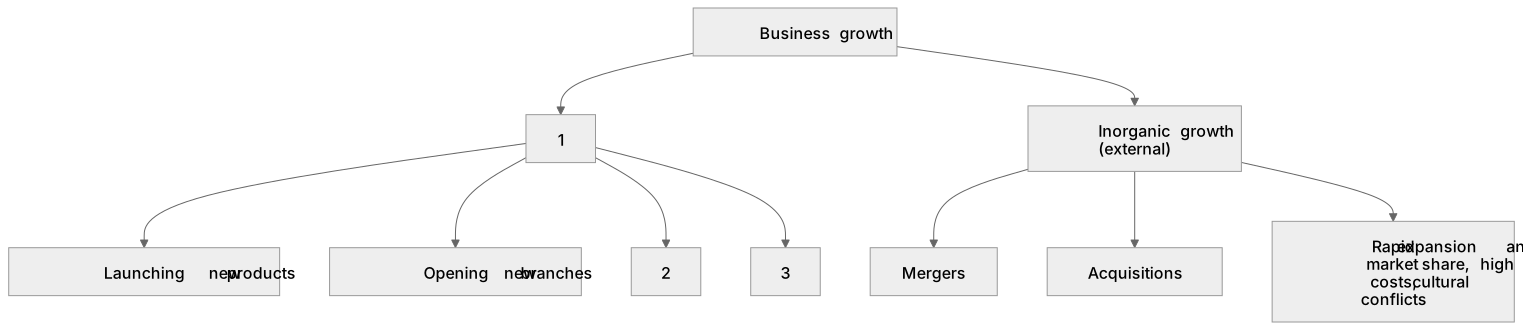
1Box 1
2Box 2
3Box 3
There is more to this lesson
The full lesson goes on to check your understanding and help you earn the marks. Create a free account to carry on, with your progress saved.
A week of Premium from your first lesson · Then the free plan continues · No card, no charge
Test your understanding of Methods of growth: a) Organic and inorganic growth
Active recall beats re-reading. Take an instant quiz now to test what you’ve learned and lock it into long-term memory.
A week of Premium from your first lesson · Then the free plan continues · No card, no charge